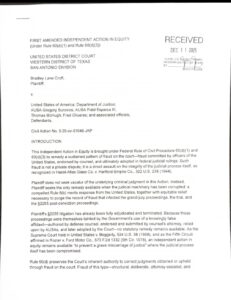
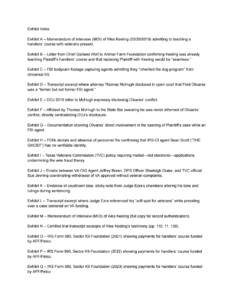
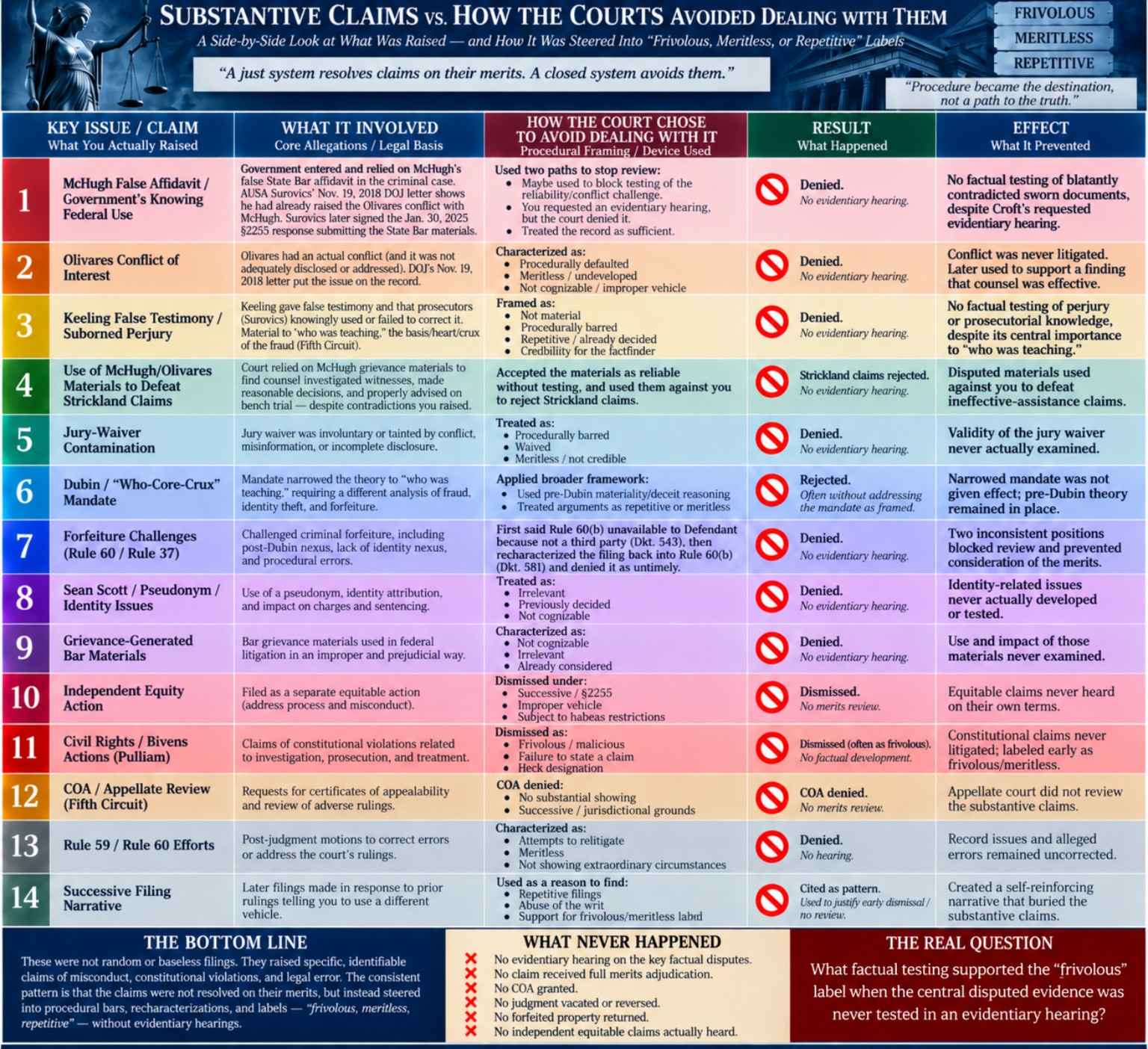
What do the court records involving Thomas J. McHugh in San Antonio show about the issues Bradley Croft has raised since his Universal K9 criminal case? The chart below is Croft’s summary of fourteen claims and the responses he says they received across criminal, post-conviction, forfeiture, civil, and appellate proceedings. It is an advocacy chart, not a court finding or a substitute for the orders themselves.
The McHugh affidavit and the Olivares conflict letter
One of Croft’s central allegations concerns a sworn statement by his former defense attorney, Thomas J. McHugh. Croft points to a November 19, 2018 letter from prosecutor Gregory Surovics raising a possible conflict involving defense investigator Fred Olivares. He argues that McHugh’s later account to the State Bar—that no potential conflict was brought to his attention—cannot be reconciled with that letter. McHugh’s position and the complete correspondence should be read together before making a finding about his knowledge or intent.
Croft also objects to the government’s later use of grievance materials in his federal post-conviction litigation. His point is specific: the disputed sworn account was presented to the court while the prosecution had authored the earlier conflict letter. Croft requested factual testing, including an evidentiary hearing. The court denied relief without such a hearing. That procedural result should not be confused with a judicial finding that Croft’s accusation of knowing falsity was proved.
What was and was not tested
The chart groups several other questions with the McHugh issue: the scope of Olivares’s prior FBI involvement, the unserved Midlothian Police Department subpoena, Wes Keeling’s testimony, counsel’s investigation, and the October 2019 jury waiver. Croft alleges that contradictory records on these subjects were never tested through witness testimony in a post-conviction evidentiary hearing. The courts rejected his requests for relief through different procedural and substantive rulings; each claim has its own record and legal standard.
For the subpoena issue, readers can compare Olivares’s sworn account with Paul Torres’s sworn statement. Torres says he did not handle criminal-case subpoena service. That disagreement raises a factual question; it does not by itself establish perjury or prove what the subpoena would have produced.
The Dubin appeal and the later proceedings
After the Supreme Court remanded the identity-theft issue in light of Dubin, the Fifth Circuit again affirmed Croft’s convictions. Its December 1, 2023 published opinion described who taught the courses as central to the fraud theory. Croft disputes whether the panel attributed a more specific “who was teaching” finding to the trial court than the trial record actually contains. The chart extends that concern to later arguments about conviction, forfeiture, and the scope of the mandate. Those are Croft’s legal positions, not rulings in his favor.
The chart also covers separate Rule 59 and Rule 60 filings, an independent equity action, civil-rights complaints, and requests for appellate review. It compresses multiple courts and proceedings into one visual. A dismissal as untimely, a denial under a merits standard, a refusal to grant a hearing, and a “frivolous” designation have different meanings. Readers should not treat every row as if the same judge made the same ruling for the same reason.
The question Croft asks
Croft frames the issue this way: What factual testing supported a “frivolous” label when the central disputed evidence was never tested in an evidentiary hearing? His chart argues that procedural rulings and labels prevented examination of important contradictions. The courts’ written orders provide their reasons for denying relief. Whether those reasons were legally sufficient remains a matter for the applicable appellate process; the chart does not resolve it.
Read the underlying record
- Thomas J. McHugh records and case documents
- Source documents and exhibits
- Court filings
- Case timeline
- Fifth Circuit opinion, December 1, 2023 (PDF)
This article describes a litigant’s arguments and points readers to source materials. Allegations concerning McHugh, Olivares, Keeling, prosecutors, and courts remain disputed unless an identified tribunal has made the particular factual finding.