Blog

  • Bradley Croft San Antonio: What the Federal Case Actually Involved and What Police K9 Officers Told the Court

    A review of the public court record involving Bradley Croft, Brad Croft, and Universal K9 in San Antonio

    Anyone searching Bradley Croft San Antonio, Brad Croft San Antonio, or Universal K9 may encounter references to a federal criminal case involving Croft and the former Universal K9 training program.

    The existence of a federal conviction can understandably create assumptions about what happened. But there is an important difference between what the government actually prosecuted and what someone unfamiliar with the case might assume from seeing the words “wire fraud,” “identity theft,” or “federal conviction.”

    That distinction matters especially to police departments, shelters, sponsors, donors, and other organizations considering a working relationship with Universal K9 today.

    This page does not ask anyone to disregard the conviction. It provides the other part of the public record: what the case actually concerned and what working police K9 officers testified under oath about the dogs and training they personally received from Universal K9.

    What the federal case was actually about

    The K9-related portion of the federal case centered on paperwork submitted in connection with Universal K9 obtaining government approval for veterans to use GI Bill benefits for dog-handler training.

    The government alleged that documents submitted to the Texas Veterans Commission identified certain individuals as instructors and included information concerning their qualifications and training. The government contended that those representations were improper and that Universal K9 later received GI Bill tuition payments after obtaining approval.

    Bradley Croft was ultimately convicted of wire fraud and aggravated identity theft arising from that theory. The case also included separate money-laundering and federal income-tax charges. But there is an important distinction.

    The government did not charge Bradley Croft with operating a fake police-dog training program

    The superseding indictment did not contain a separate criminal count alleging that:

    • Police officers were never actually trained.
    • Universal K9’s police K9 training was fictitious or nonexistent.
    • Universal K9 supplied police departments with dogs incapable of performing police work.
    • Dogs were falsely represented as trained police dogs and then sent into service unable to perform.
    • Police officers were sent back to their departments without genuine K9 training.
    • Universal K9 abused or mistreated the dogs in its program.

    Those would be different allegations. This distinction about the charges does not resolve every factual dispute about the training program. Because someone encountering a federal fraud conviction may naturally assume that the underlying K9 program itself was fictitious, the sworn testimony of officers who attended the program and worked the dogs is particularly important.

    What the officers actually told the court

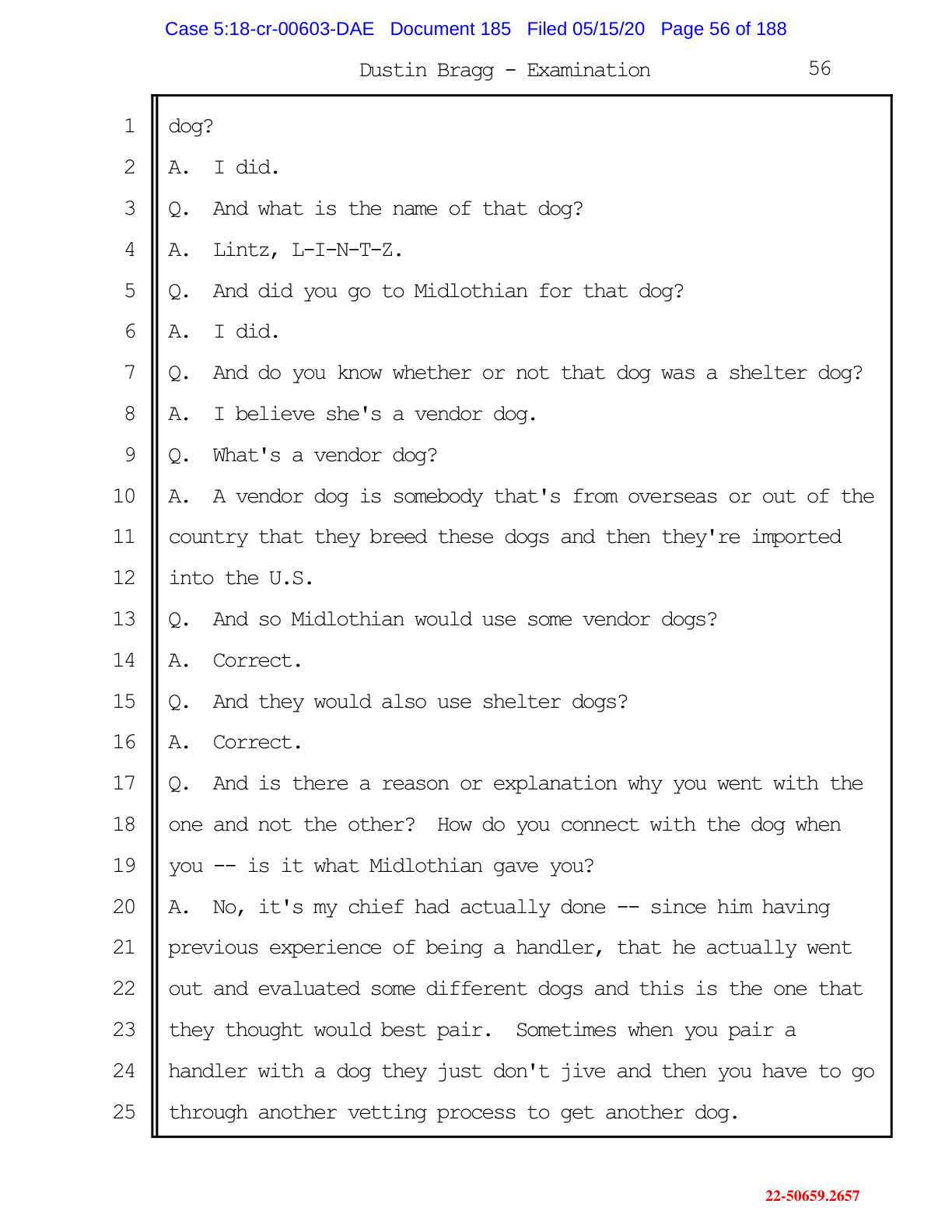
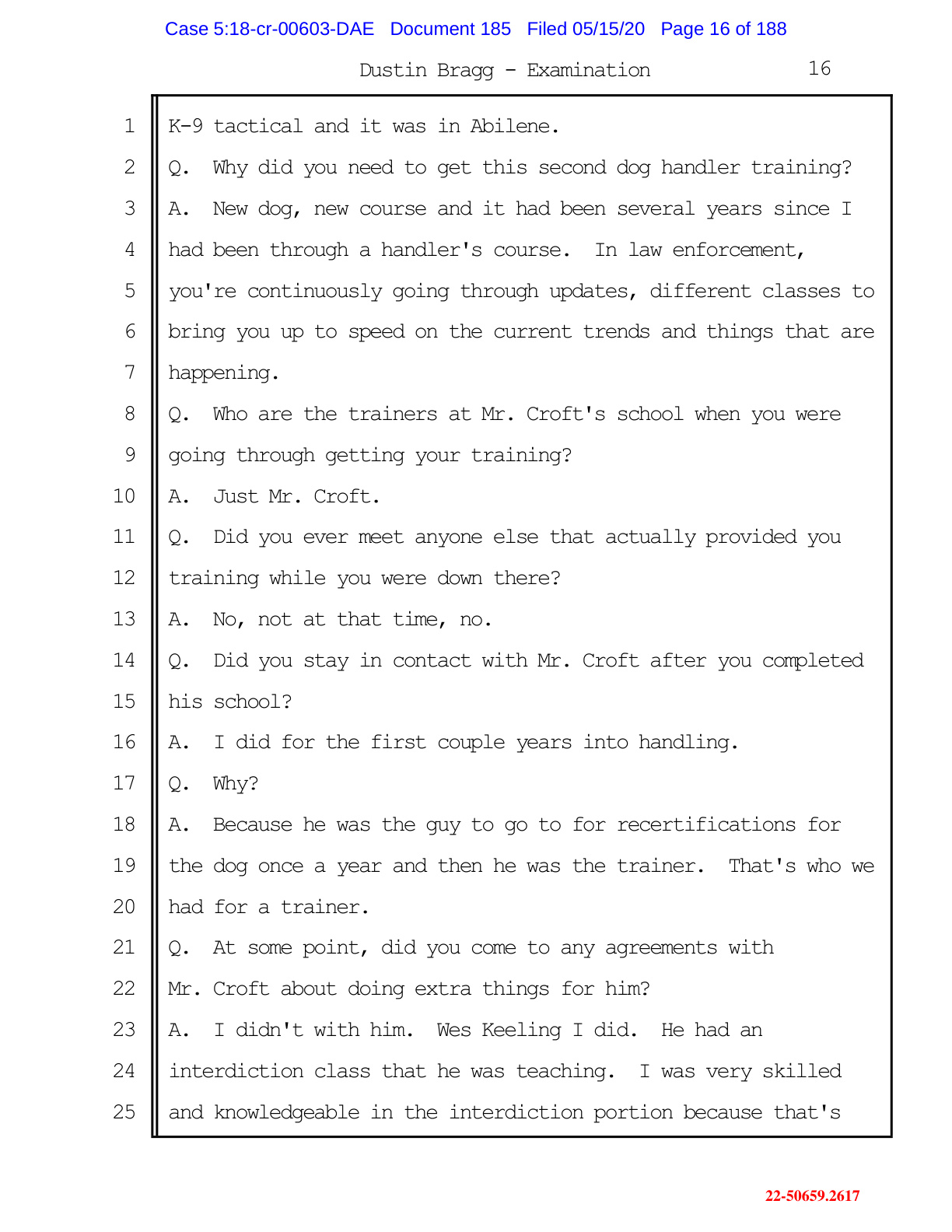
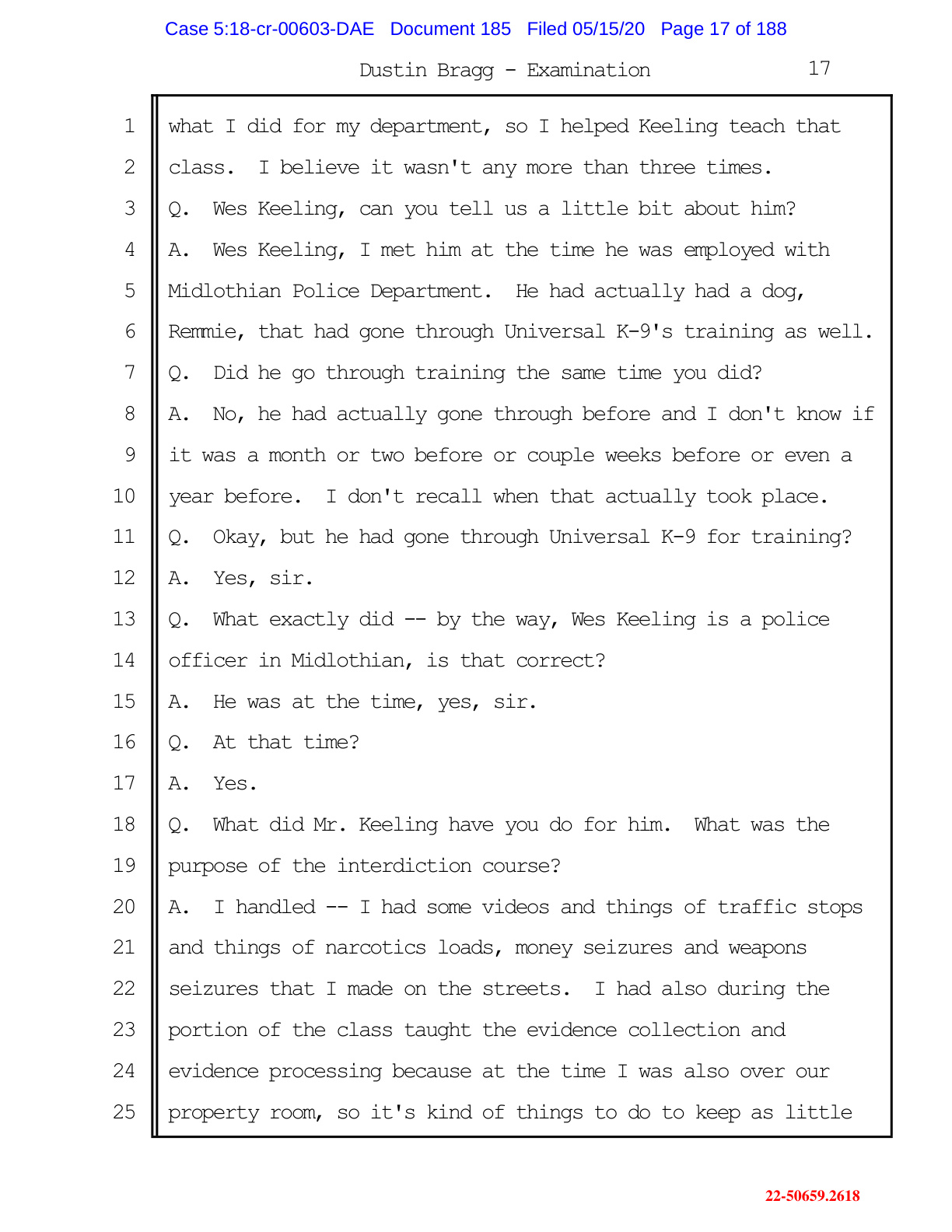
    Dustin Bragg

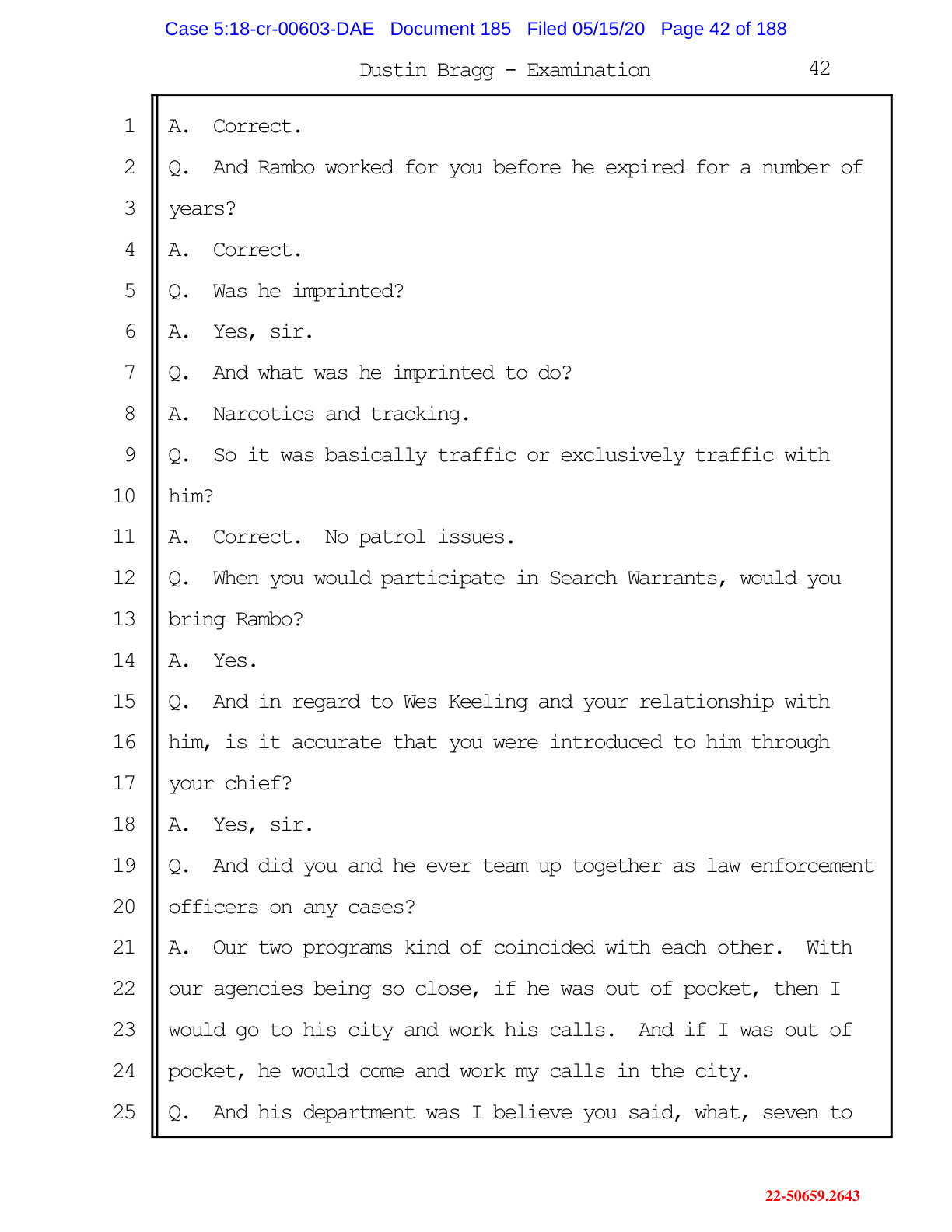
    Government witness · Red Oak Police Department K9 handler. Click his name to view the original trial transcript page containing his testimony about Rambo.

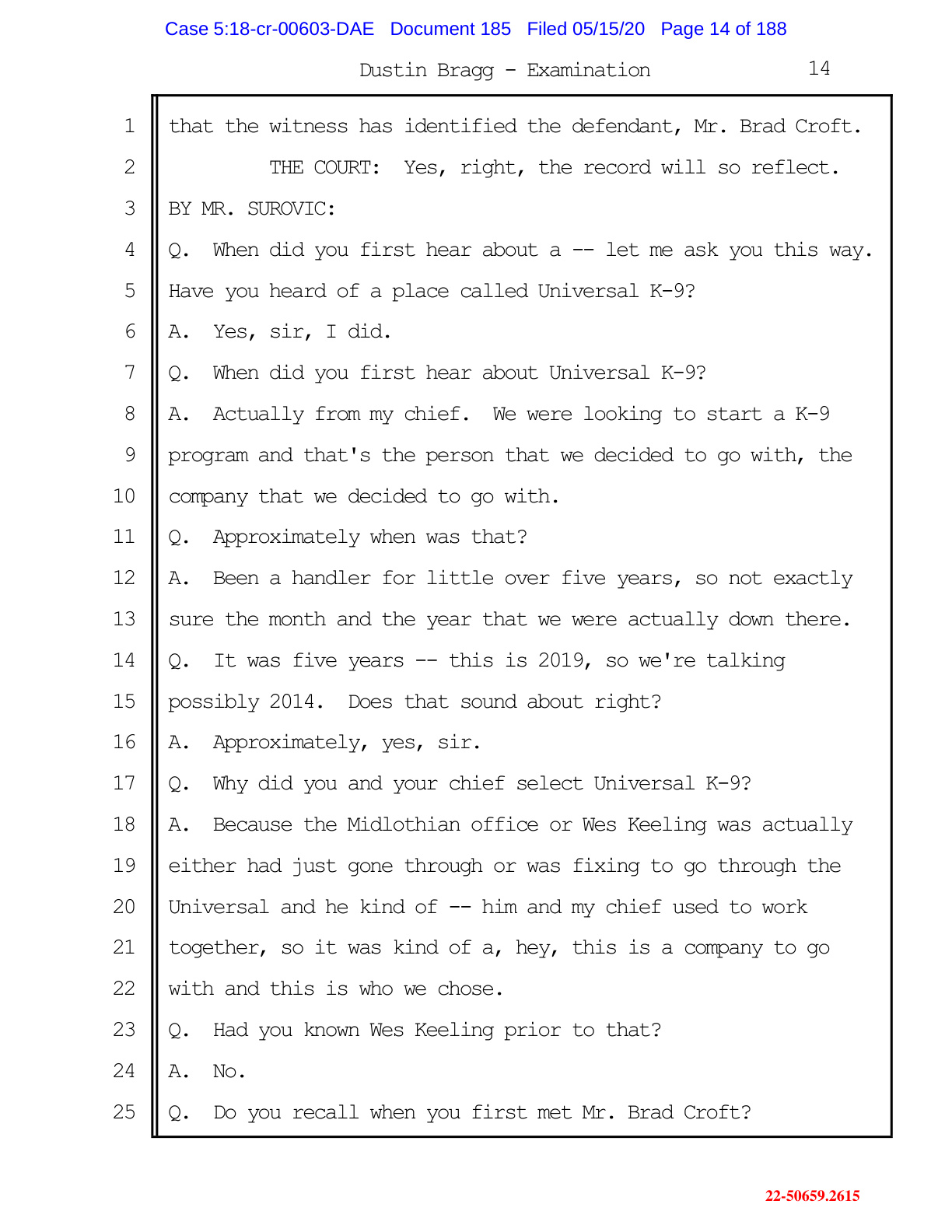
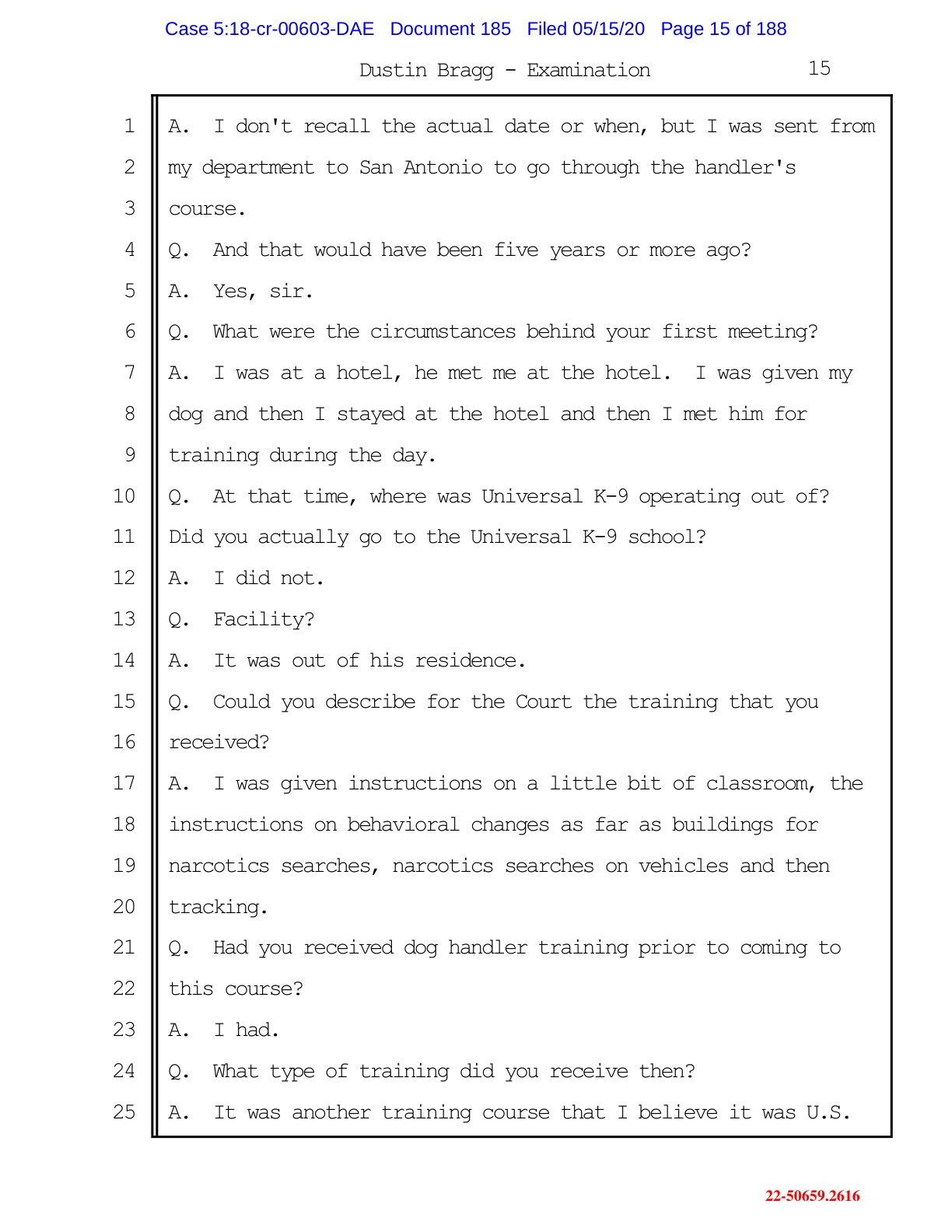
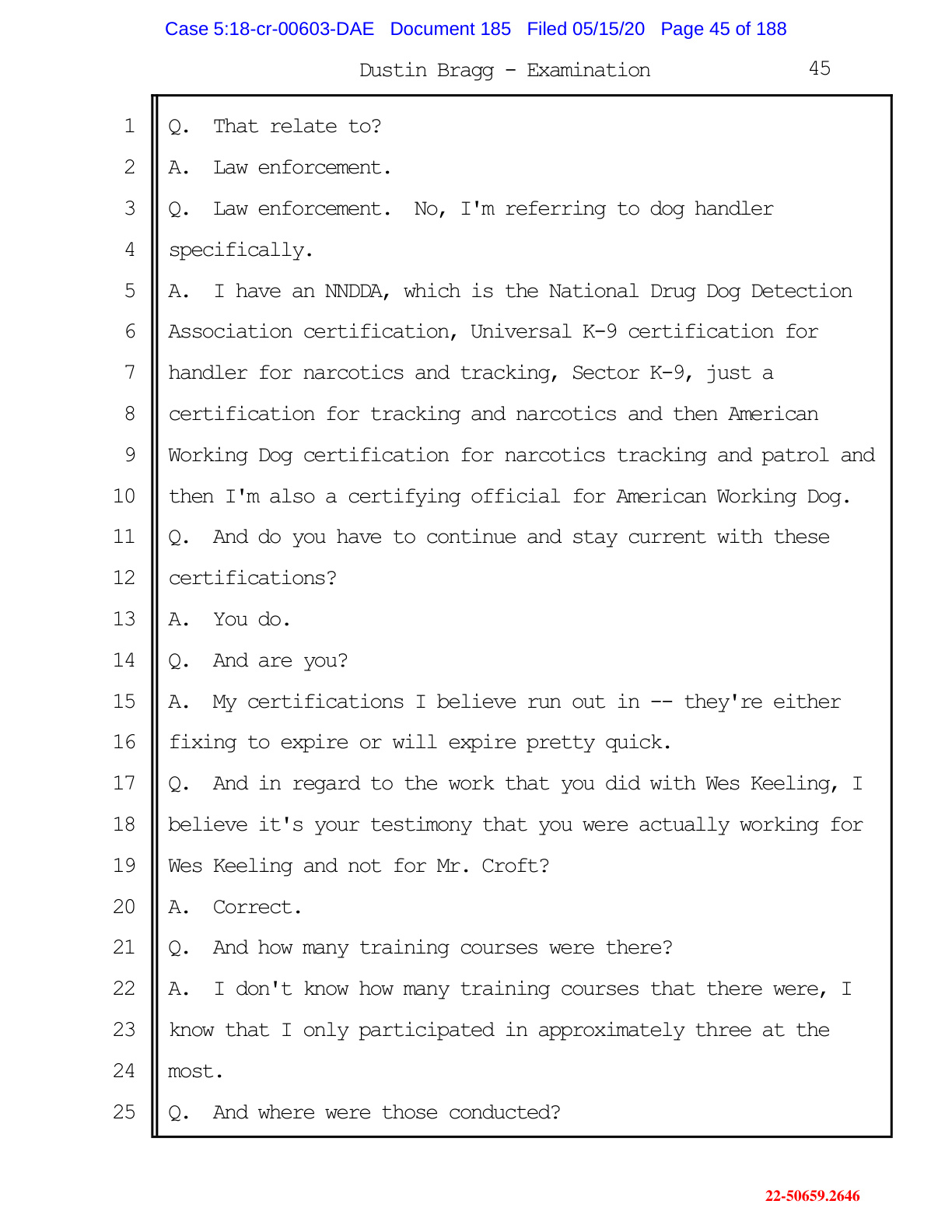
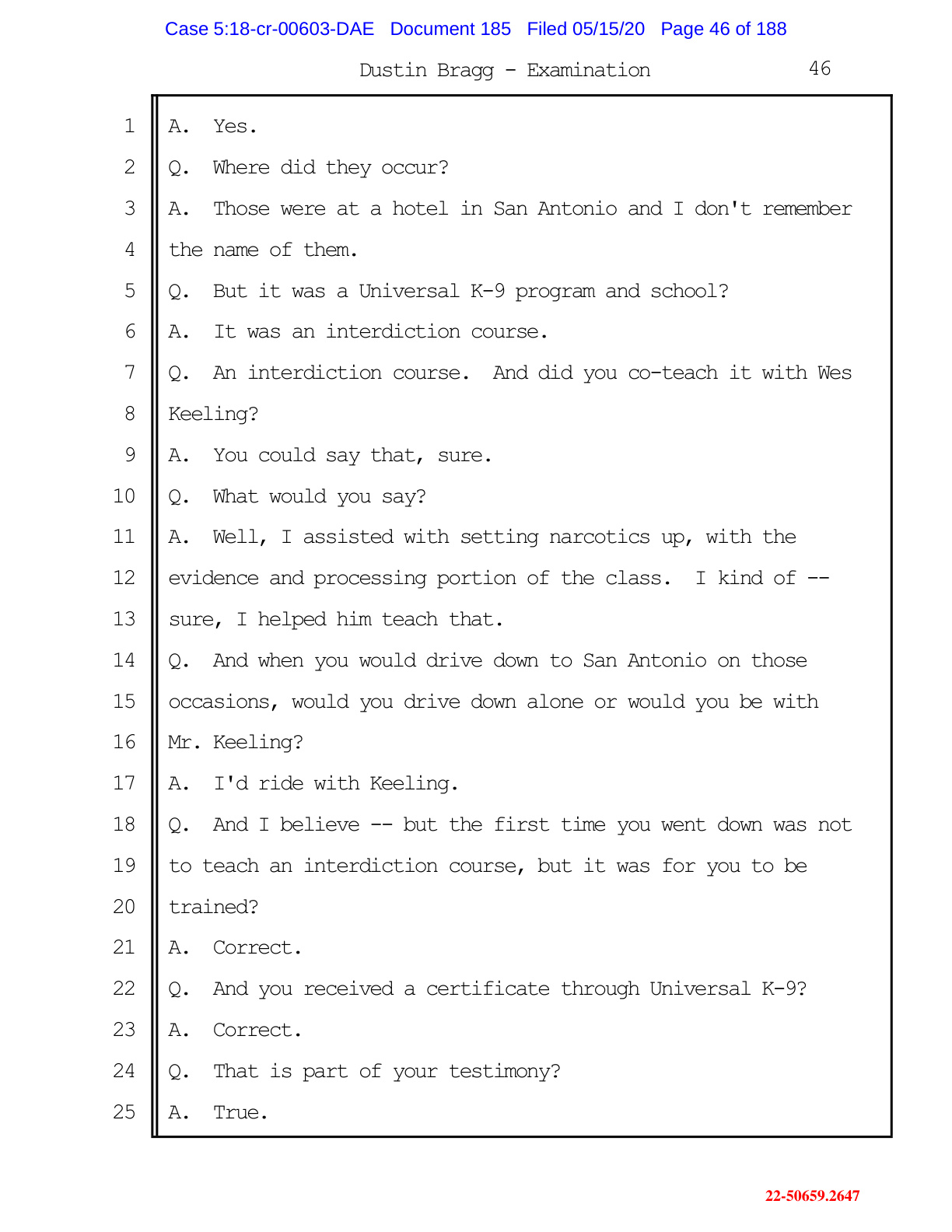
    Dustin Bragg was called as a witness by the federal government. Bragg testified that his police department sent him to San Antonio for a Universal K9 handler course. He described receiving instruction involving narcotics searches, vehicle searches, behavioral changes, and tracking. Bragg testified that Croft trained him during that course.

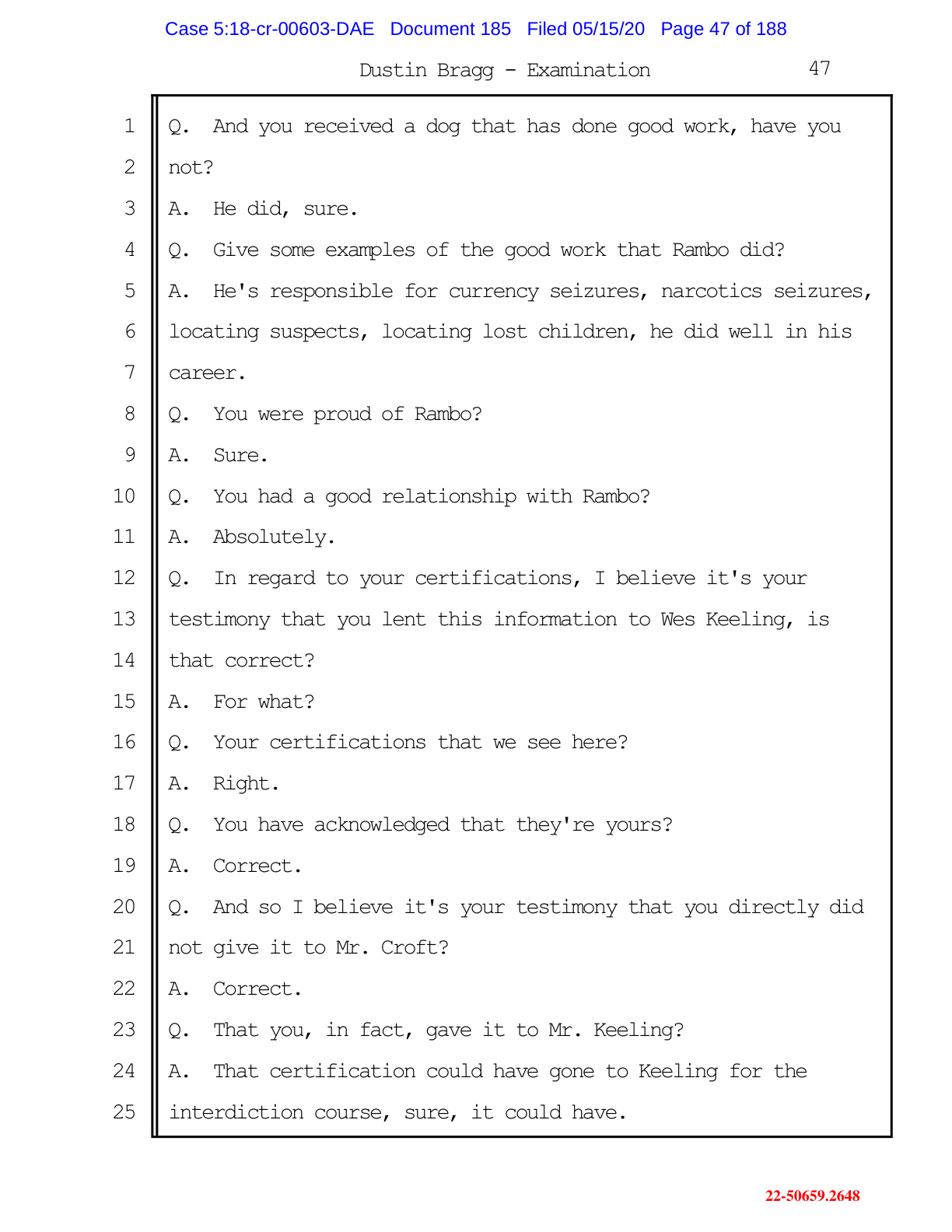
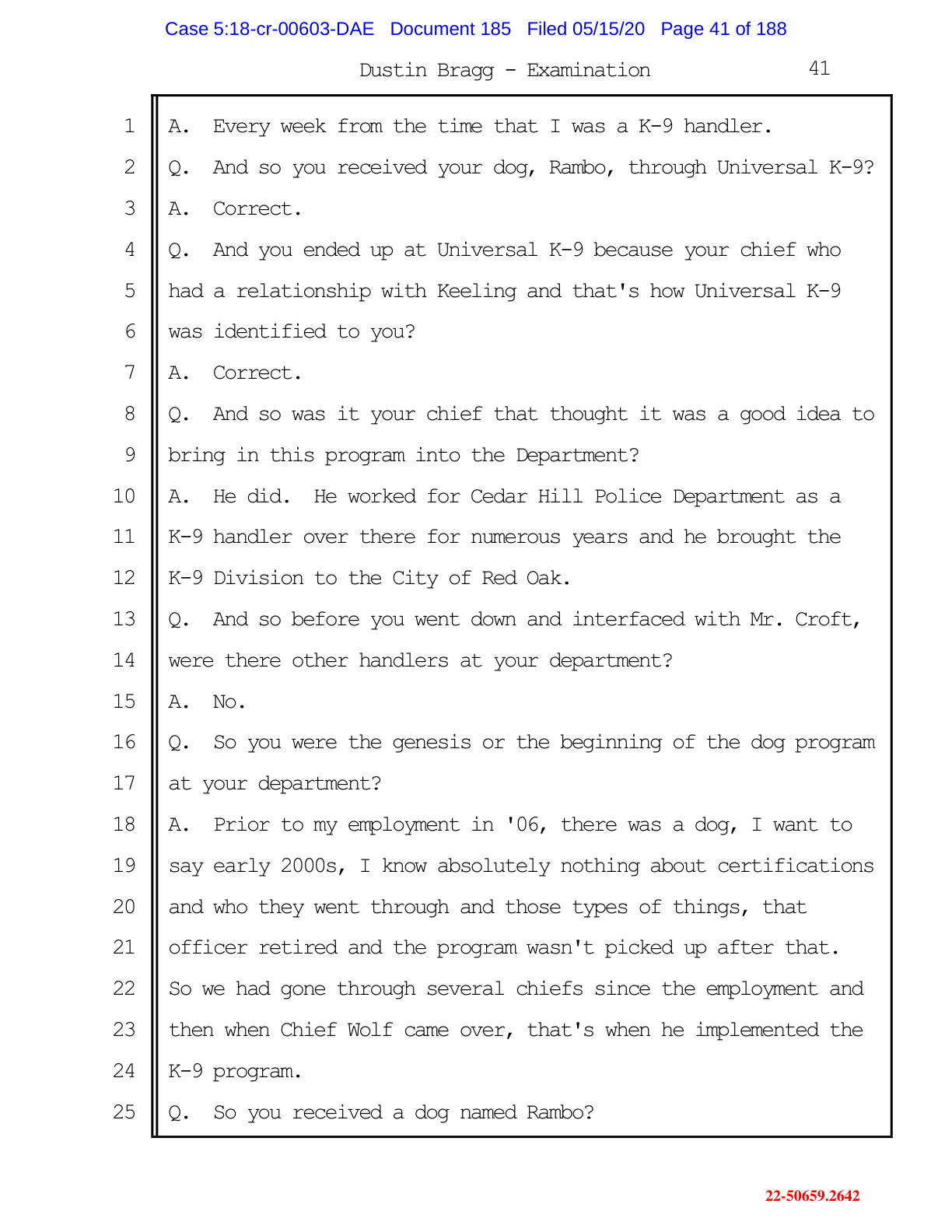
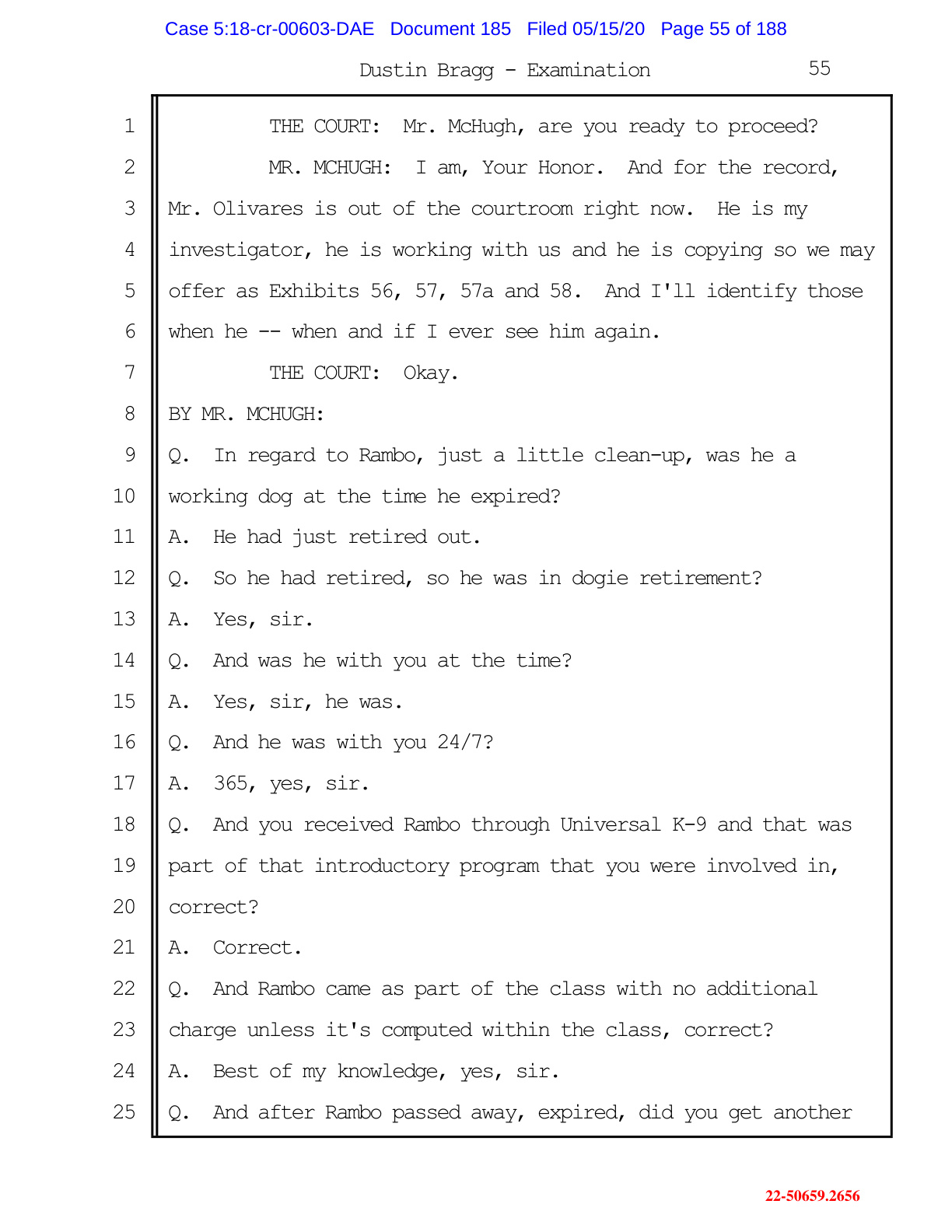
    Bragg received a dog through Universal K9 named Rambo. Asked about Rambo’s work, Bragg testified: “He’s responsible for currency seizures, narcotics seizures, locating suspects, locating lost children, he did well in his career.” Bragg said he was proud of Rambo and described his relationship with the dog as “absolutely” good.

    Bragg was a government witness. Although he disputed other matters concerning Universal K9, his testimony about the dog he received described actual police work, including narcotics and currency seizures and locating suspects and missing children. Read the cited transcript page.

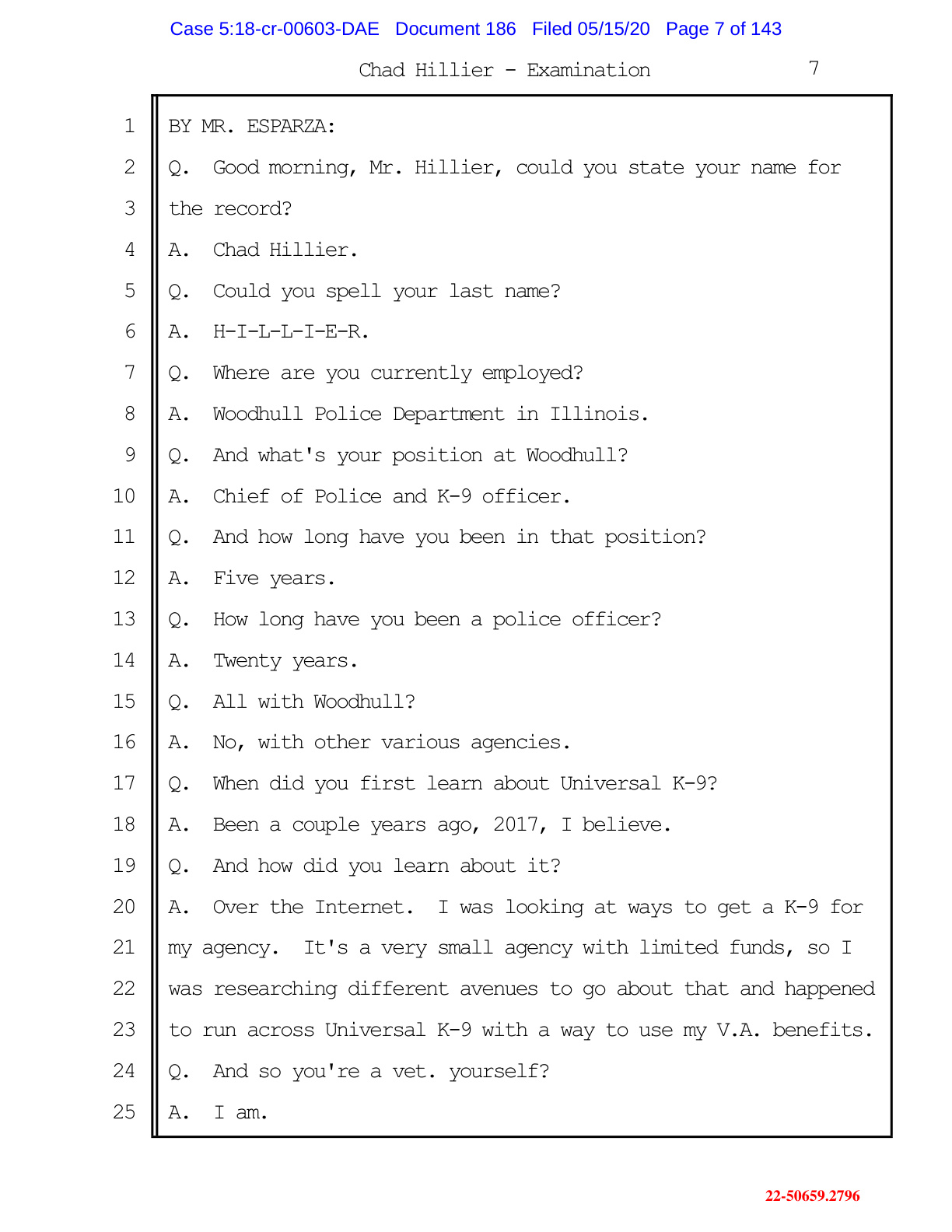
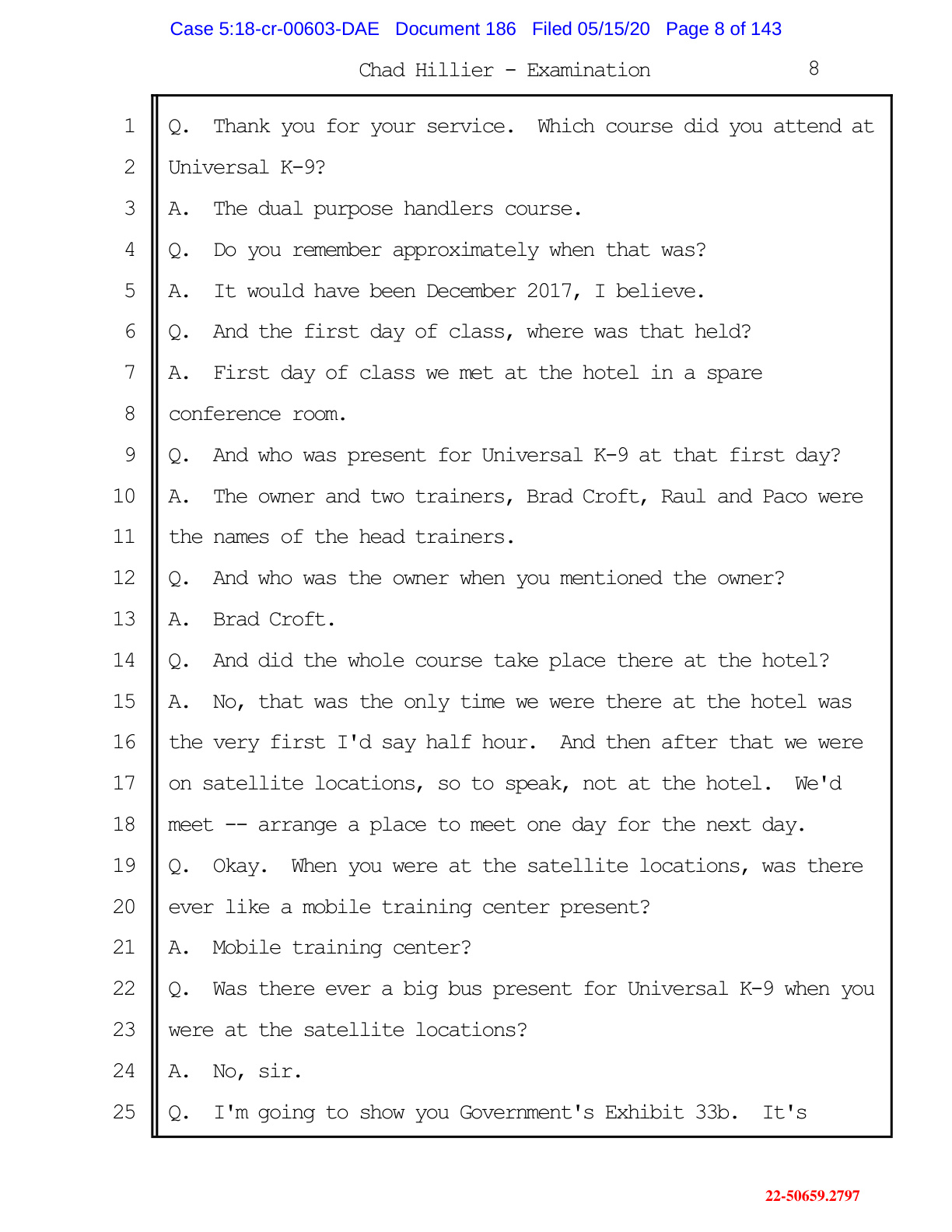
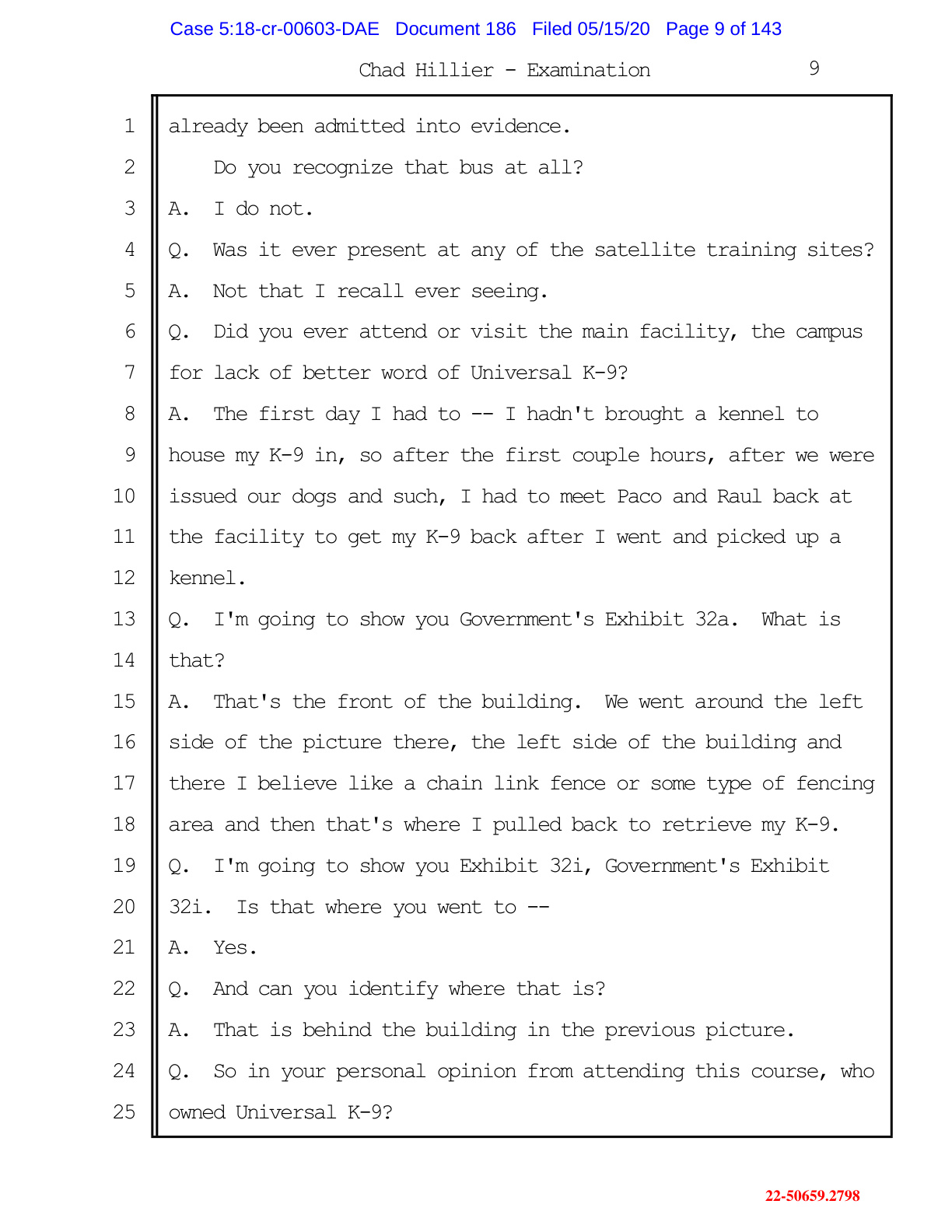
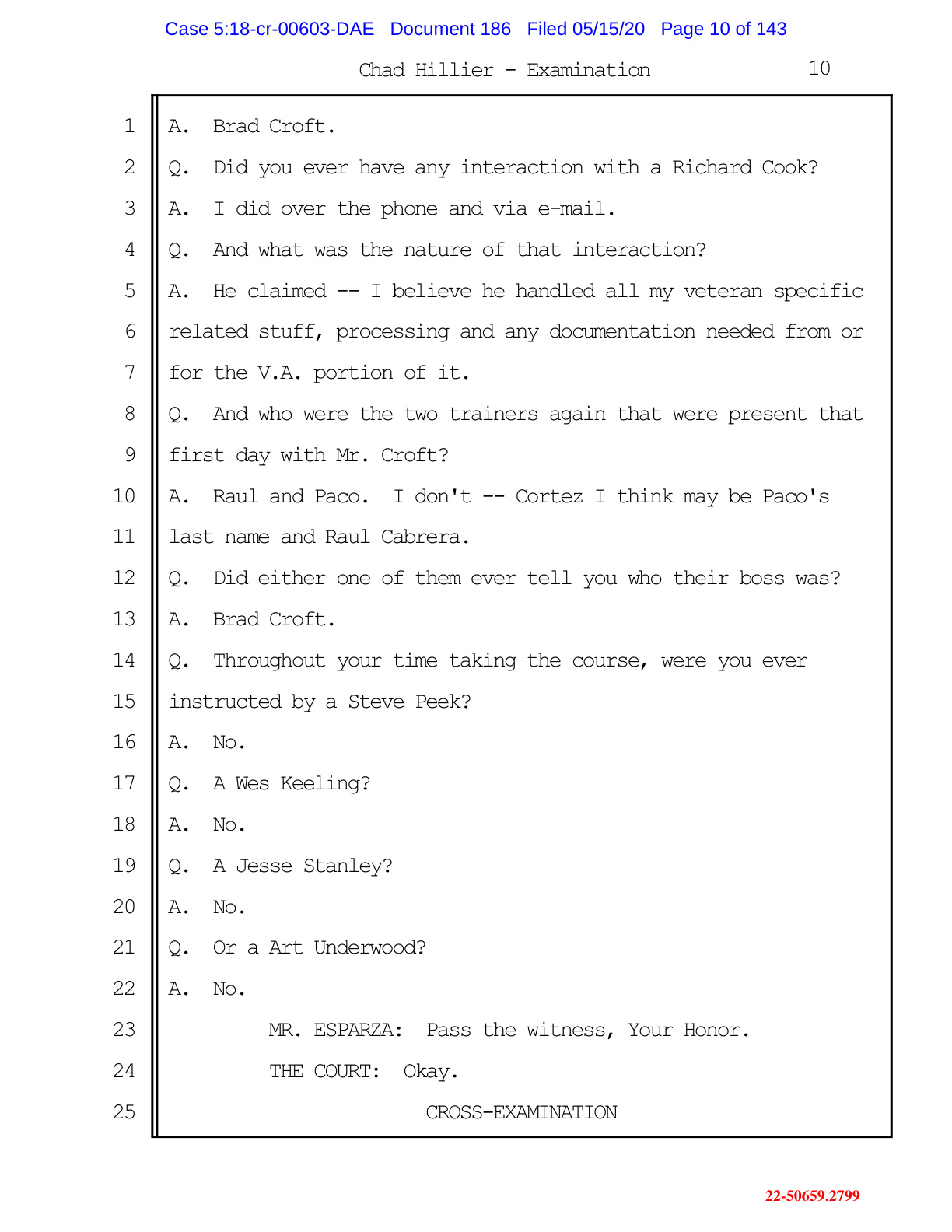
    Chad Hillier

    Government witness · Woodhull, Illinois chief of police and K9 officer. Click his name to view the original trial transcript page about Casey’s arrests and certification.

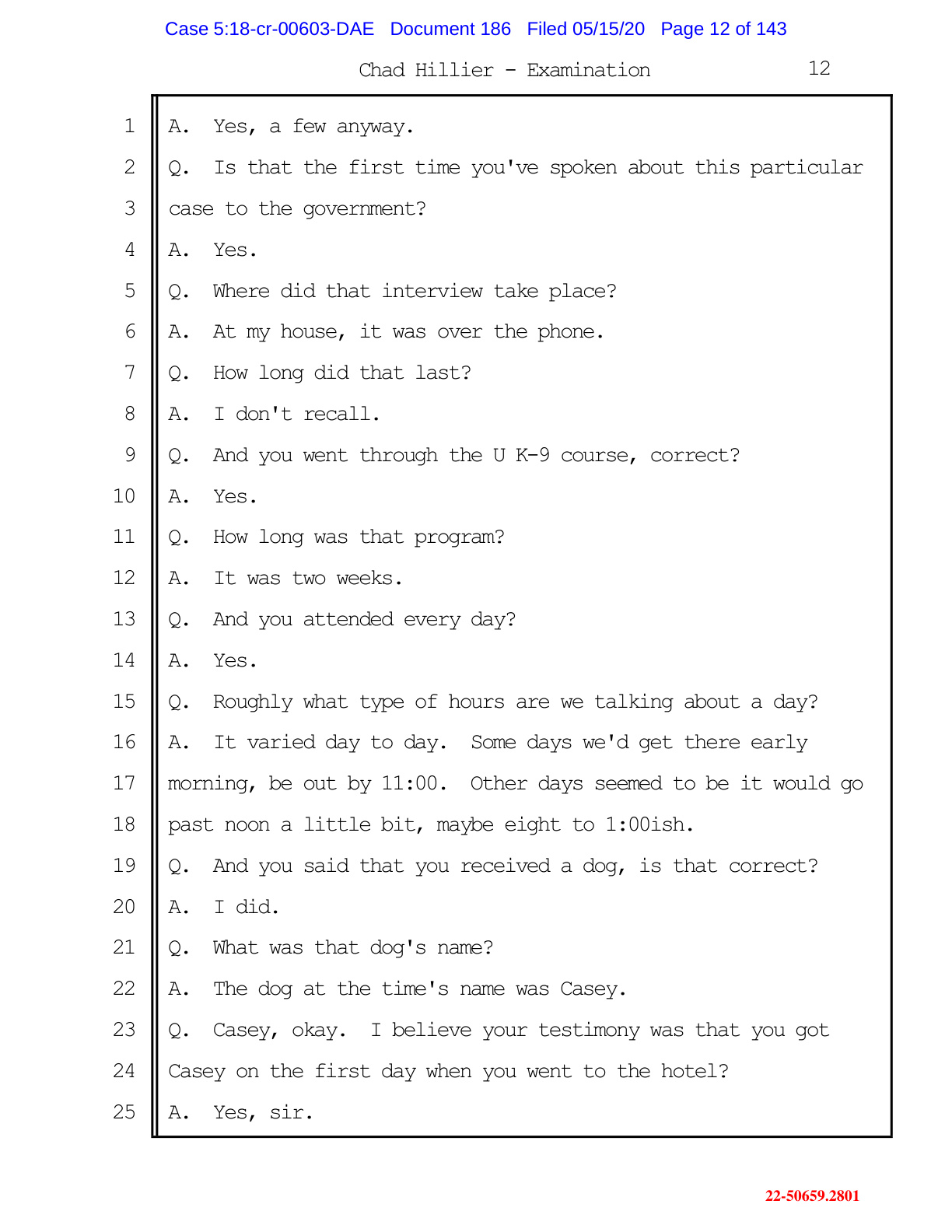
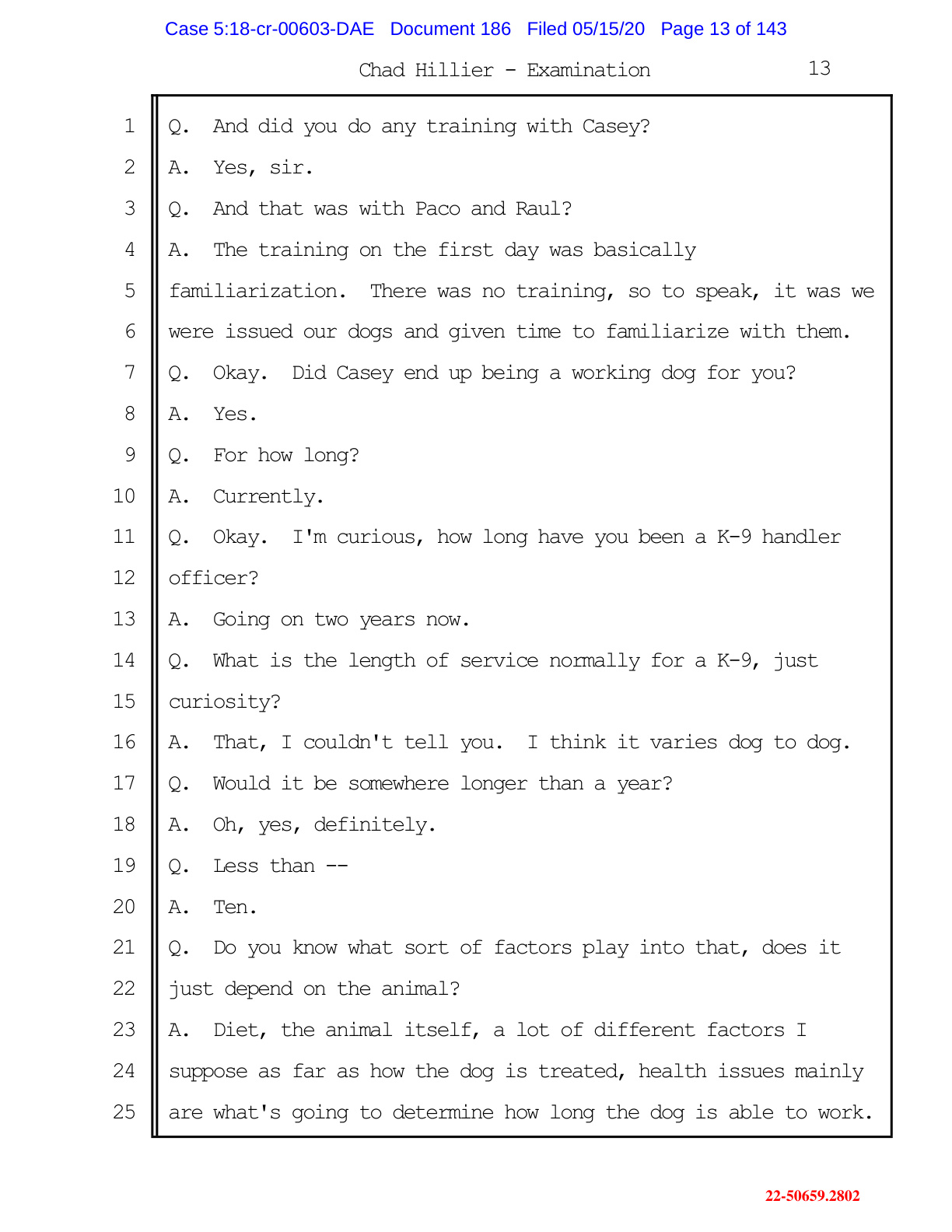
    Chad Hillier was called by the federal government. He testified that he was Chief of Police and a K9 officer for the Woodhull Police Department in Illinois. He attended Universal K9’s dual-purpose handler course and received a rescue dog named Casey. At trial, Casey was still working as his police K9.

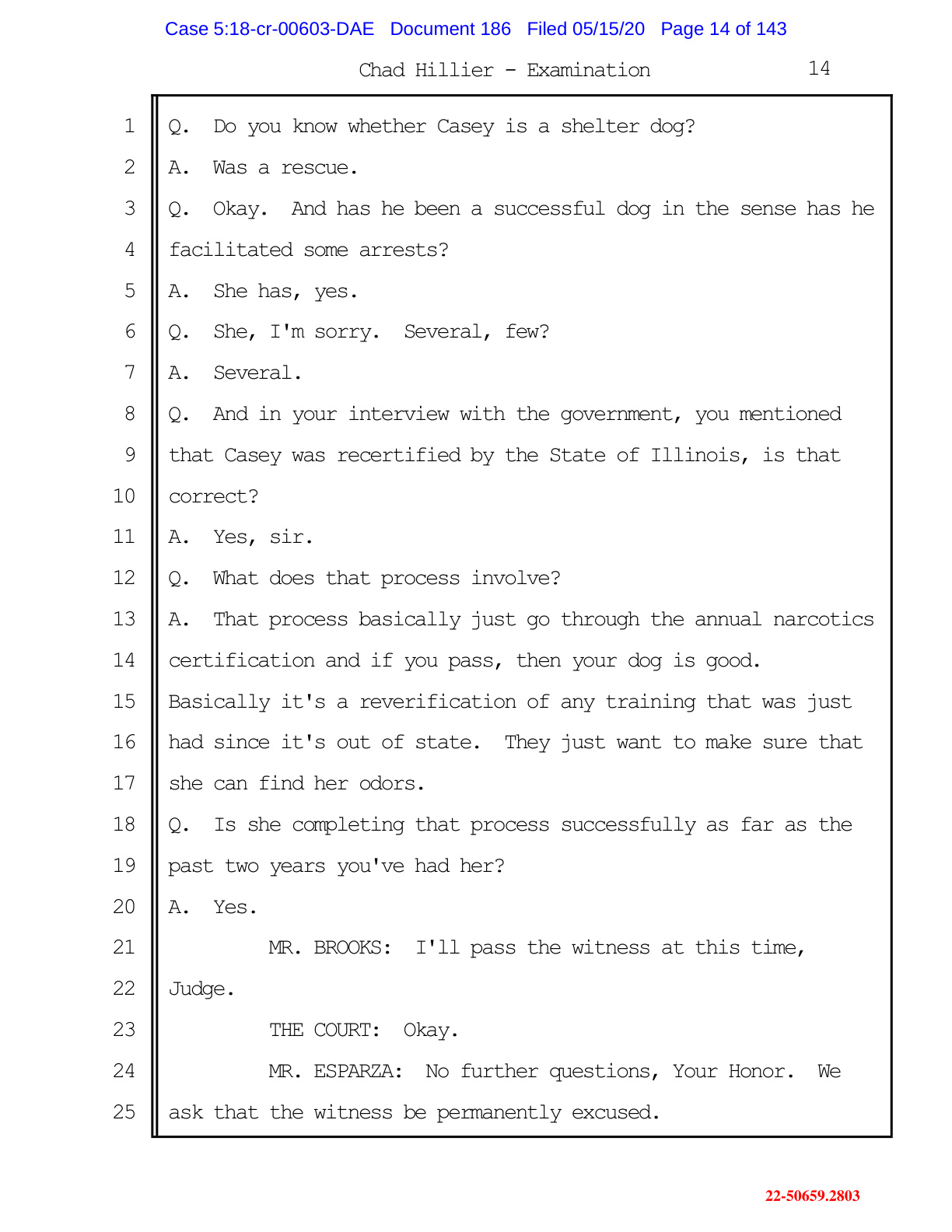
    Asked whether Casey had facilitated arrests, Hillier answered yes and said Casey had been involved in several arrests. He explained that after returning to Illinois, Casey went through the state’s annual narcotics certification process to verify that she could find her odors. Asked whether Casey had completed that process successfully in the two years after the course, he answered “Yes.”

    Whatever dispute existed about paperwork submitted during the approval process, this government witness described a rescue dog that entered police service, assisted in arrests, and passed later narcotics certification. Read the cited transcript page.

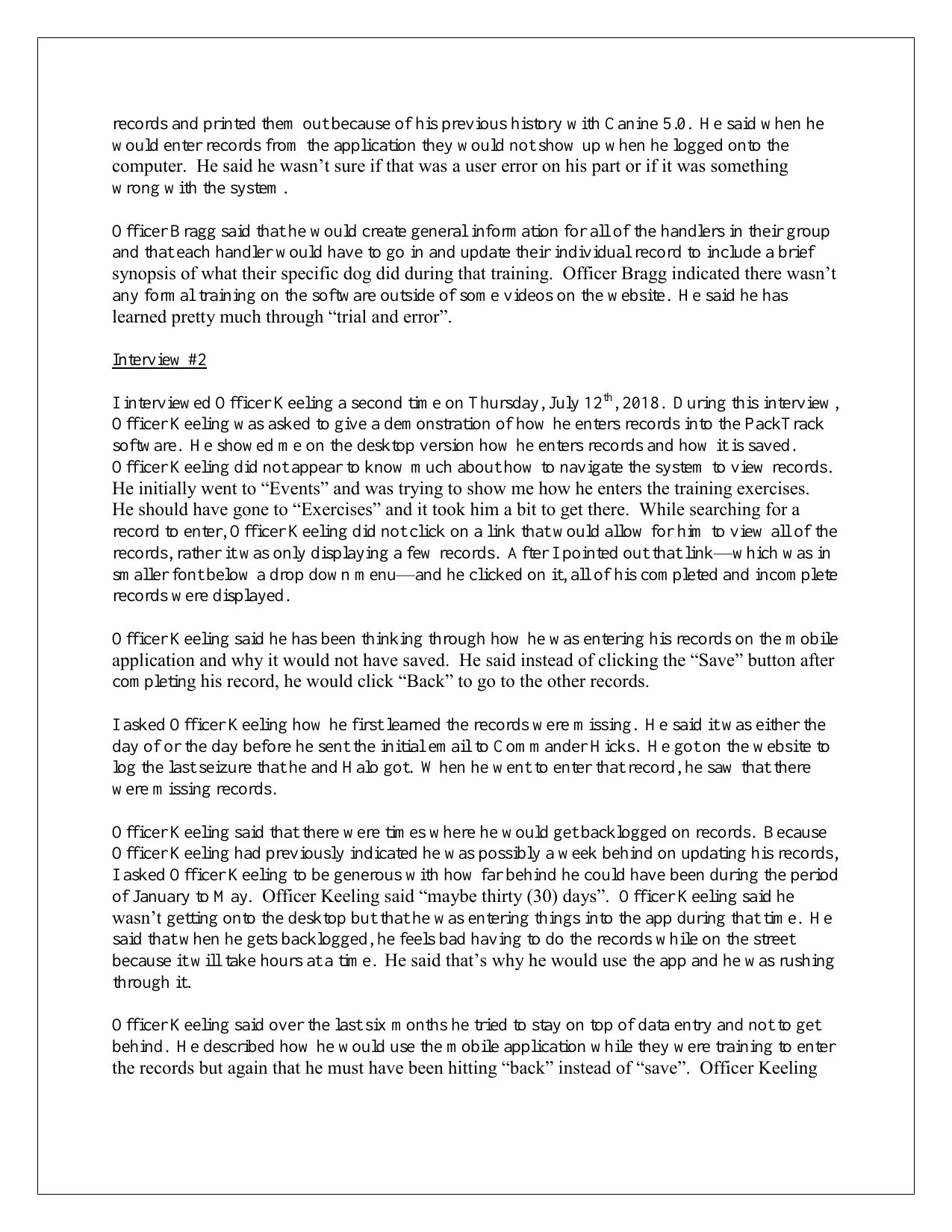
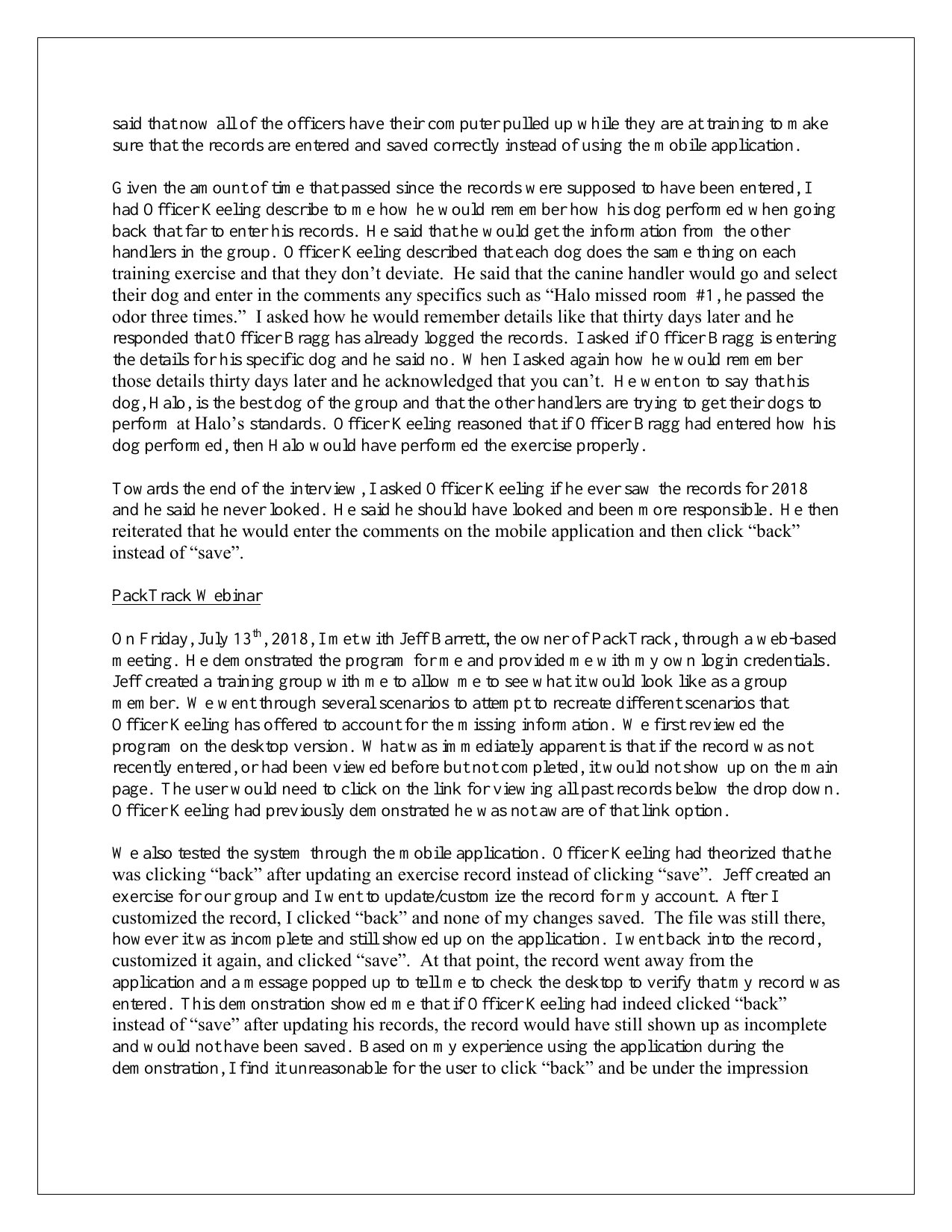
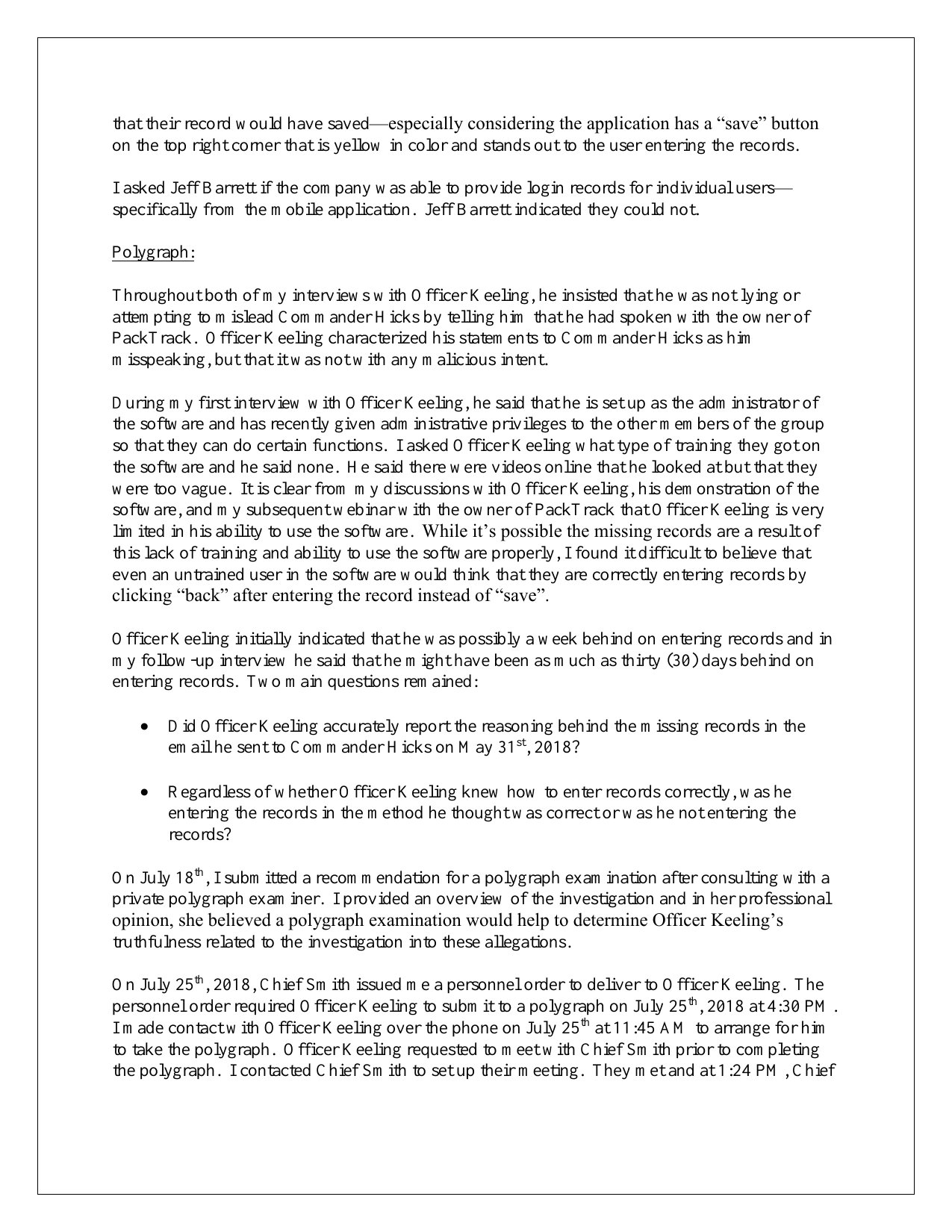
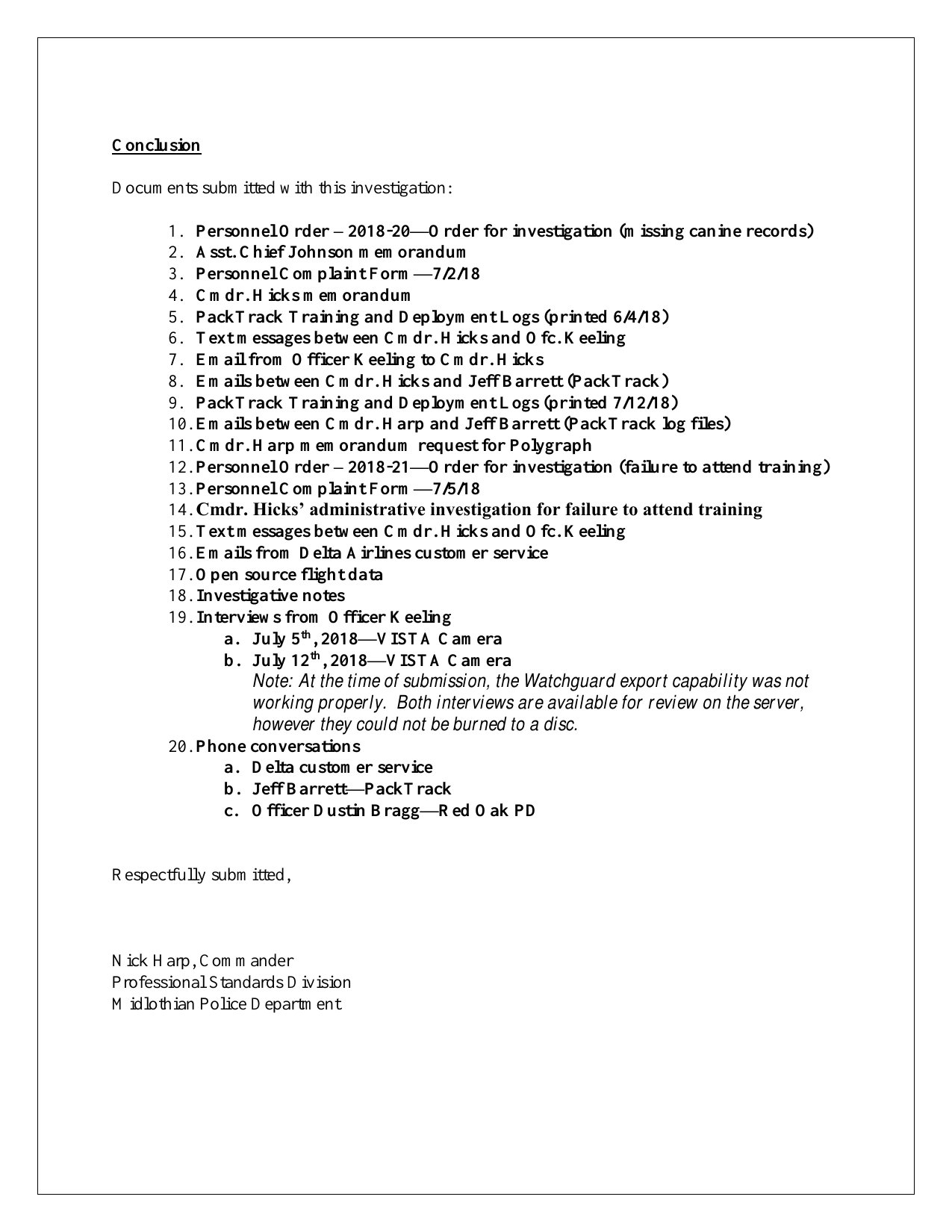
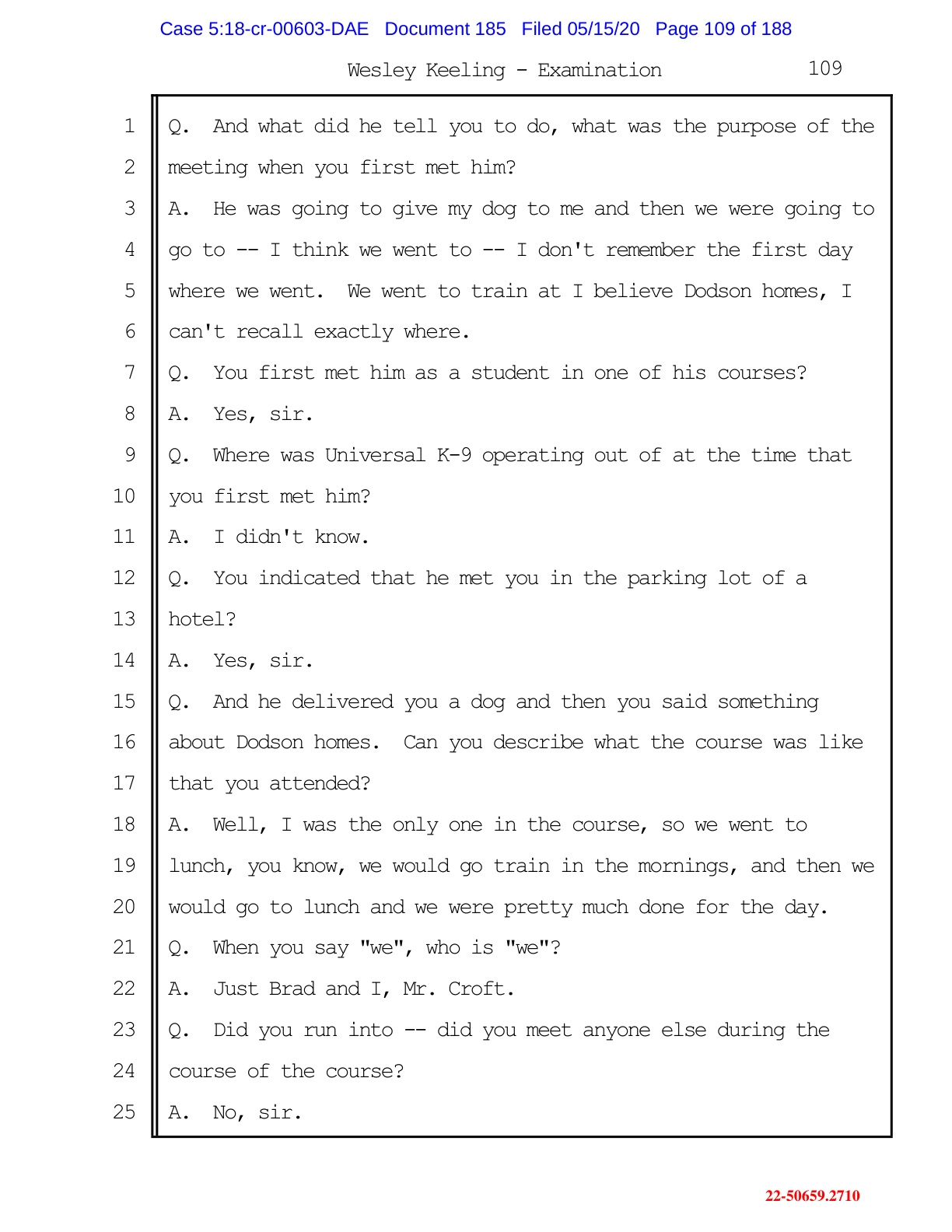
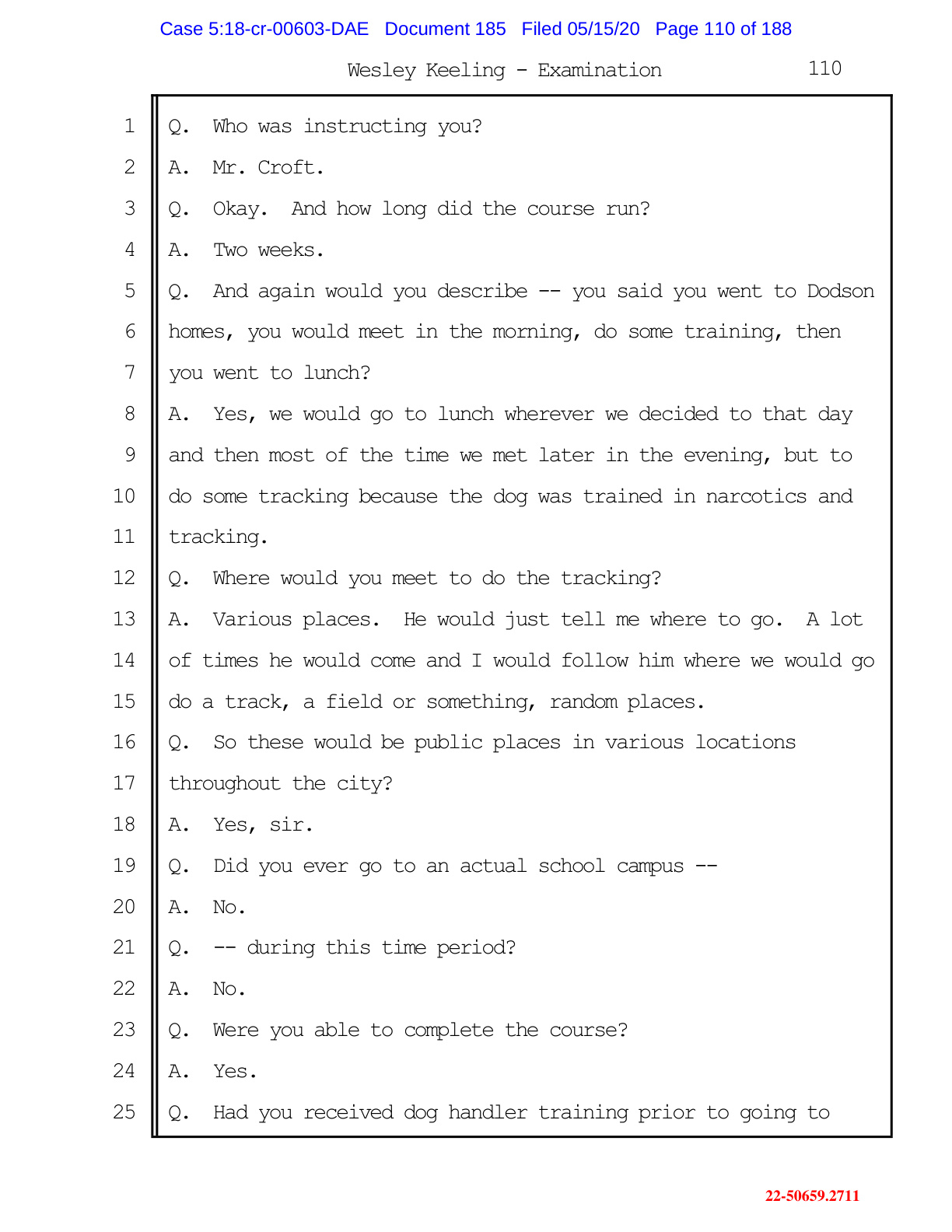
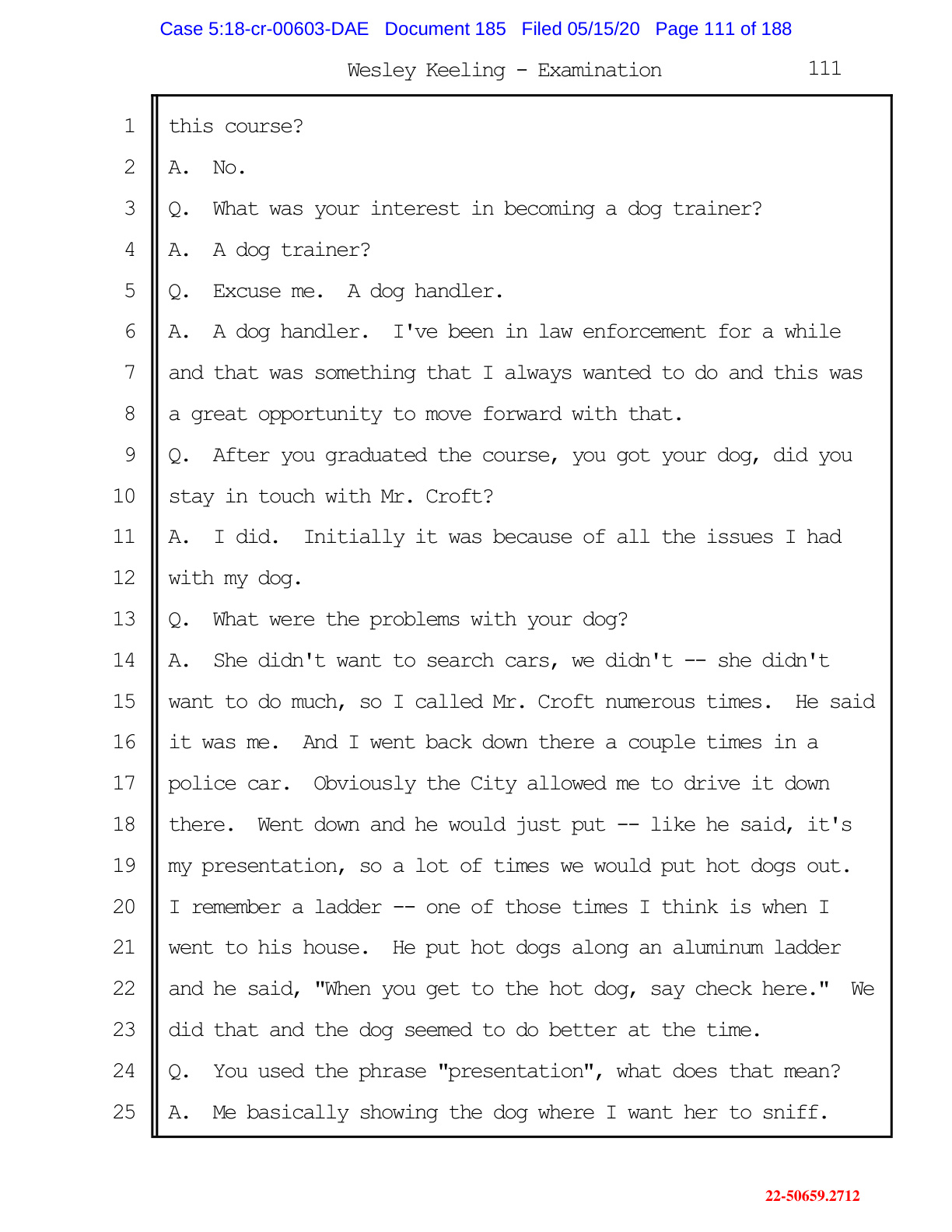
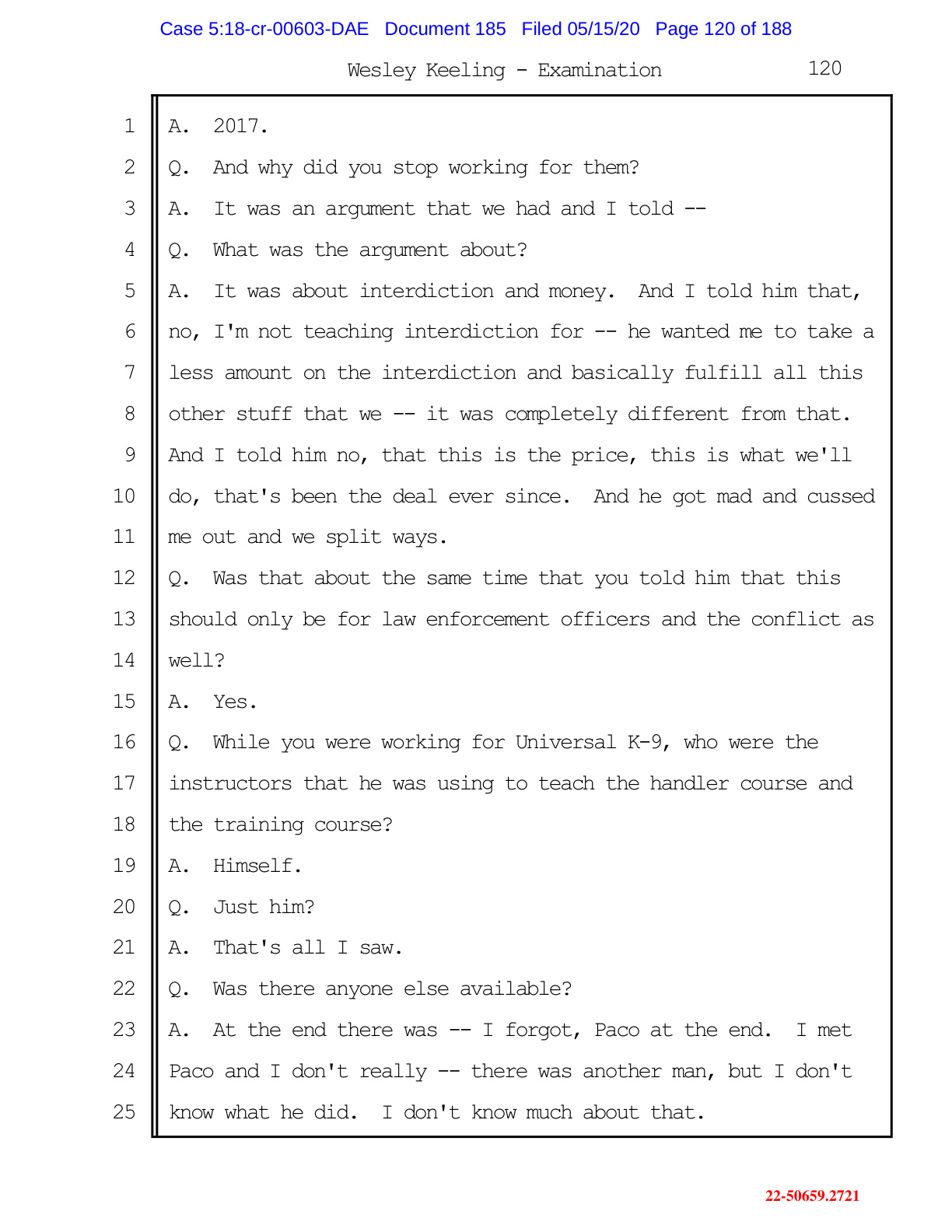
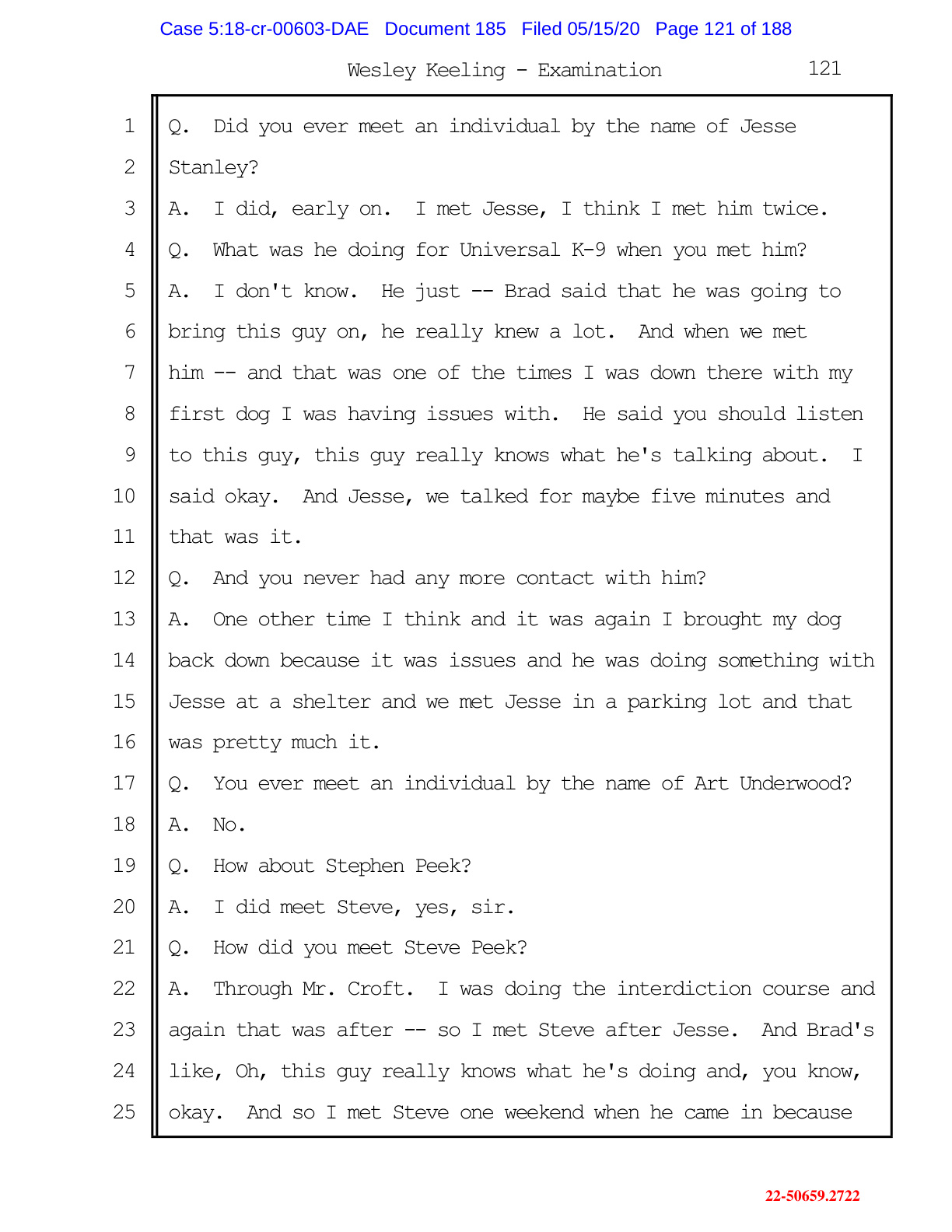
    Wesley Keeling

    Government witness · Former Midlothian police officer and K9 handler. Click his name to view the original trial transcript page about his Universal K9 dog, Remmie.

    Wesley Keeling was a government witness important to the allegations concerning instructor information submitted during the approval process. His testimony about the Universal K9 dog he received tells a separate part of the story.

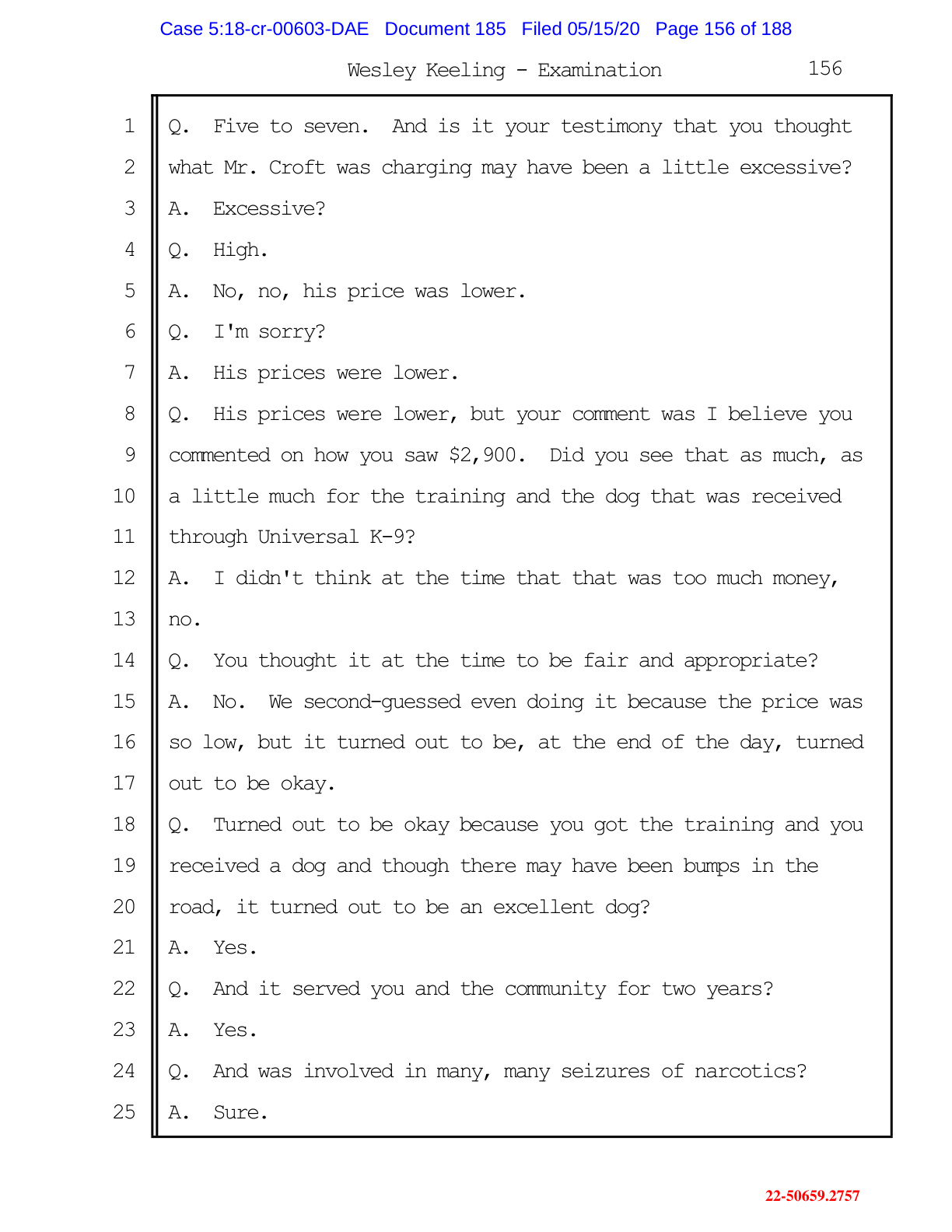
    Keeling testified that Universal K9’s price was lower than prices he later charged through his own K9 business. Despite what a question described as “bumps in the road,” he agreed that Remmie became an “excellent dog.” He testified that she served him and his community for approximately two years and participated in numerous narcotics seizures. Read page 156.

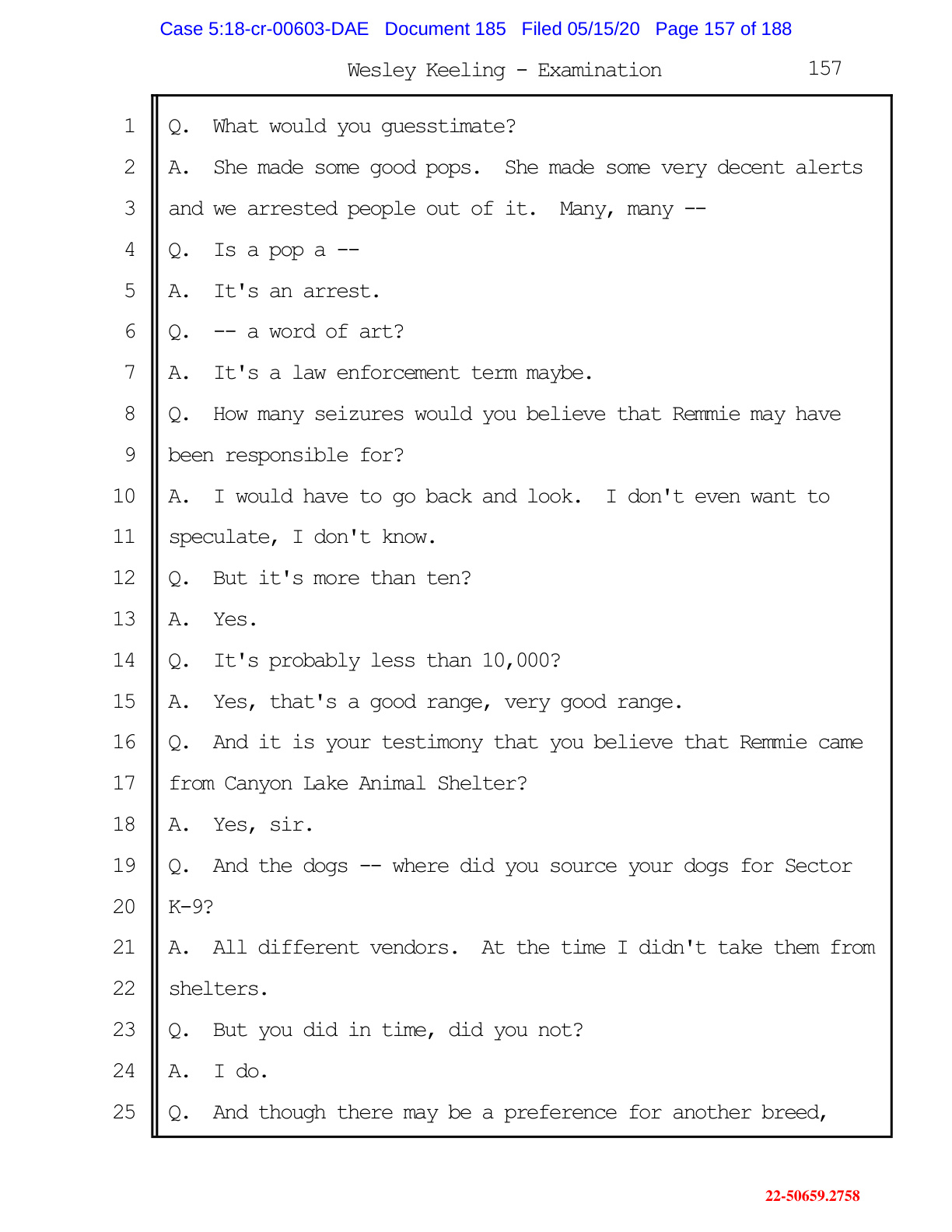
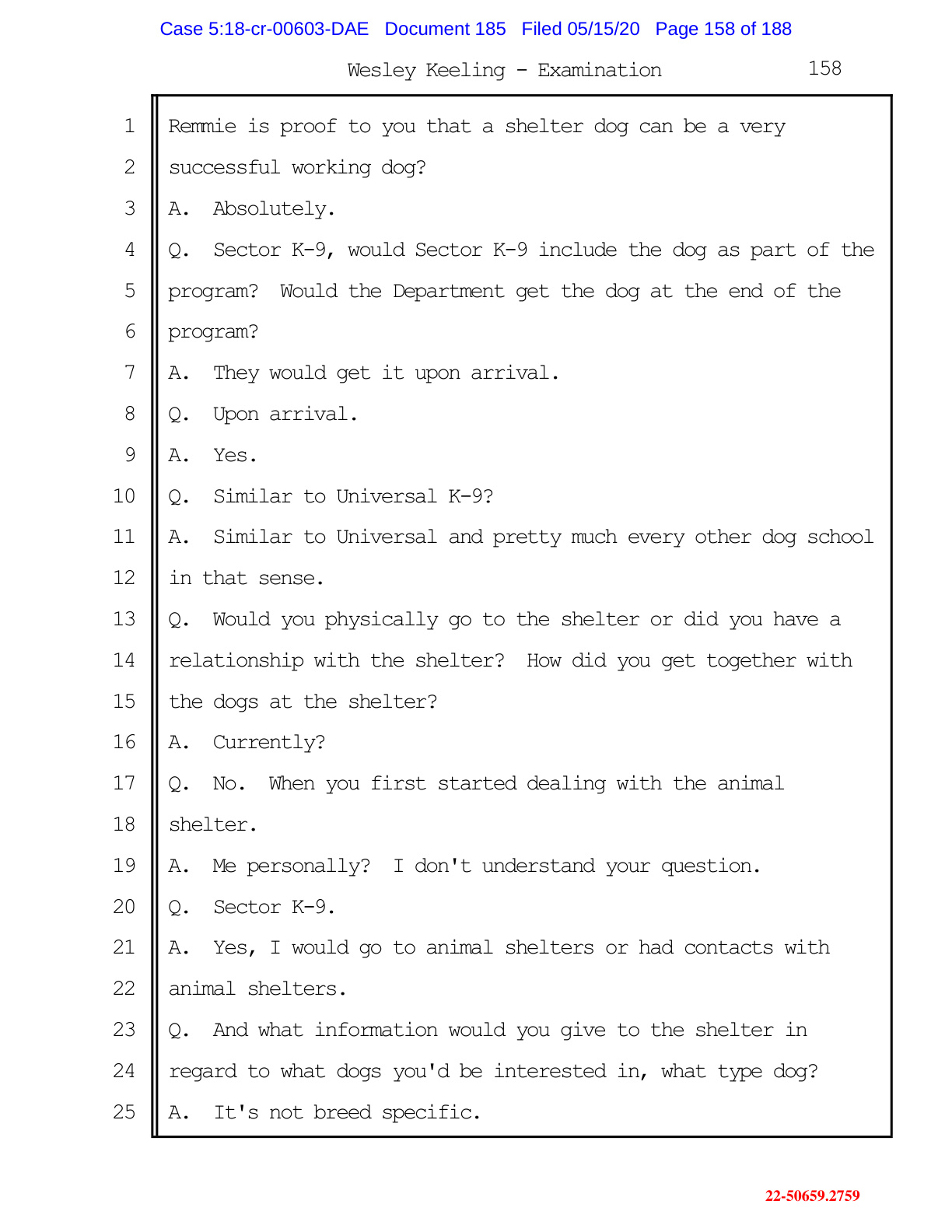
    Keeling described successful alerts leading to arrests. Asked whether Remmie had been responsible for more than ten seizures, he answered “Yes.” He said Remmie came from an animal shelter. Read page 157. Asked whether Remmie proved a shelter dog could become a successful working police dog, Keeling answered “Absolutely.” Read page 158.

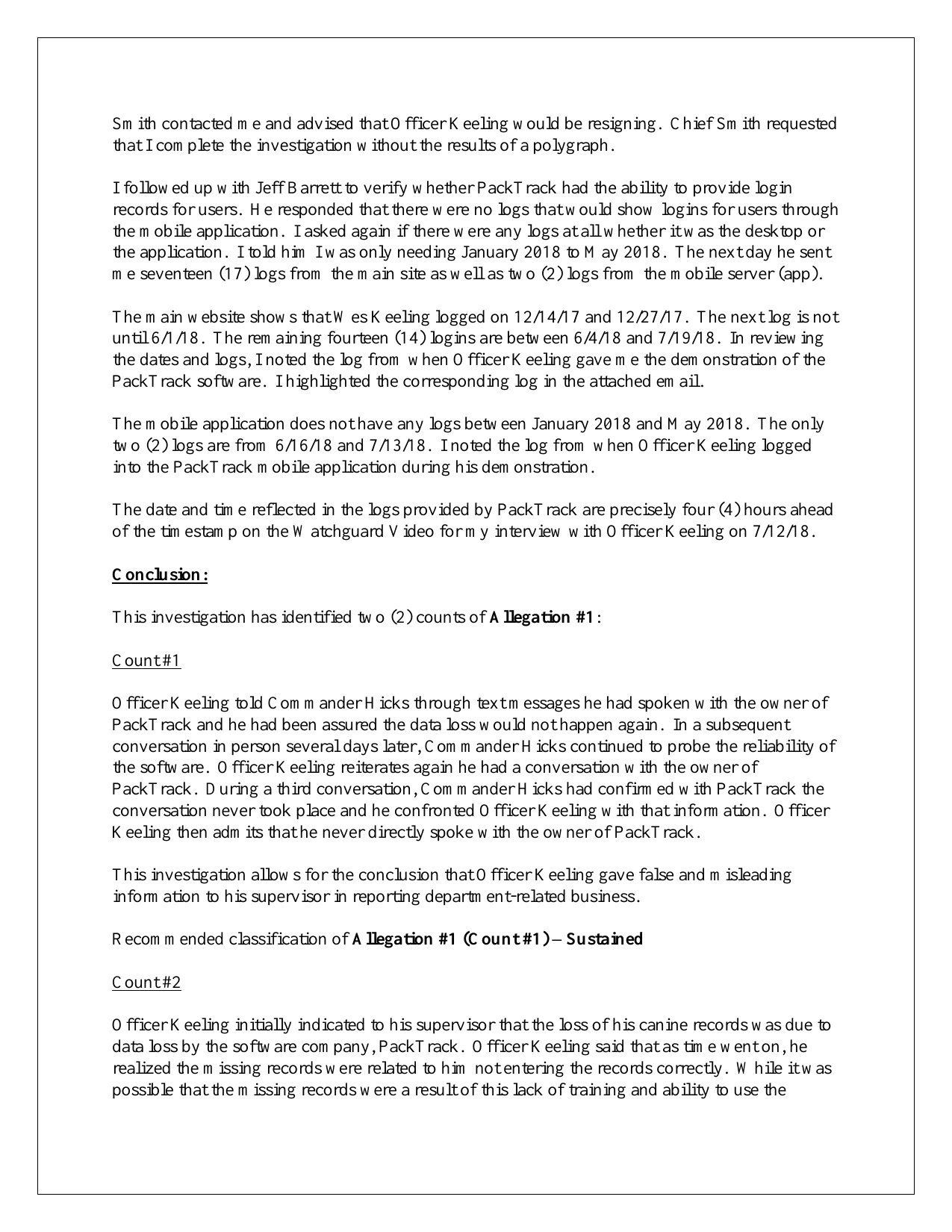
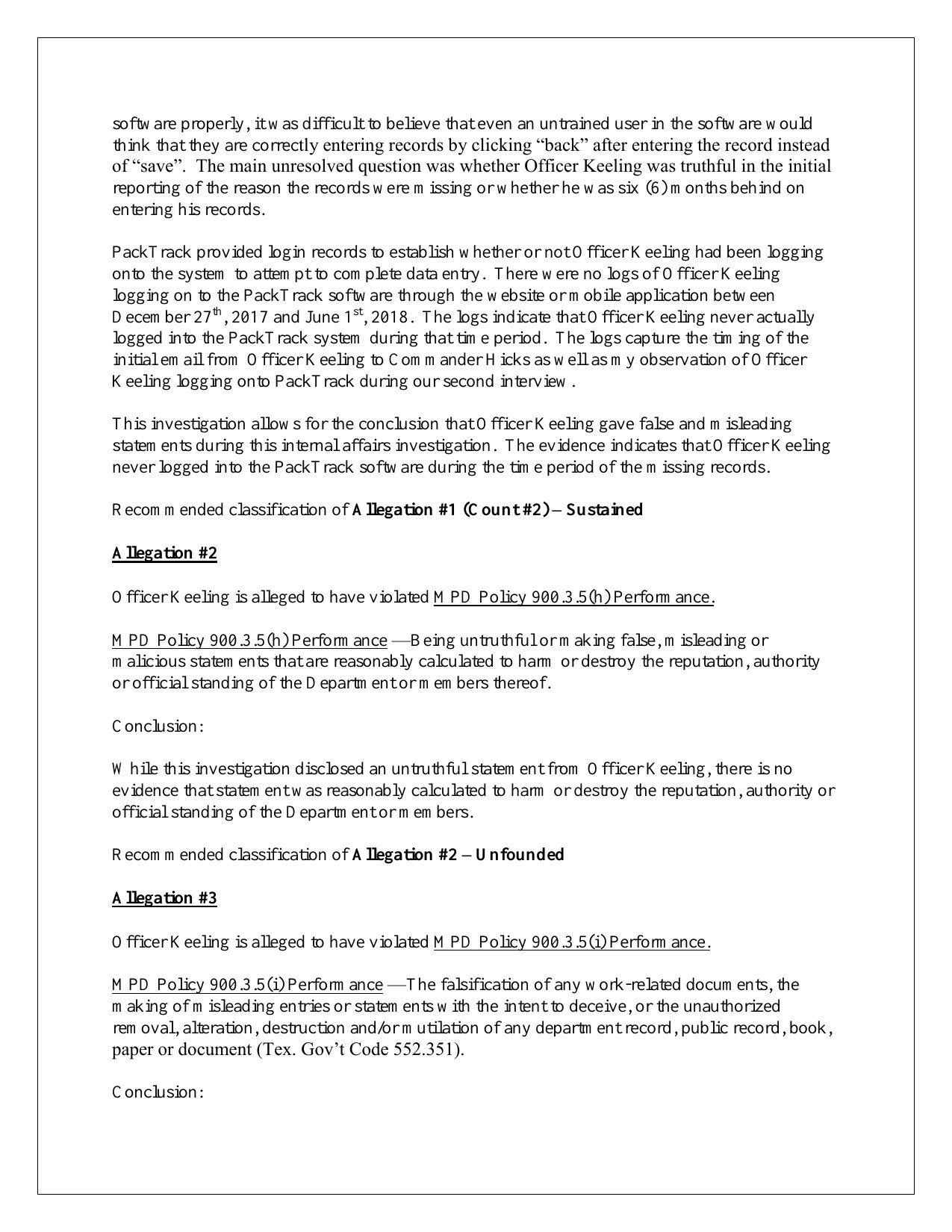
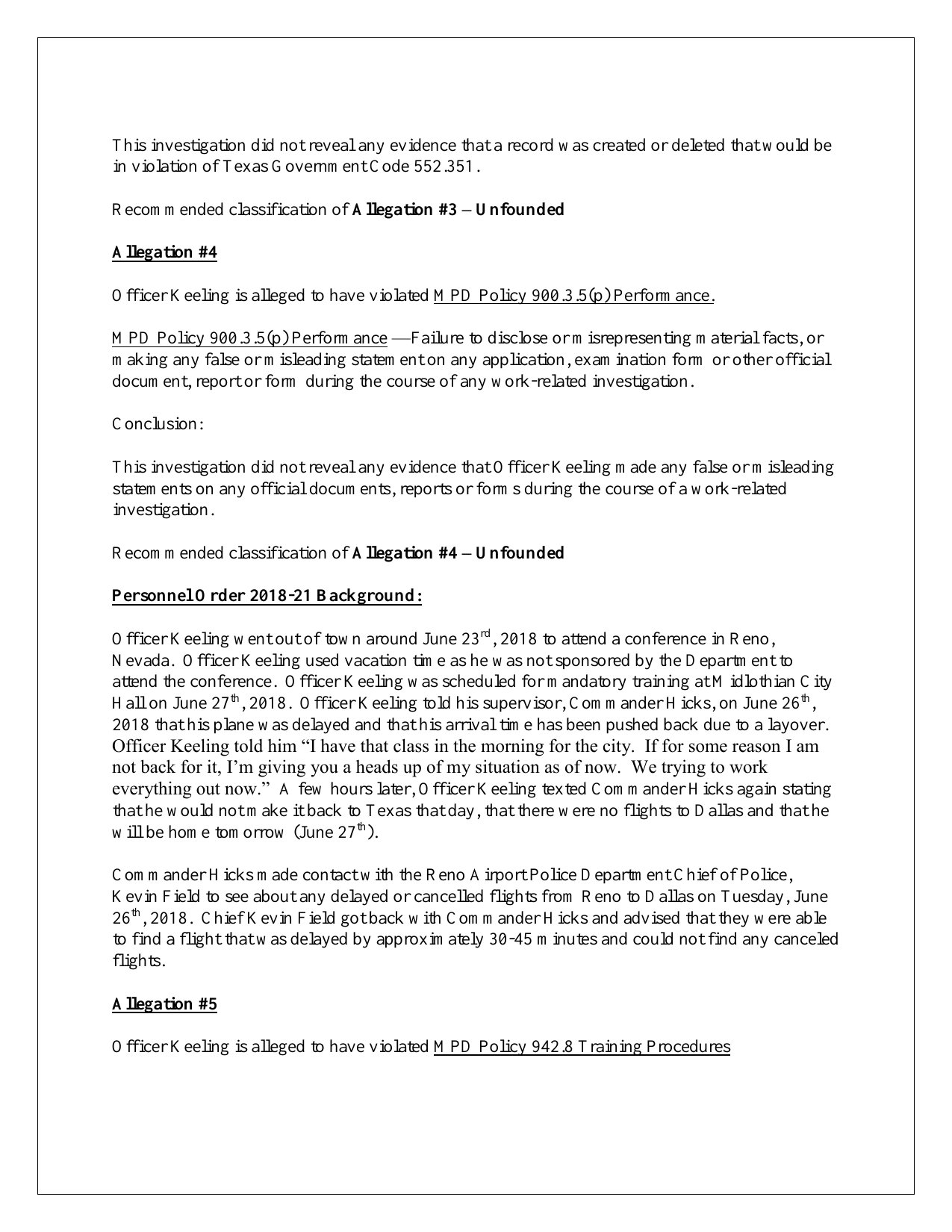
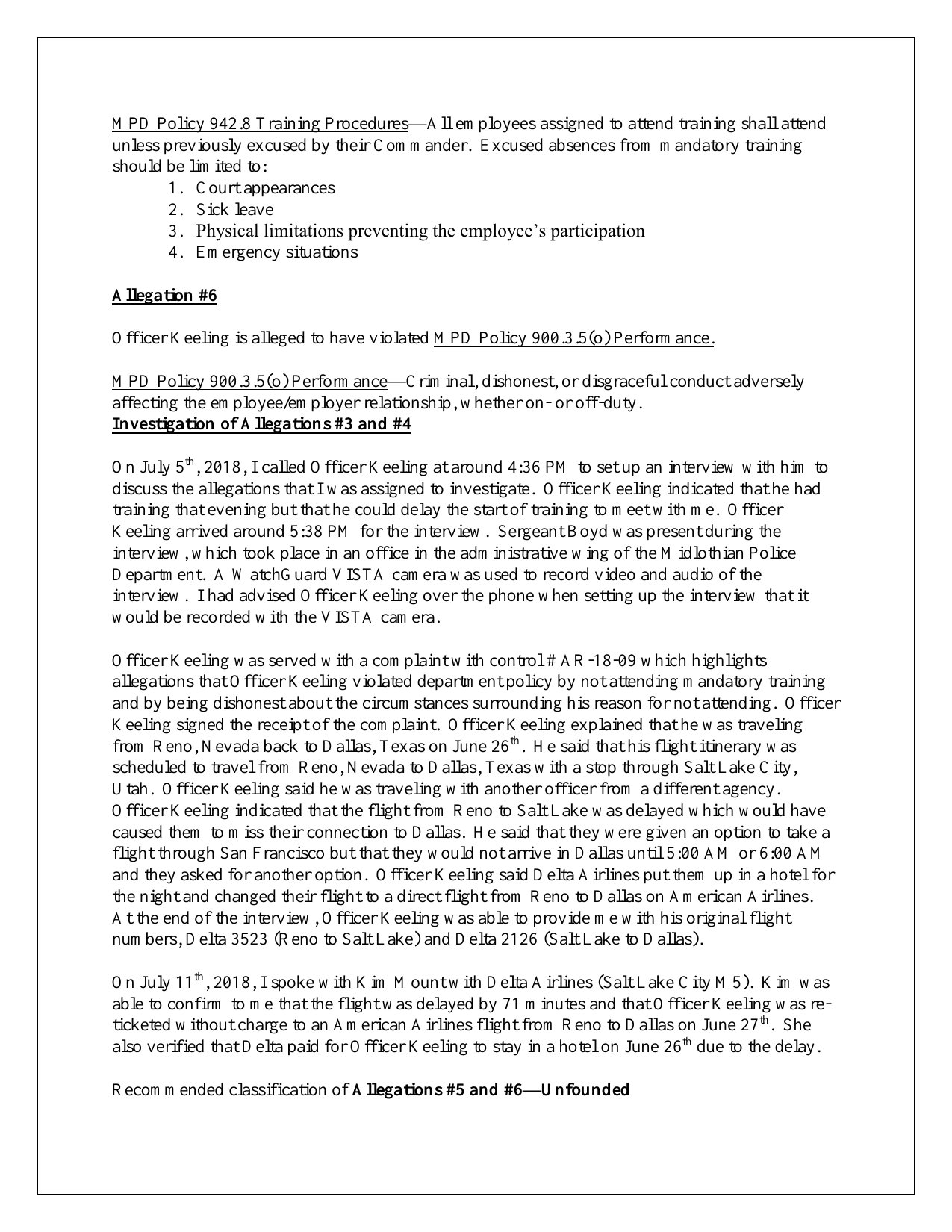
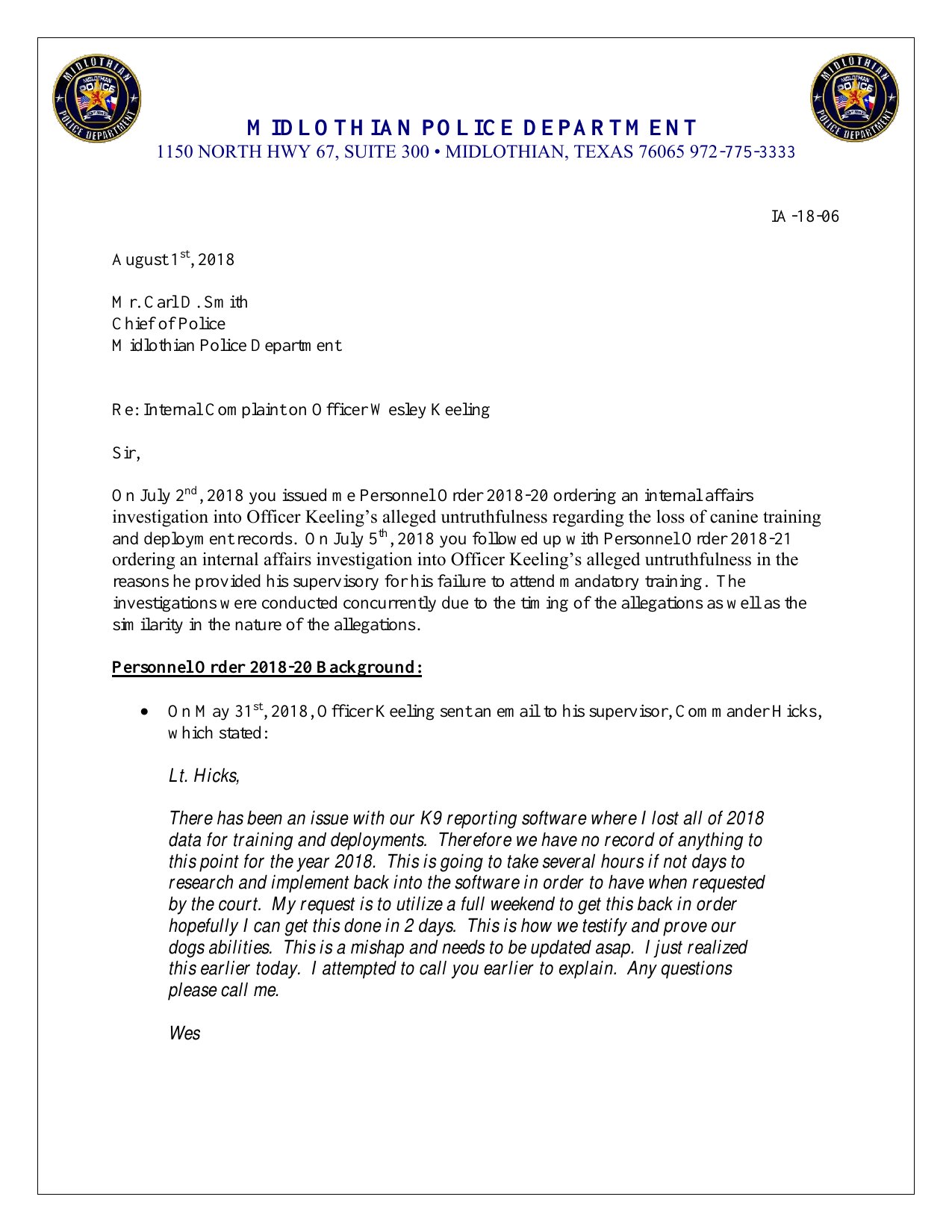
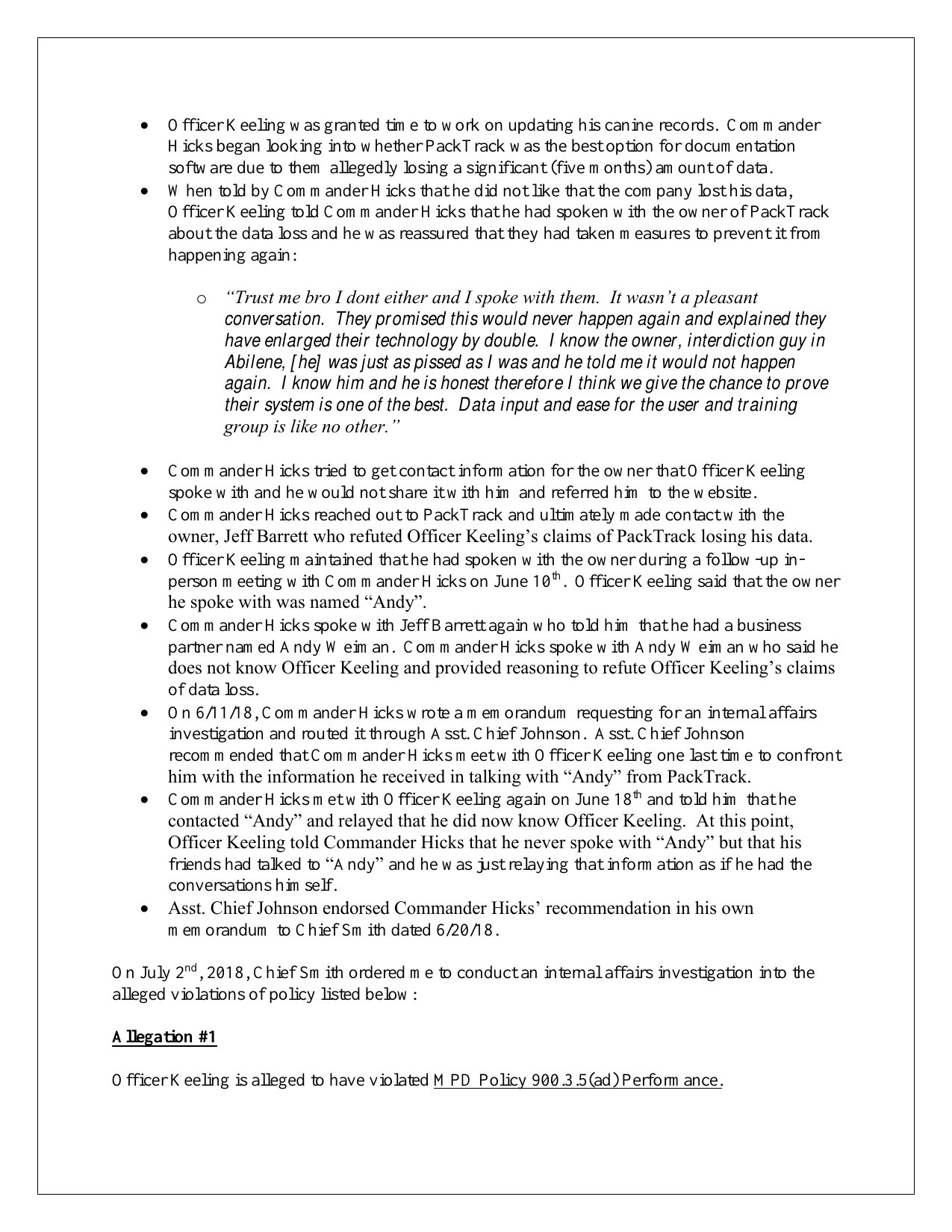
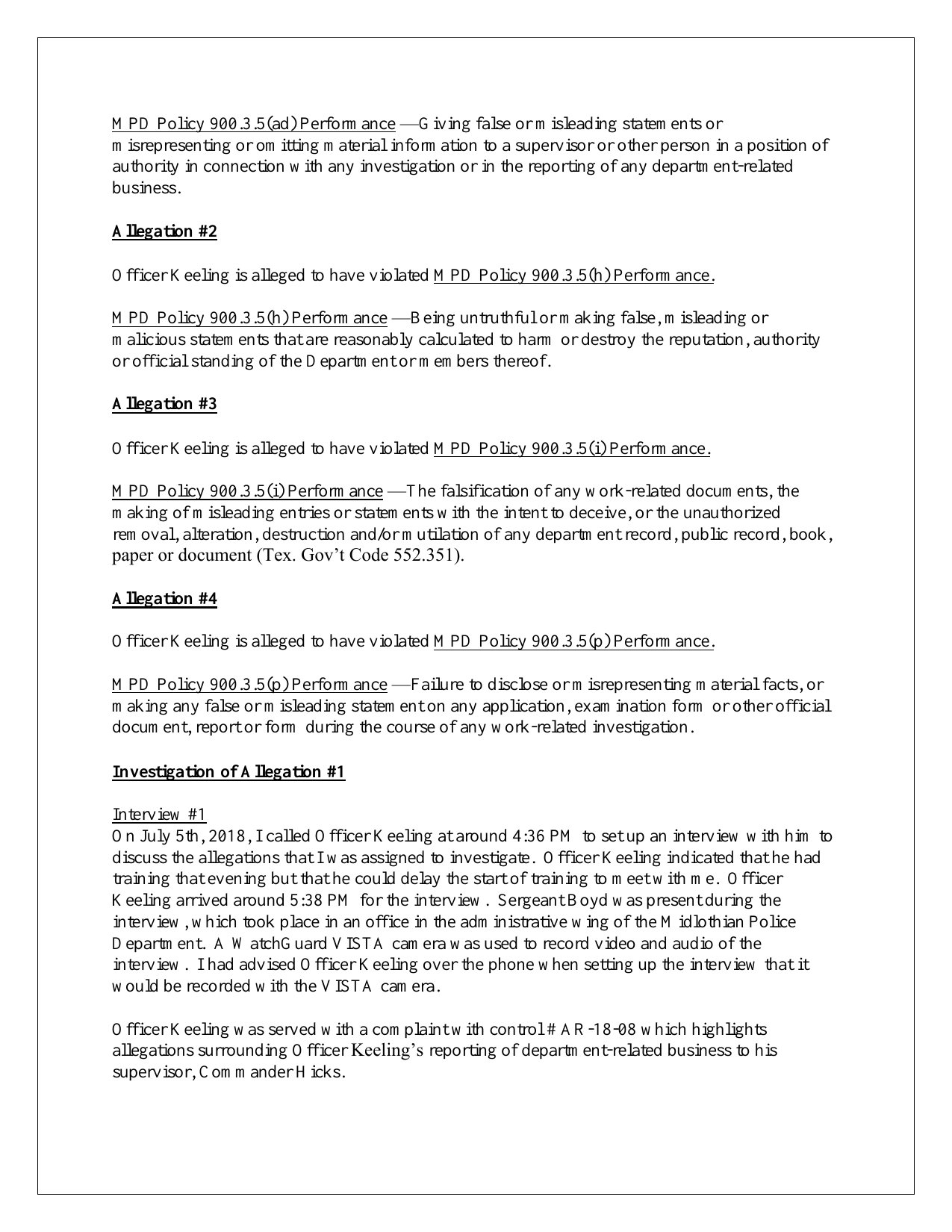
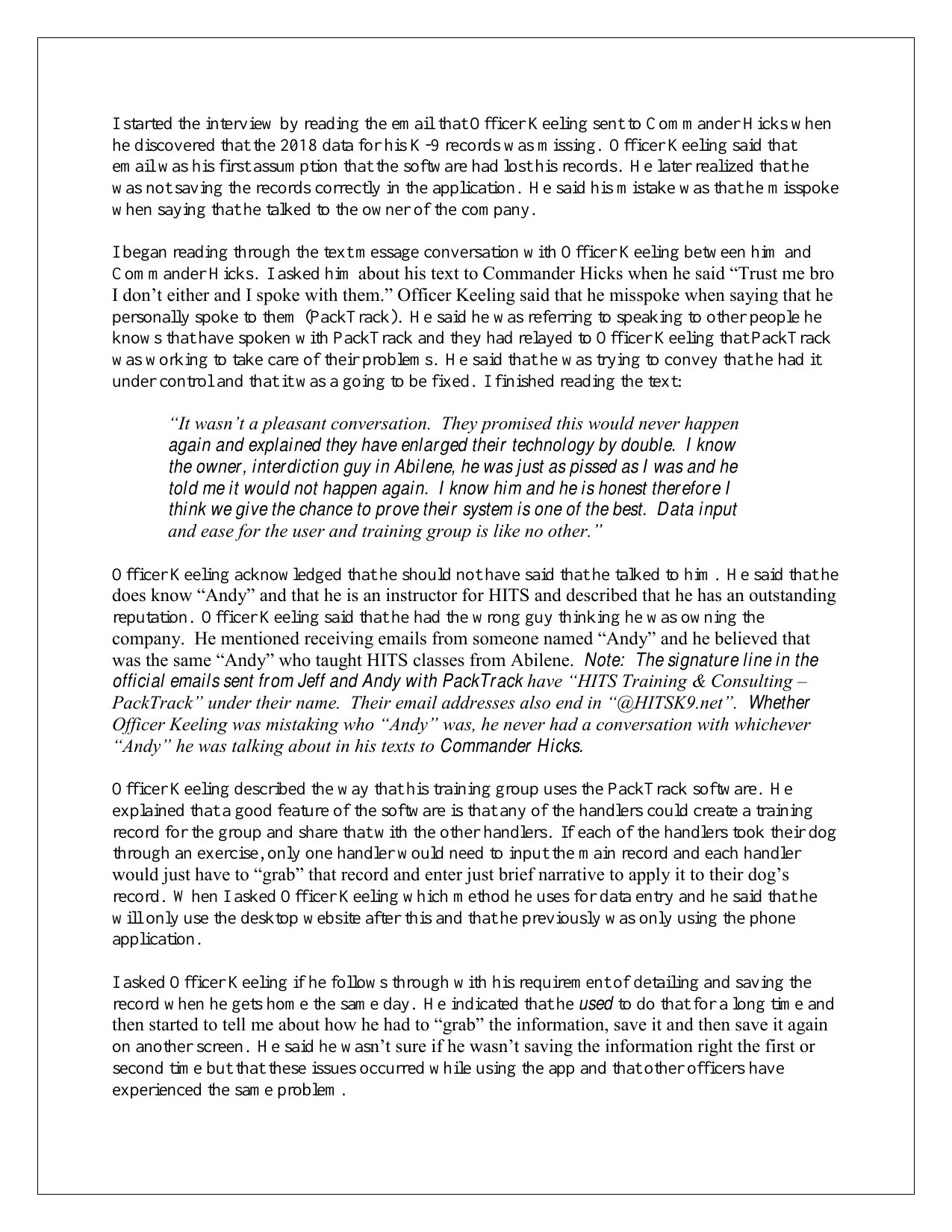
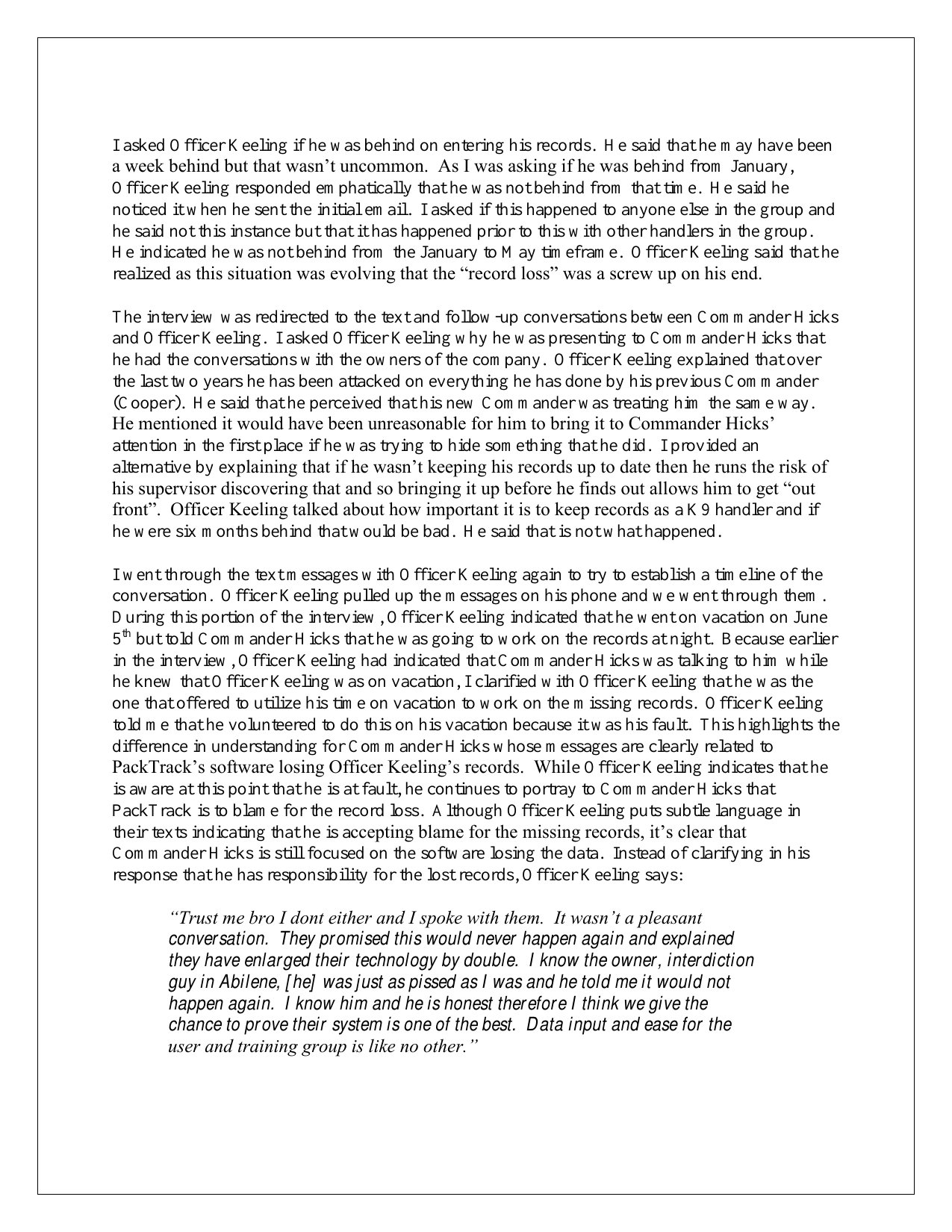
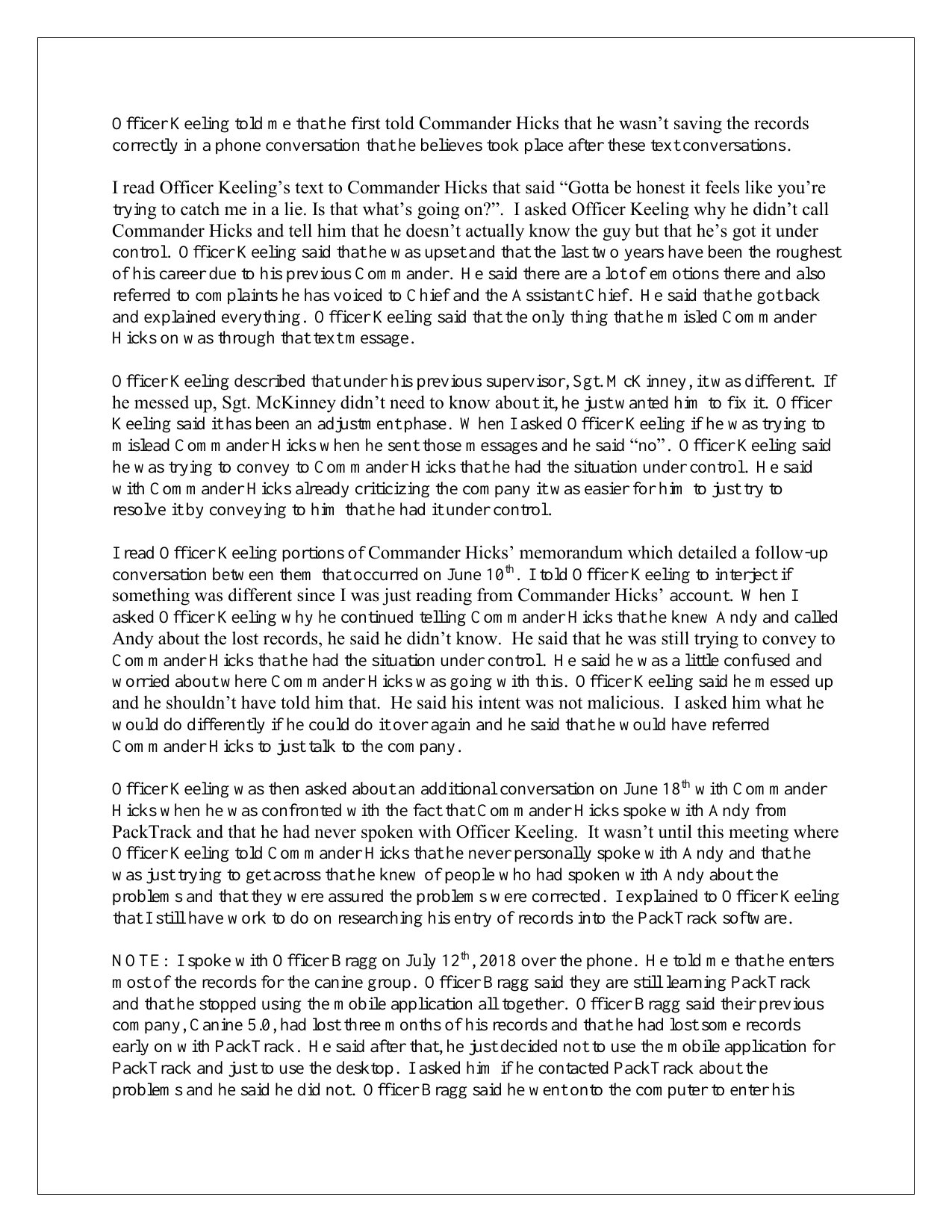
    There is also credibility information concerning Keeling in Midlothian Police Department and Ellis County records that predated Croft’s 2019 trial and was raised in the federal litigation later. In an August 1, 2018 internal investigation report, the investigator classified two counts concerning false or misleading statements as sustained (finding on the first count; finding on the second count). Several other allegations in that same report were classified unfounded (page 11; page 12; page 13).

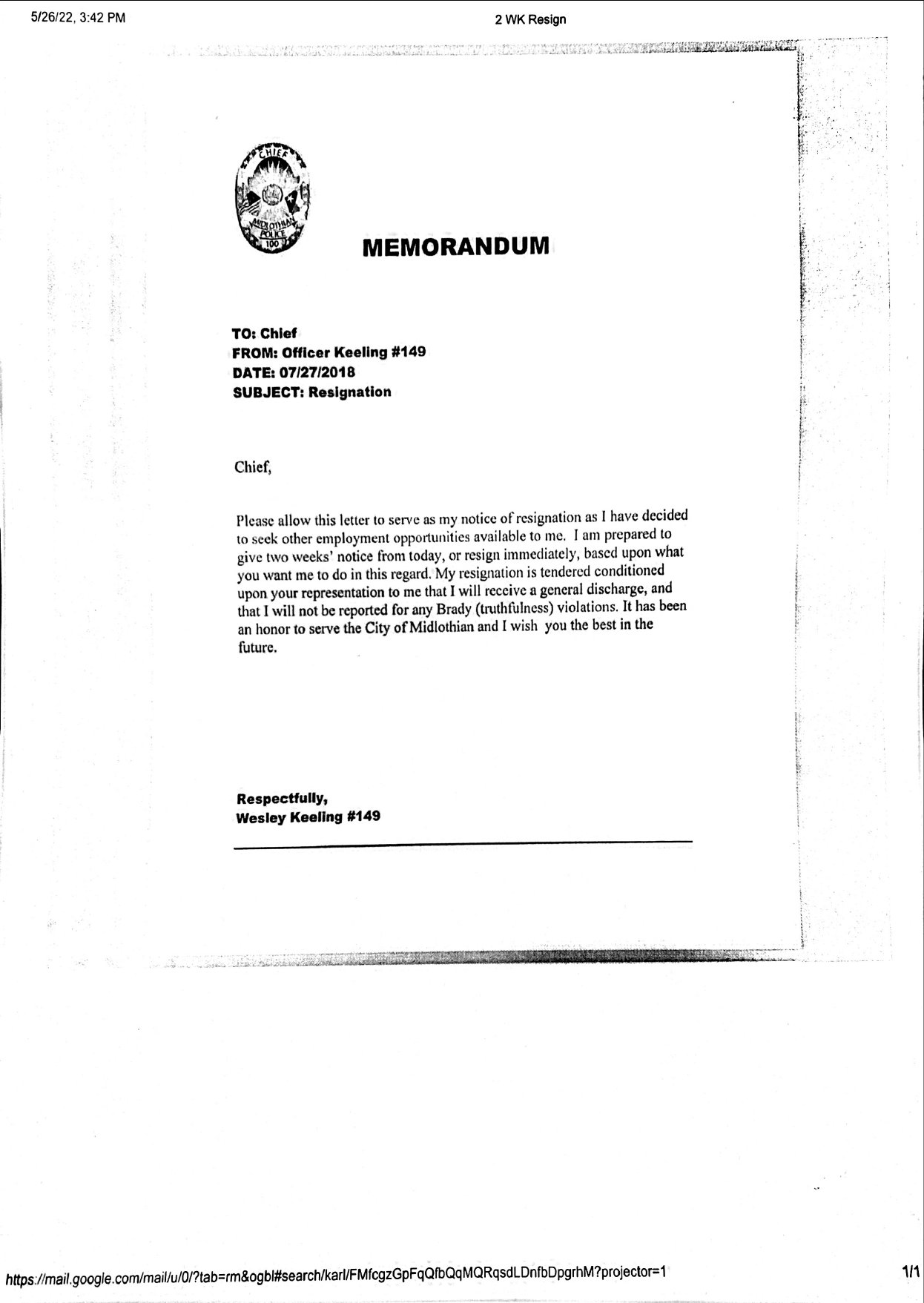
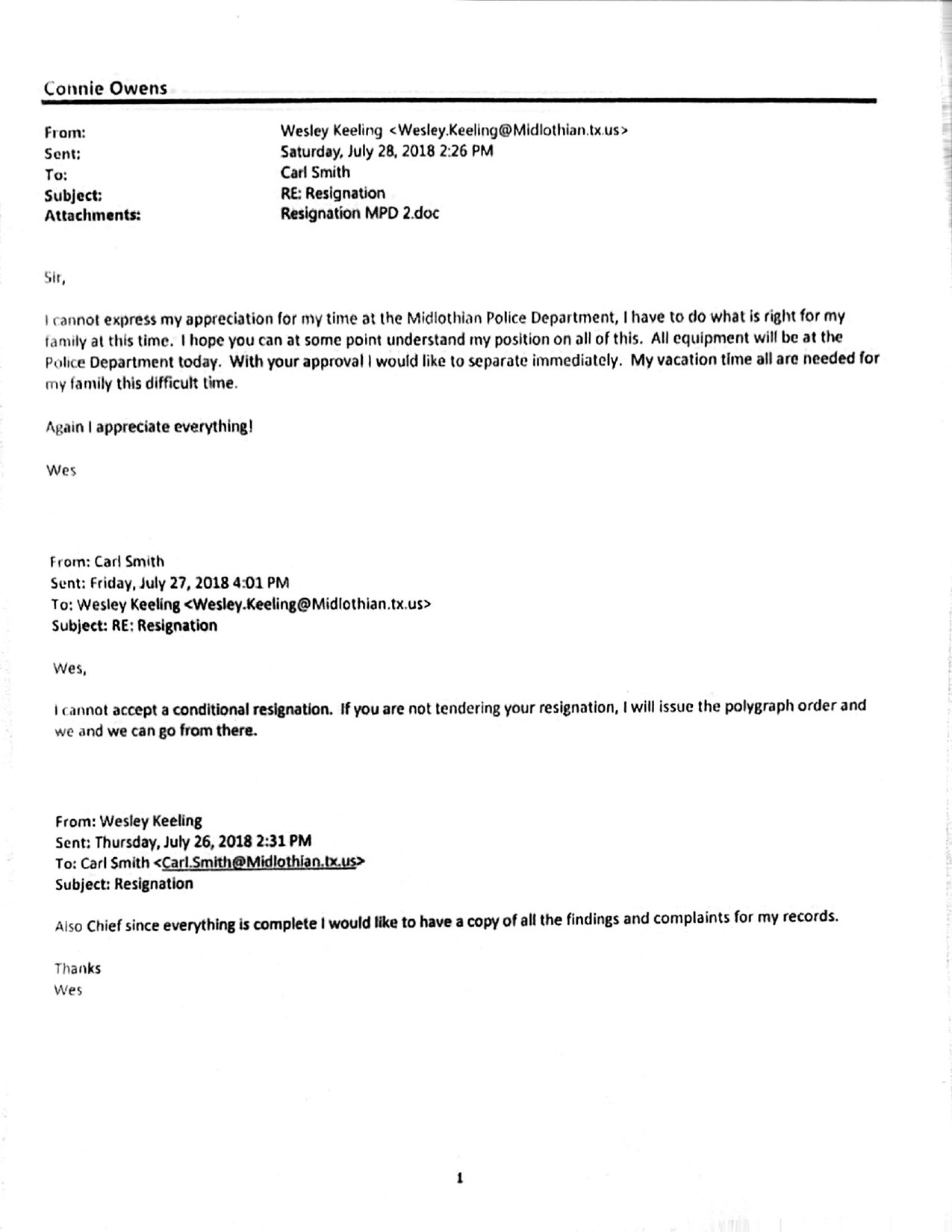
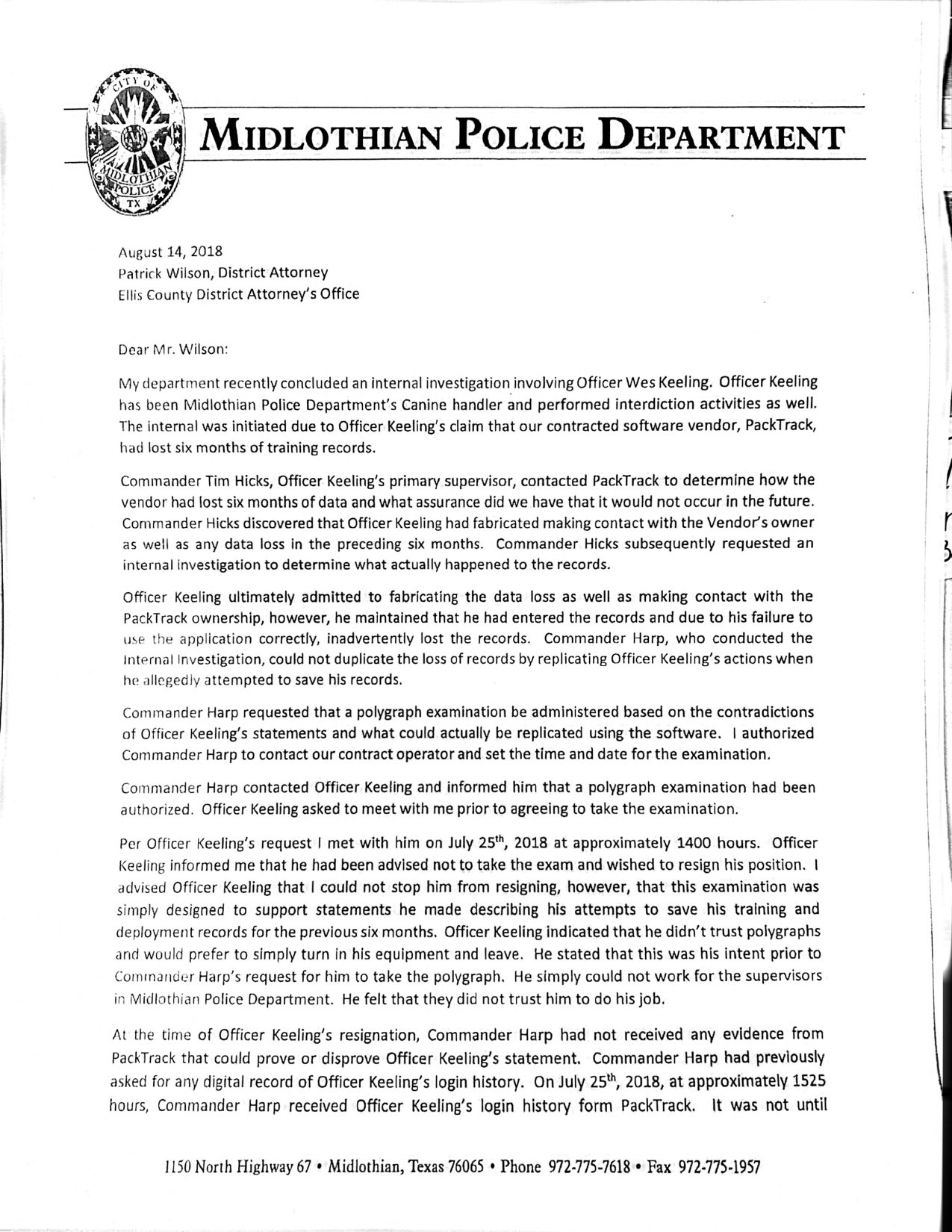
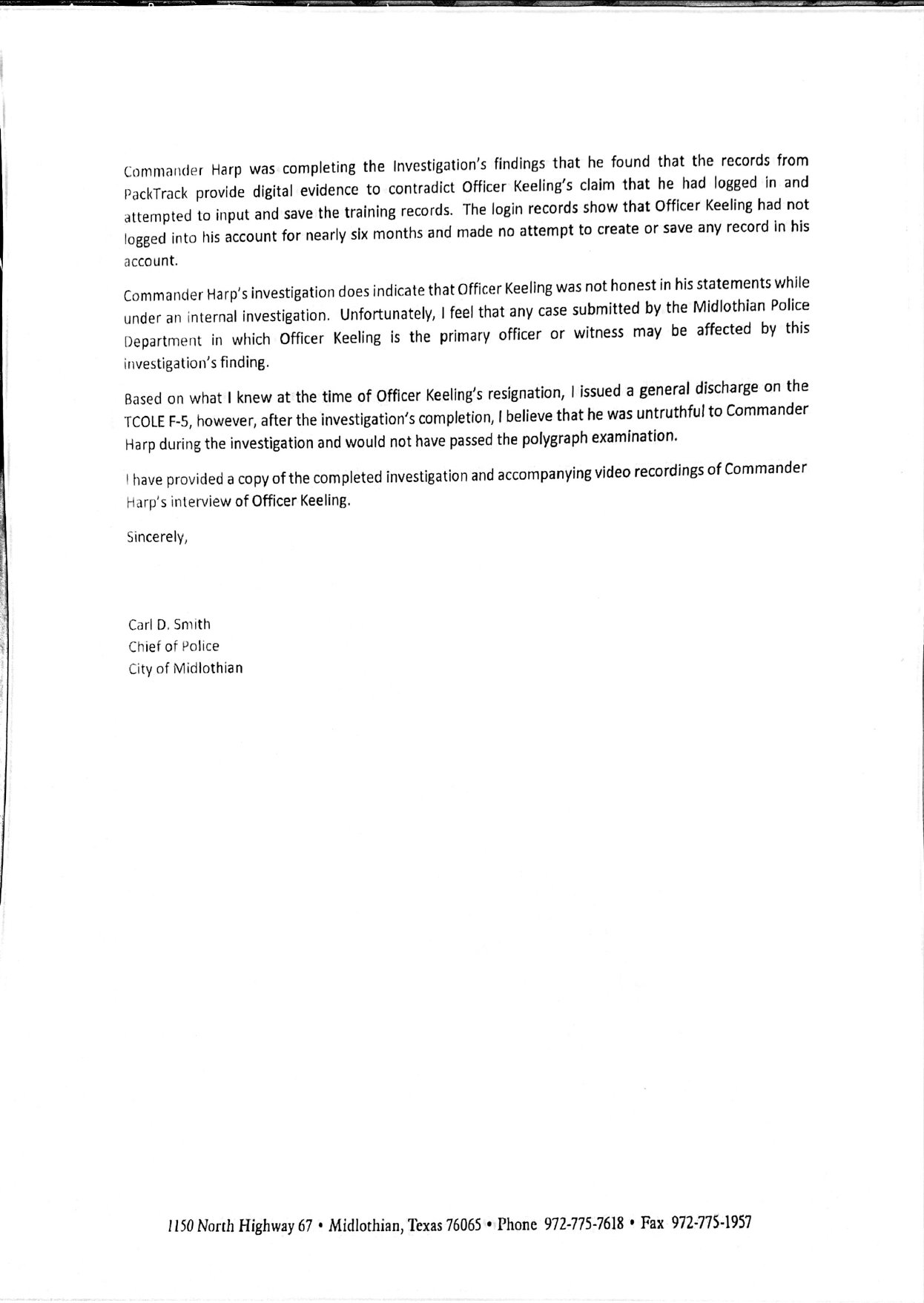
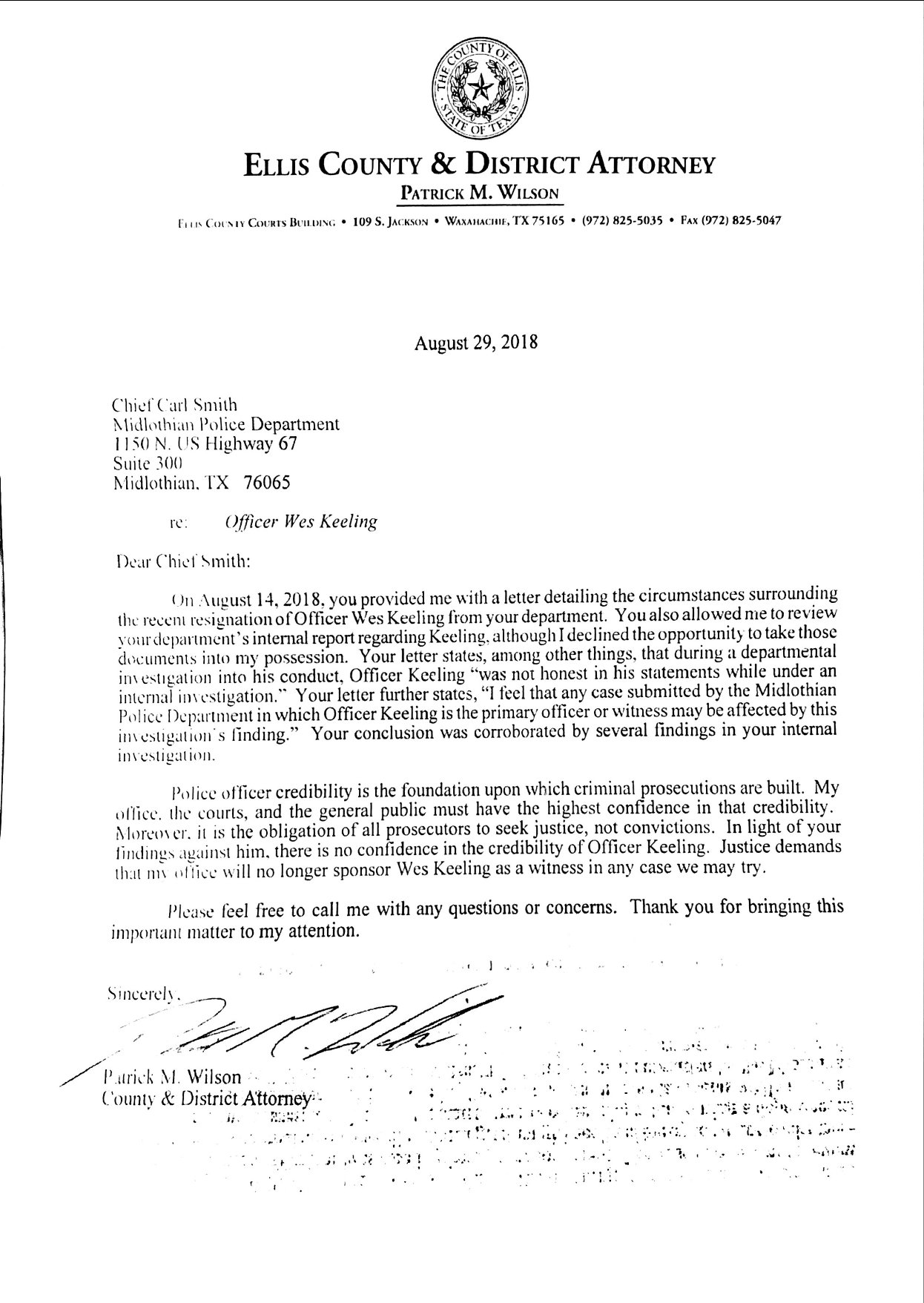
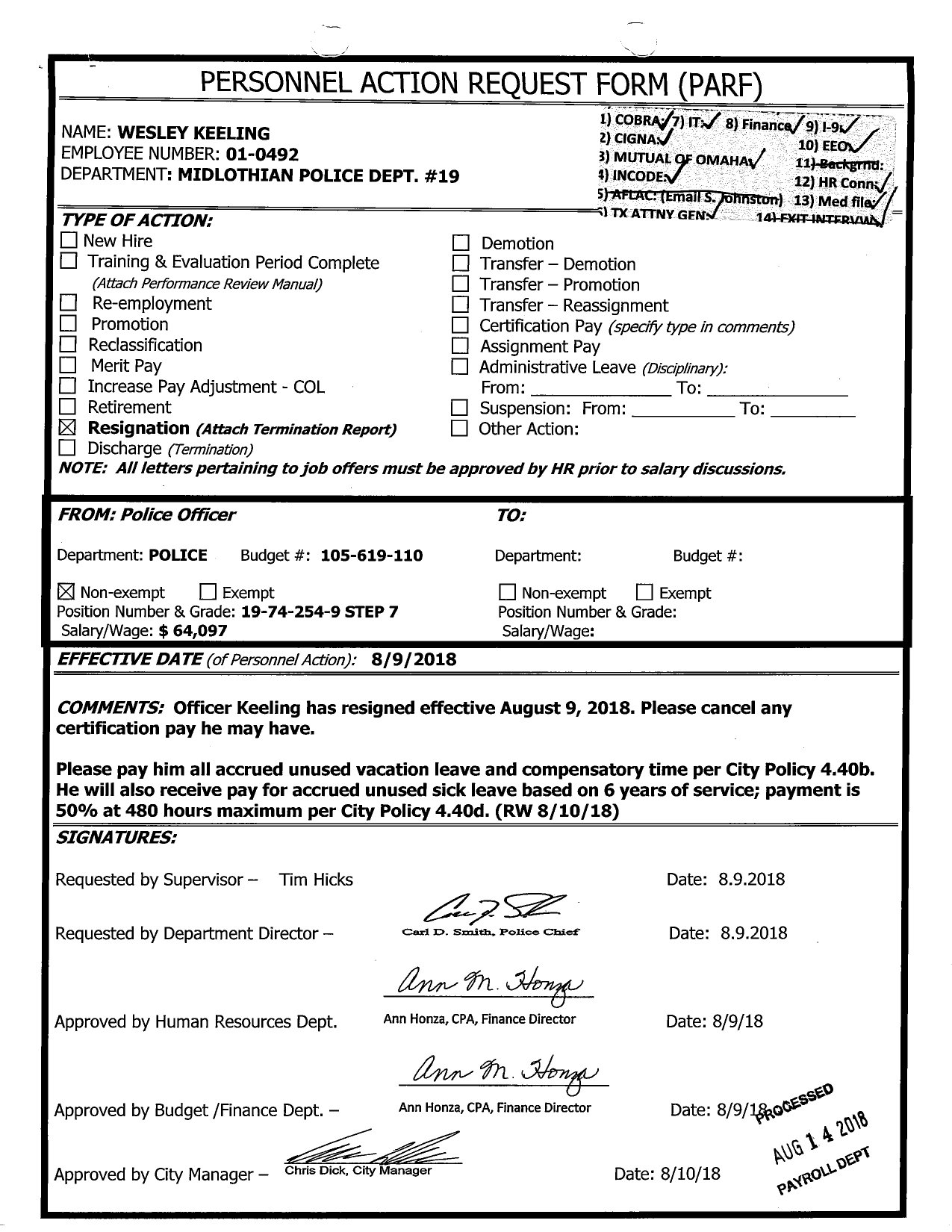
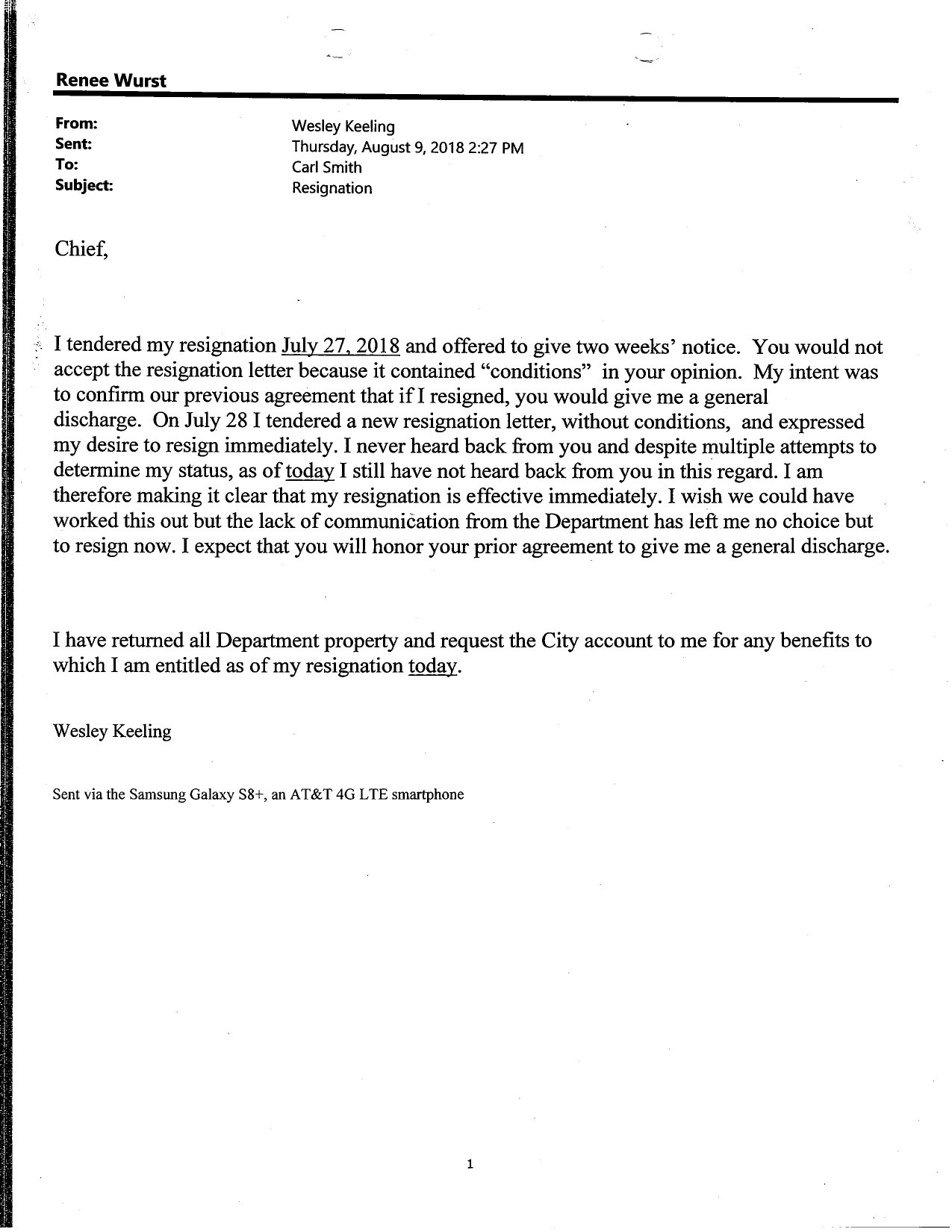
    Keeling’s July 27, 2018 resignation memorandum discussed reporting Brady-related truthfulness issues, and the resignation email exchange includes Chief Carl Smith’s response. In his August 14 letter to the Ellis County DA (page 1) and (page 2), Smith reported that Keeling was not honest during the internal investigation and warned that cases in which Keeling was a primary officer or witness might be affected. After reviewing the findings, District Attorney Patrick Wilson wrote on August 29, 2018 that there was “no confidence in the credibility of Officer Keeling” and that his office would no longer sponsor Keeling as a witness (read Wilson’s letter).

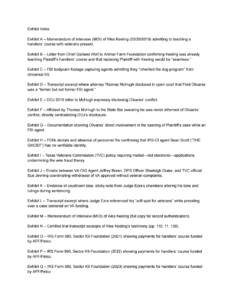
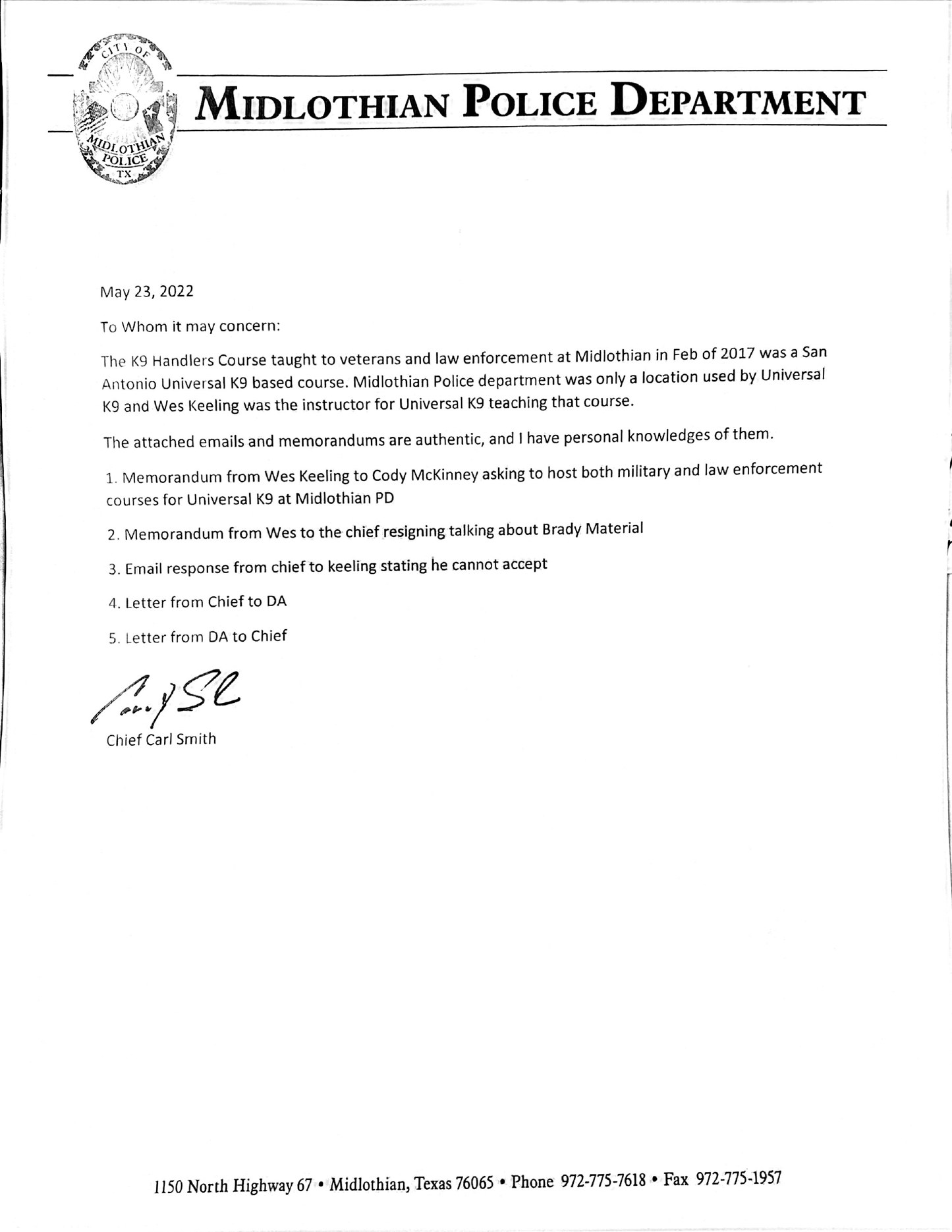
    In a signed May 23, 2022 statement, Chief Smith identified five attached emails, memoranda, and letters as authentic and said he had personal knowledge of them. That statement expressly lists the resignation and correspondence, but does not expressly list the separate 14-page internal investigation report. The documents’ existence before trial does not by itself establish when federal prosecutors or Croft’s defense obtained them.

    View the complete Keeling credibility document images

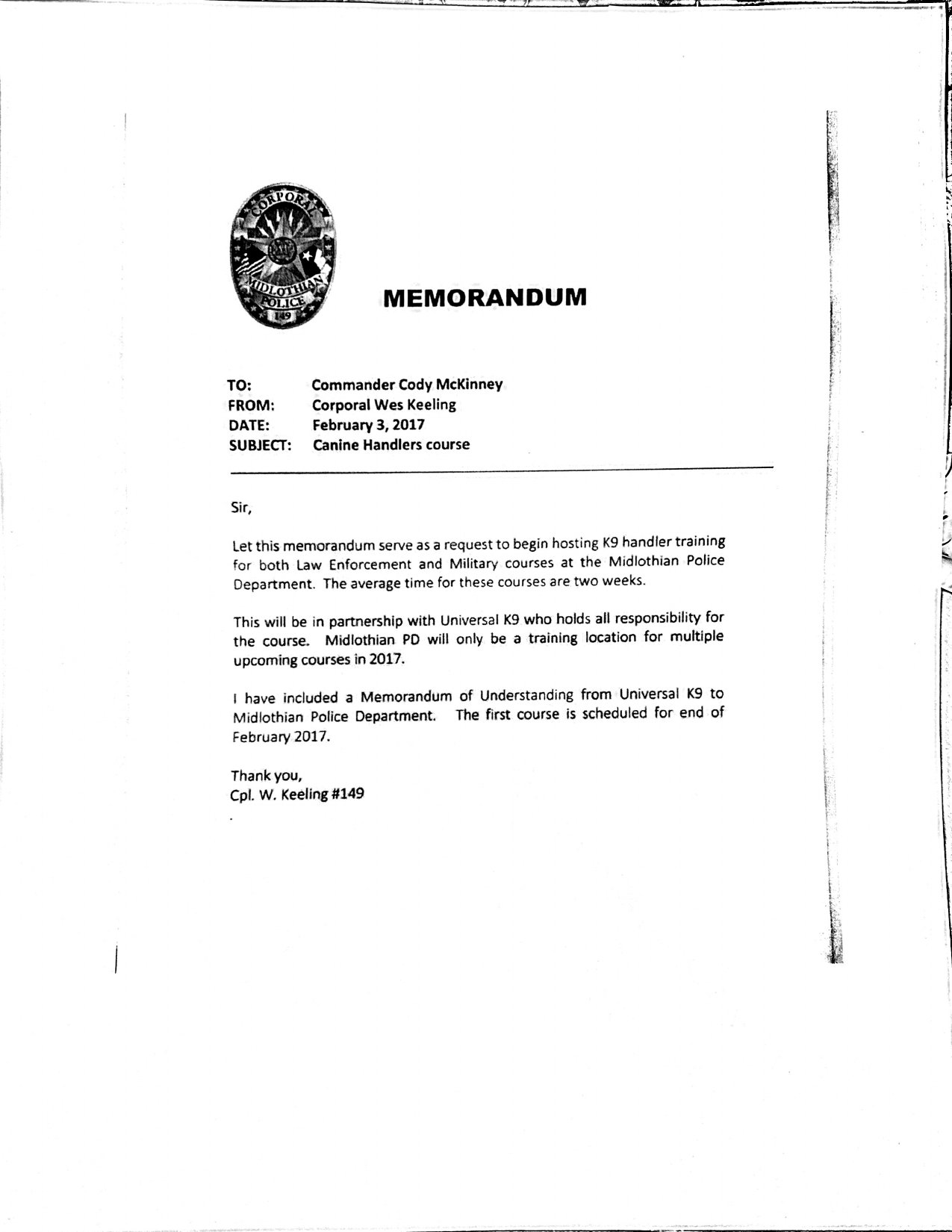
    Chief Smith’s signed statement and its attachments: authentication statement; 2017 course memorandum; resignation memorandum; email exchange; chief’s letter, page 1; chief’s letter, page 2; DA’s reply.

    Separate internal investigation report, pages 1–14: page 1; page 2; page 3; page 4; page 5; page 6; page 7; page 8; page 9; page 10; page 11; page 12; page 13; page 14.

    Additional personnel correspondence: personnel action form; August 9 email. These supplementary images are not among the five items expressly listed in Smith’s May 2022 statement.

    That credibility history does not alter the words Keeling spoke under oath about Remmie. The transcript pages let readers examine his testimony directly rather than accept anyone else’s characterization.

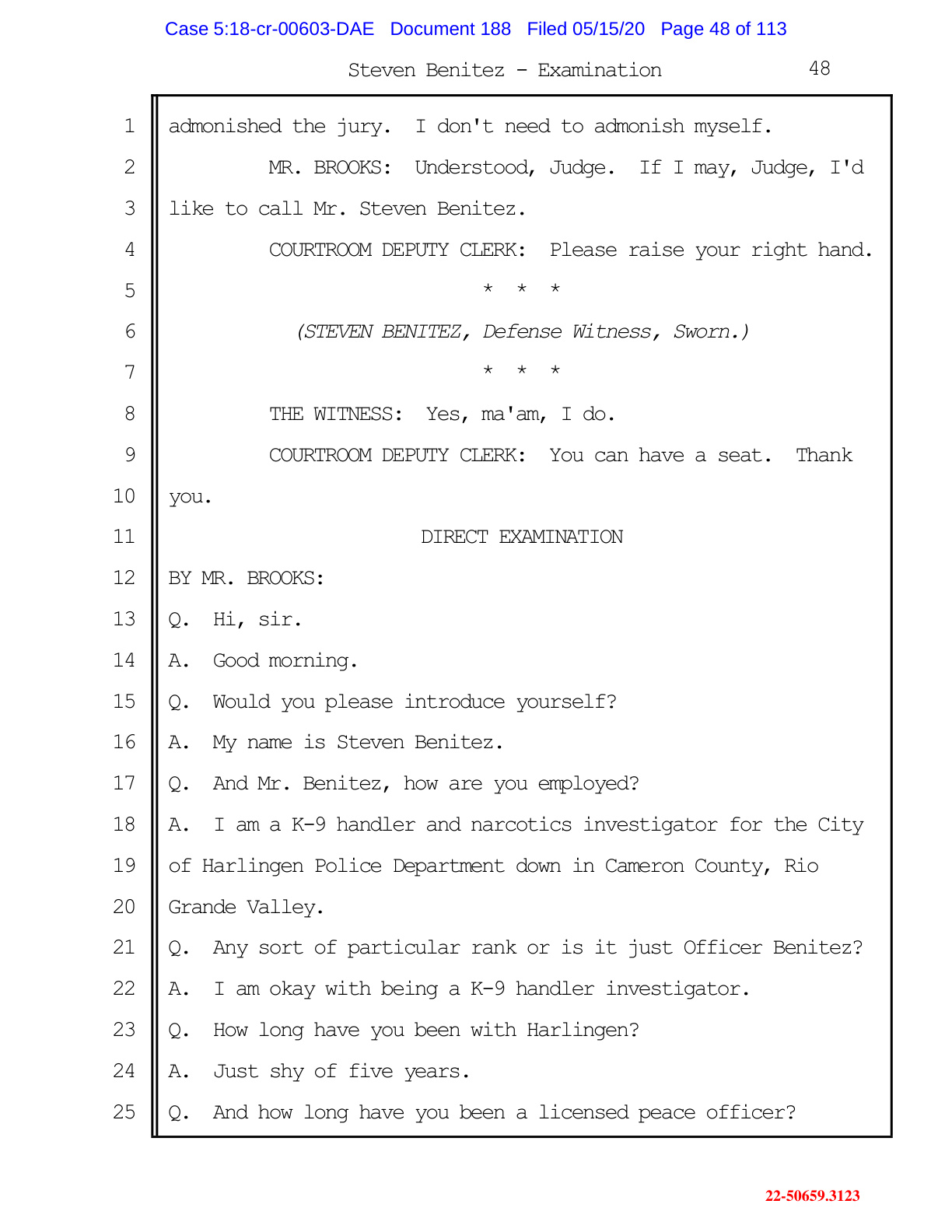
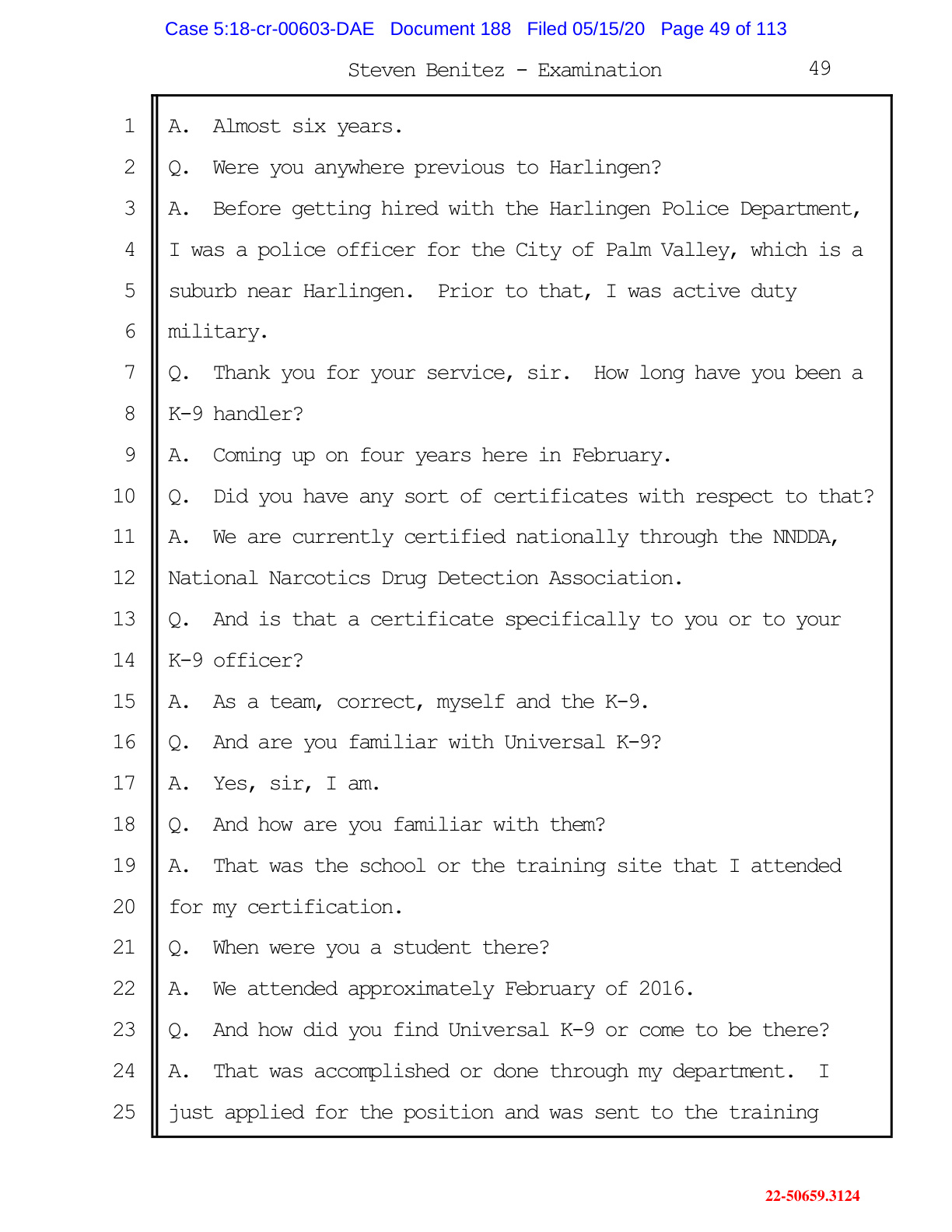
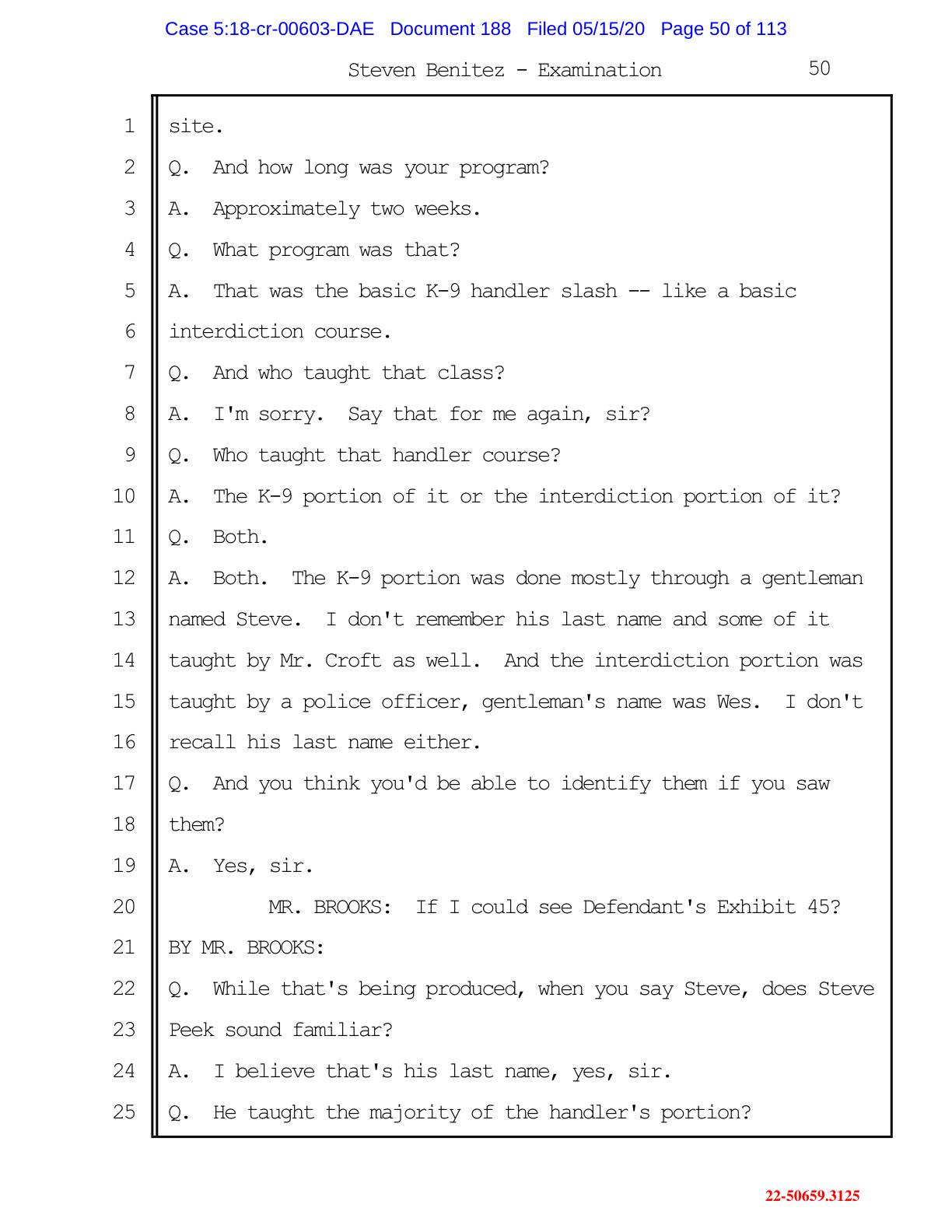
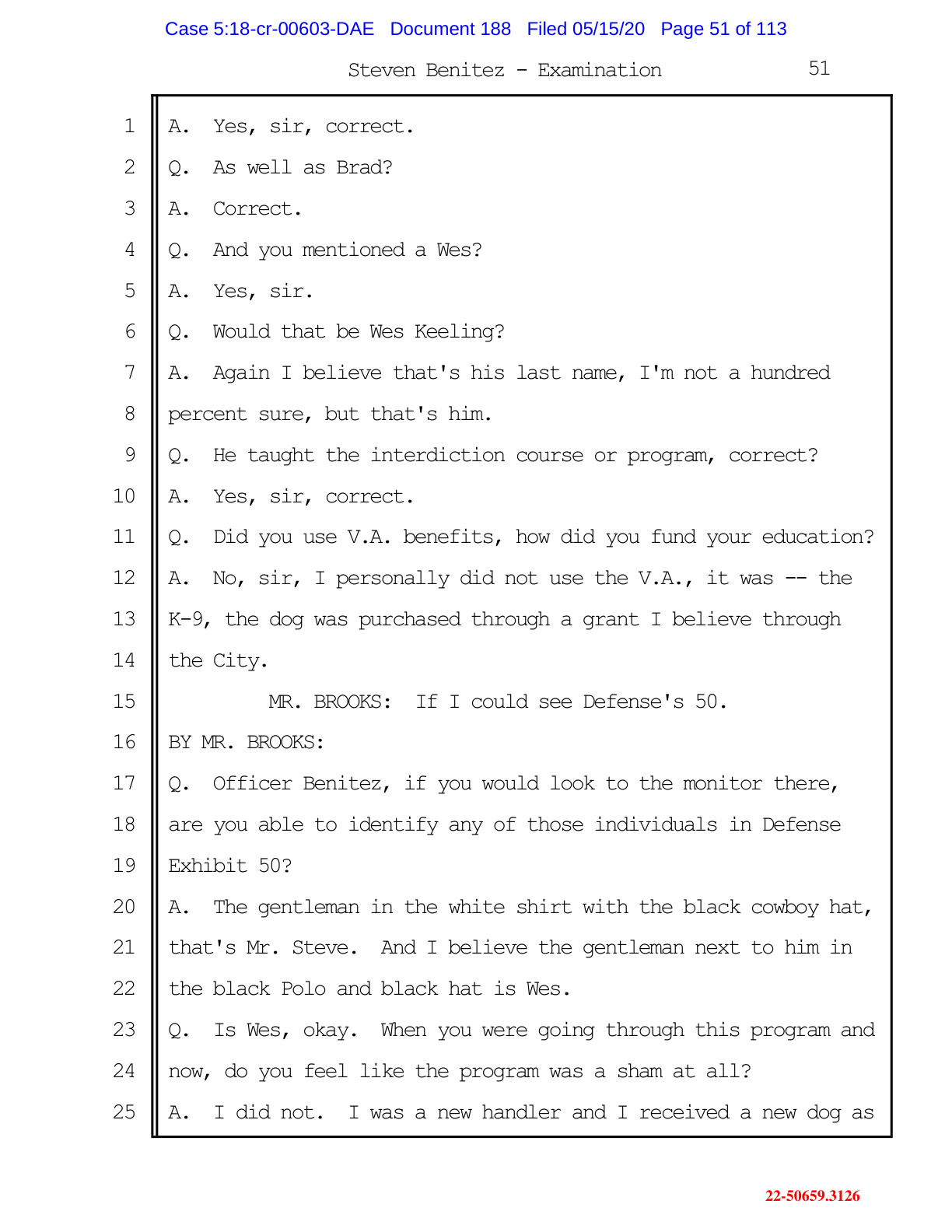
    Steven Benitez

    Defense witness · Harlingen Police Department K9 handler and narcotics investigator. Click his name to view the original trial transcript page about Katniss.

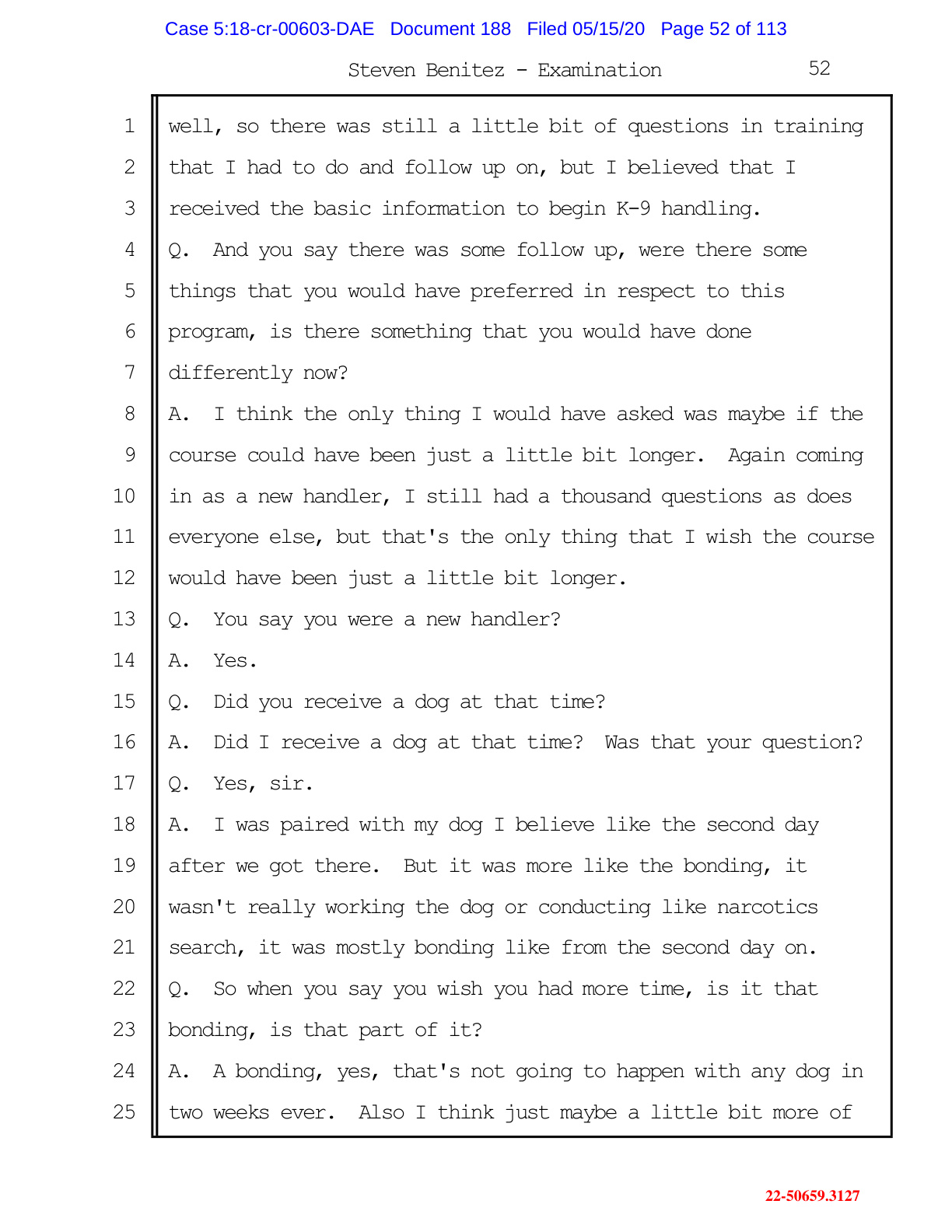
    Officer Steven Benitez testified that his department sent him to Universal K9 in approximately February 2016. He was a K9 handler and narcotics investigator and testified that he and his K9 were nationally certified through the National Narcotic Detector Dog Association.

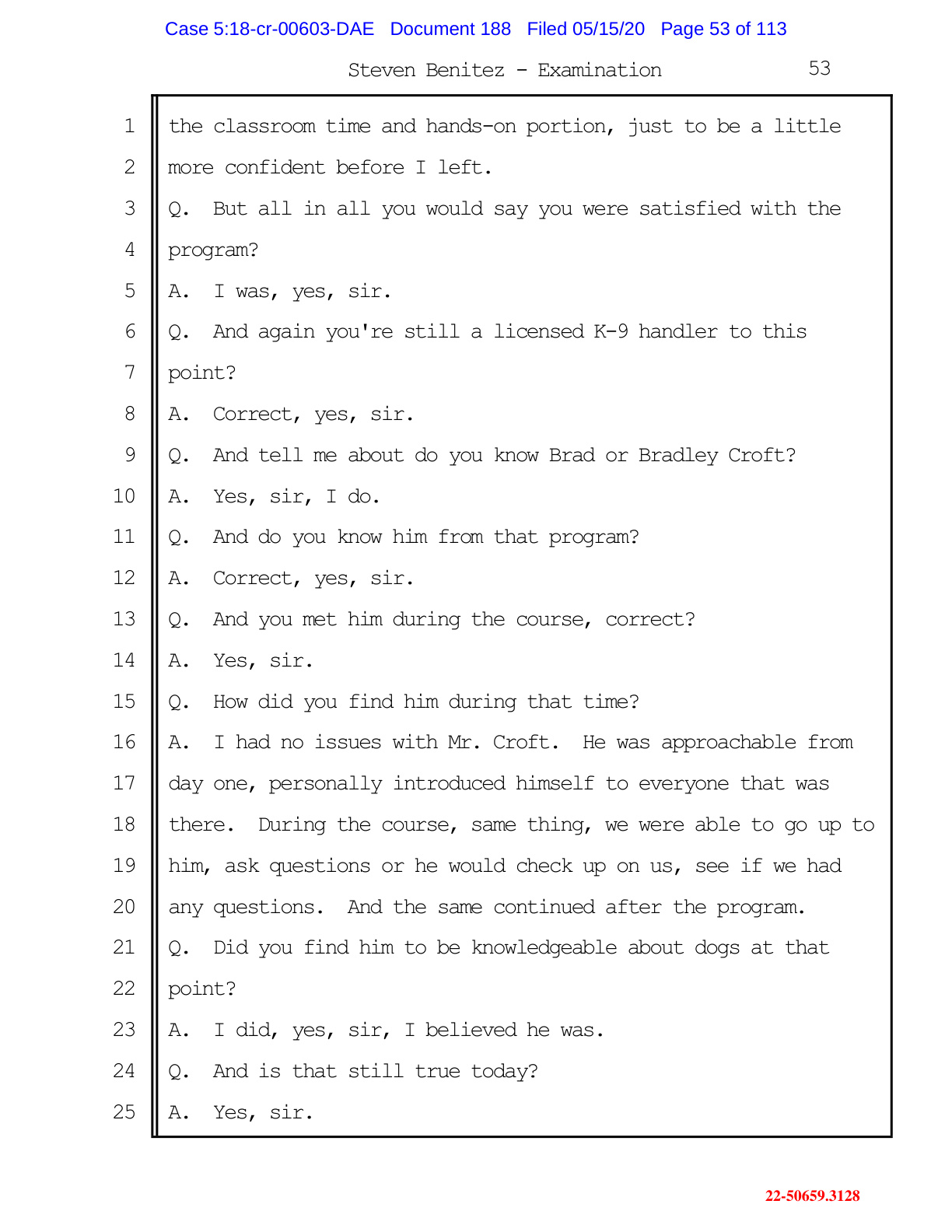
    His account was not completely uncritical. Benitez said that as a new handler he would have preferred a somewhat longer course and more classroom and hands-on time. But asked whether, all things considered, he was satisfied with the program, he answered: “I was, yes, sir.” He testified that Croft was approachable, available to students, and knowledgeable about dogs.

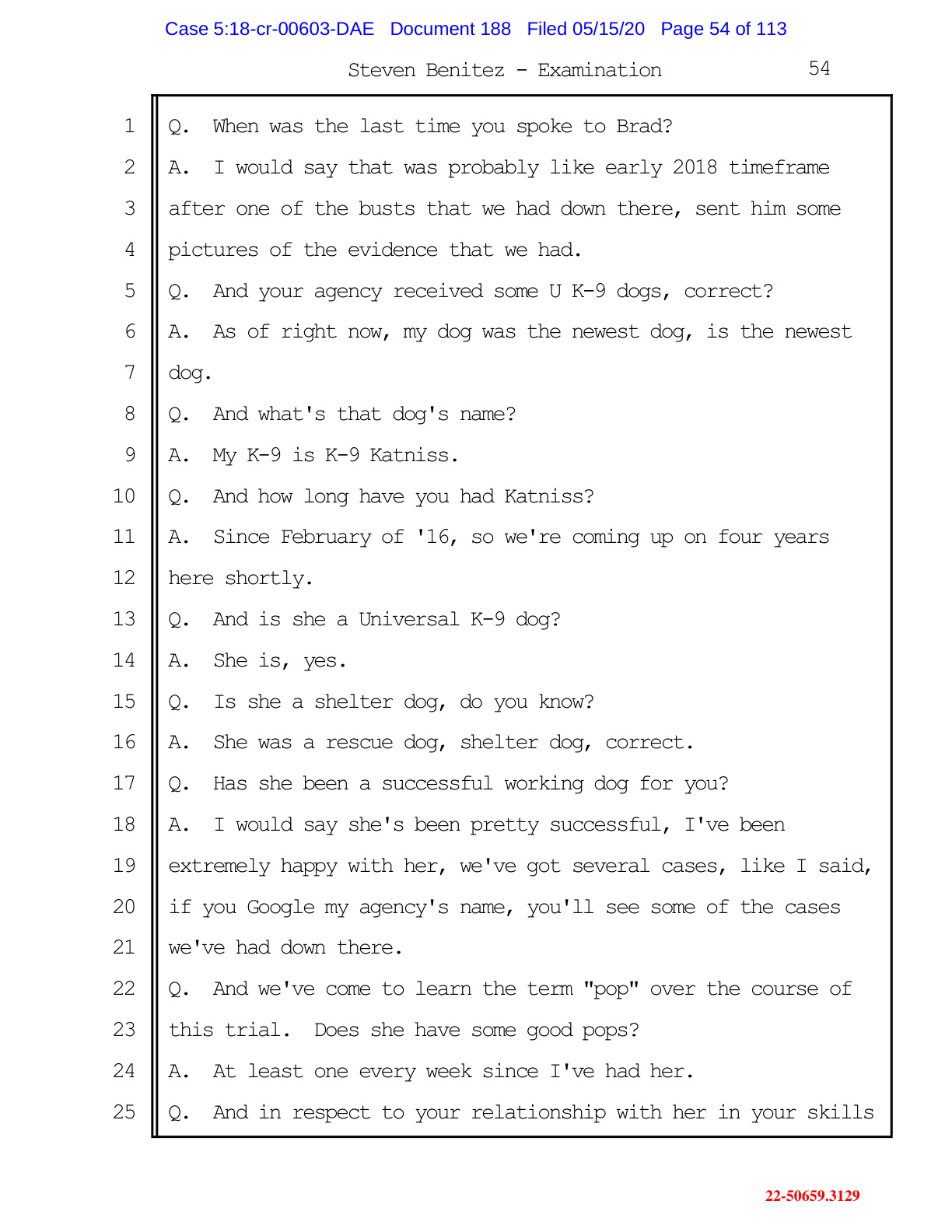
    Benitez received a rescue dog named Katniss and had worked with her for nearly four years at the time of trial. Asked whether she was a successful working police dog, he said: “I would say she’s been pretty successful, I’ve been extremely happy with her.” He described multiple cases and testified that she produced at least one successful detection “pop” per week. Read page 54.

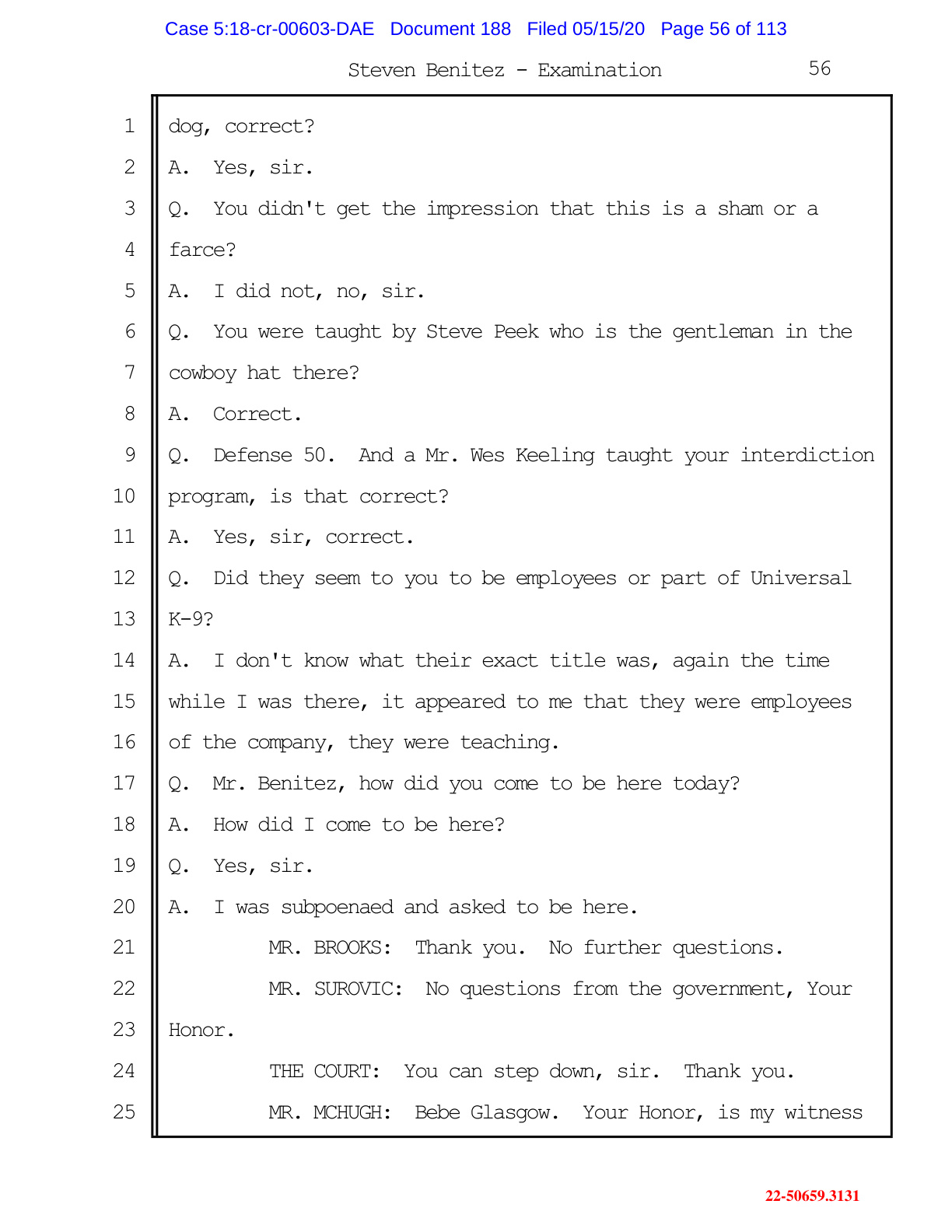
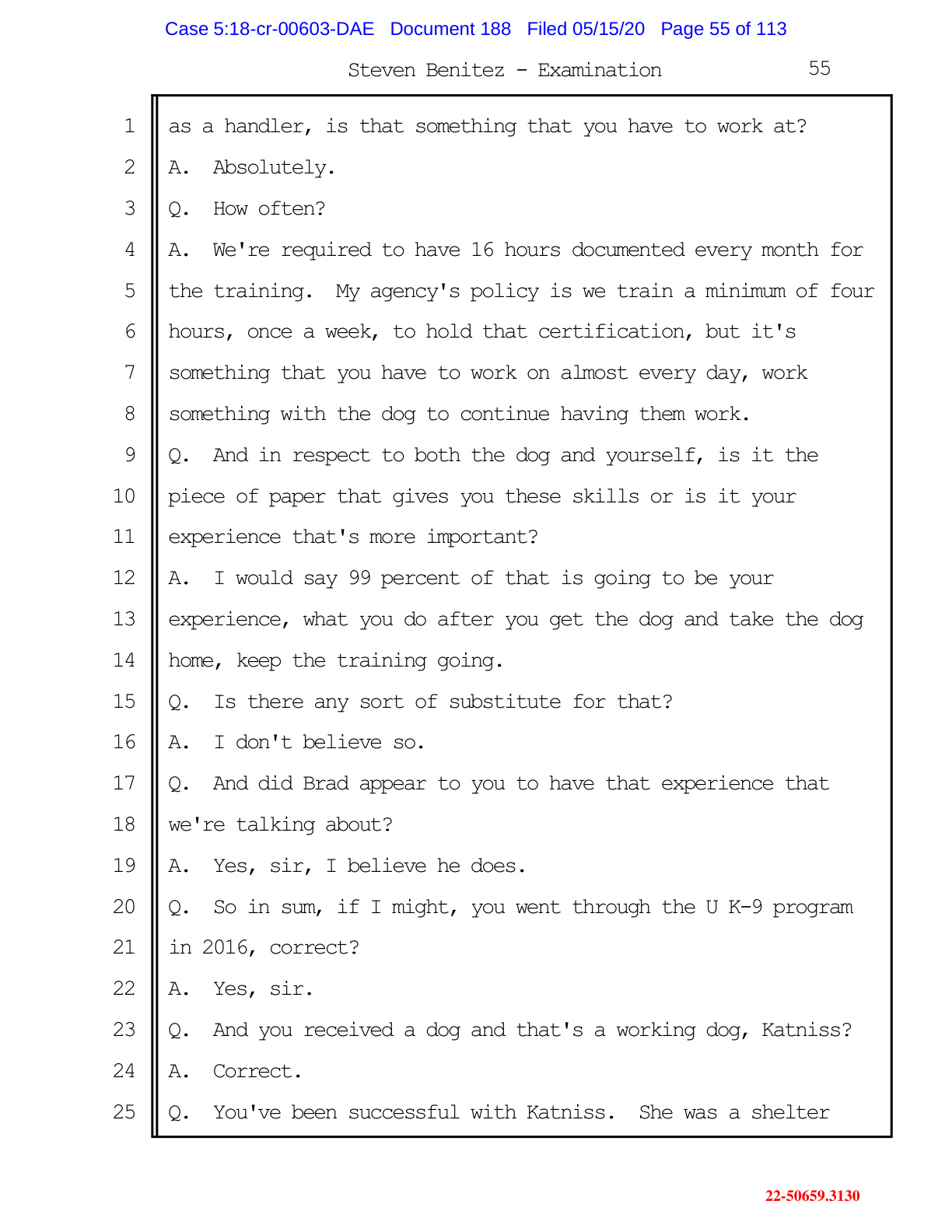
    Benitez explained that continued training and experience after receiving a dog matter greatly to a successful K9 team. Asked directly whether he considered the Universal K9 program a sham or a farce, he answered: “I did not, no, sir.” Read page 56.

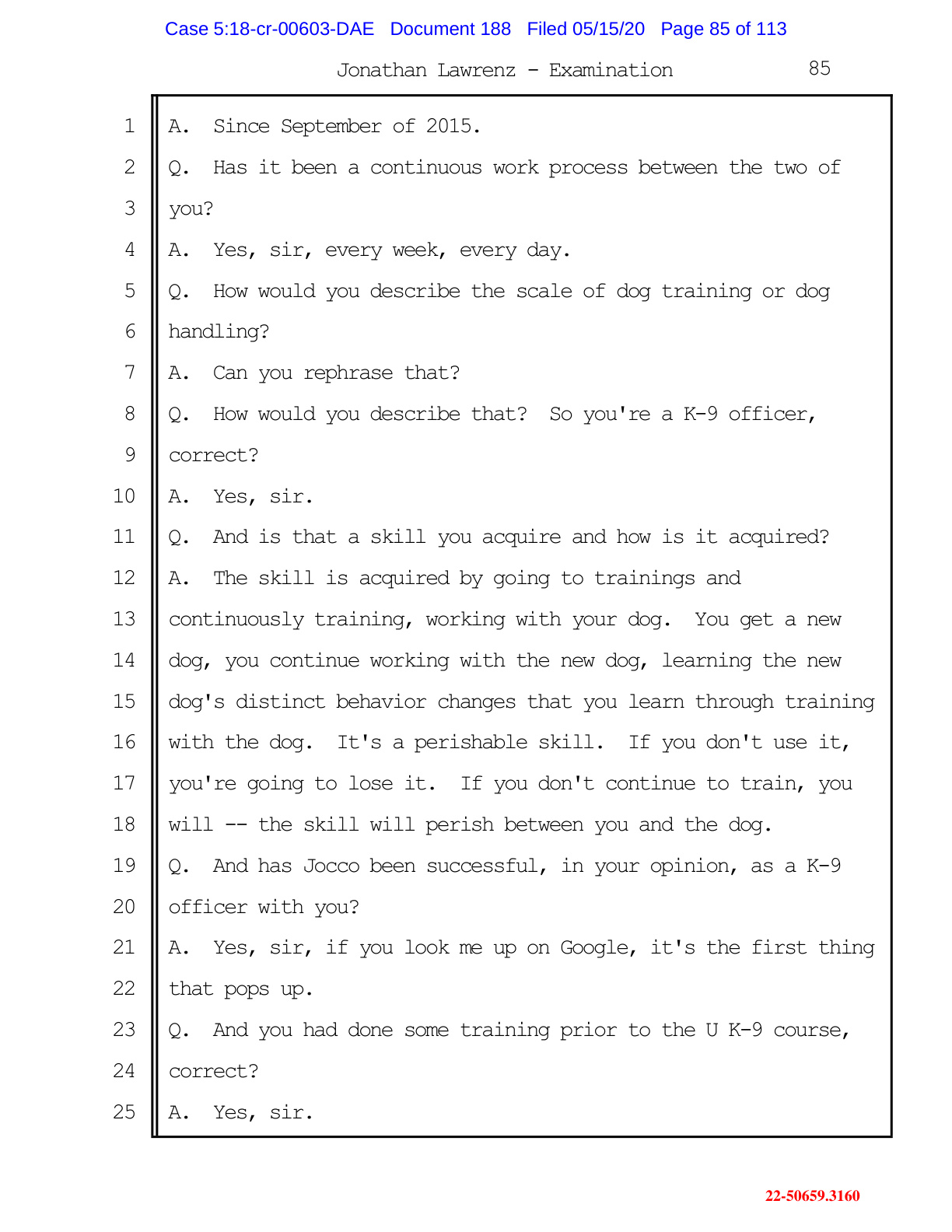
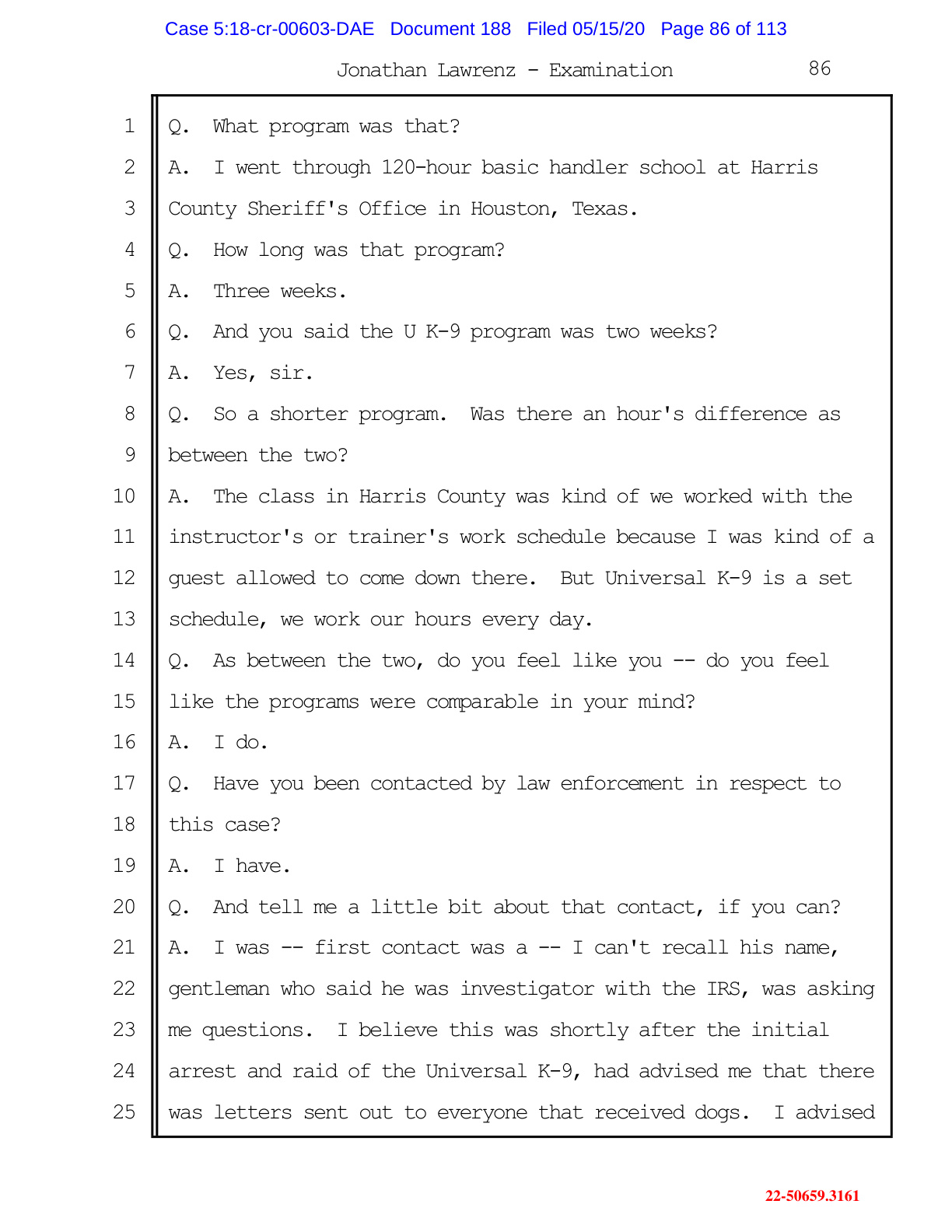
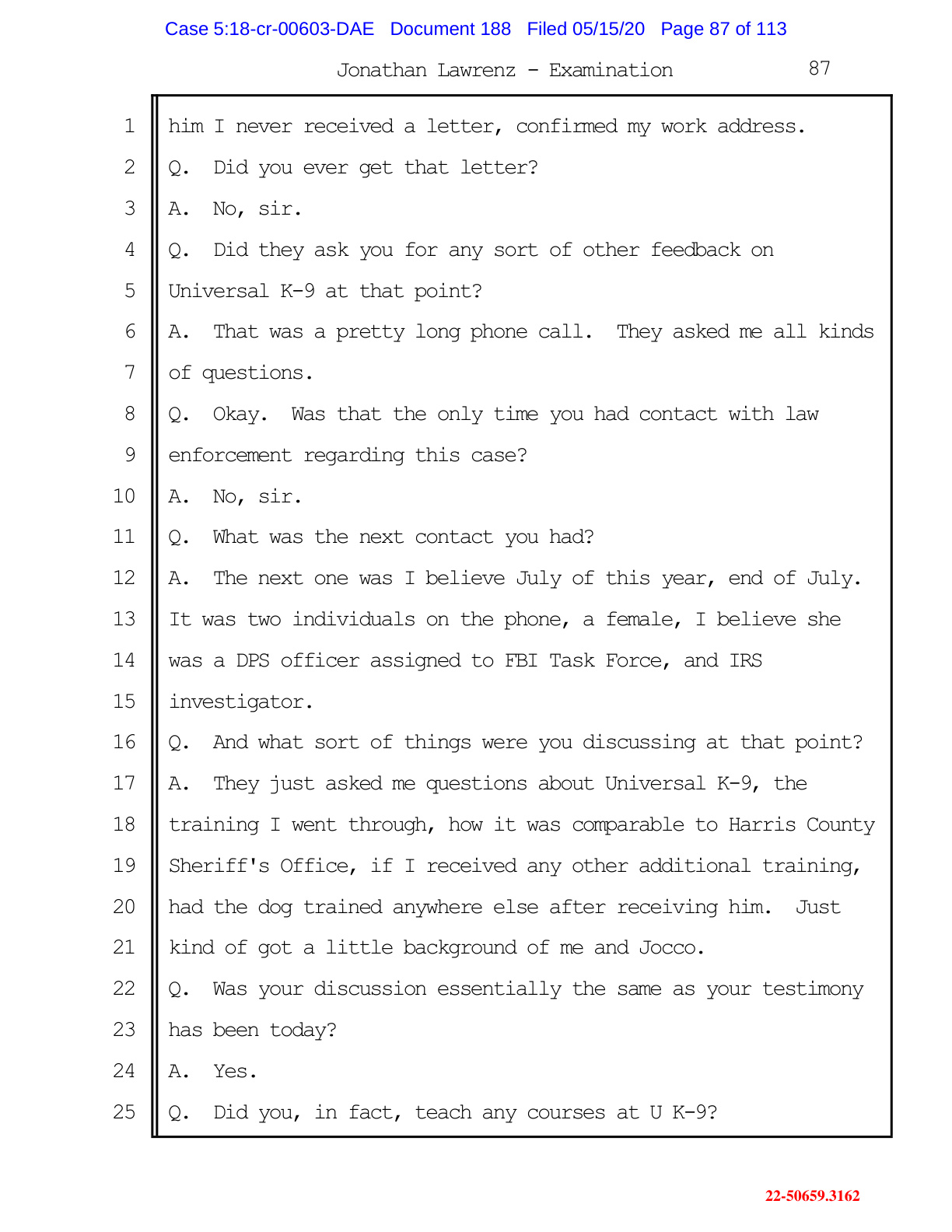
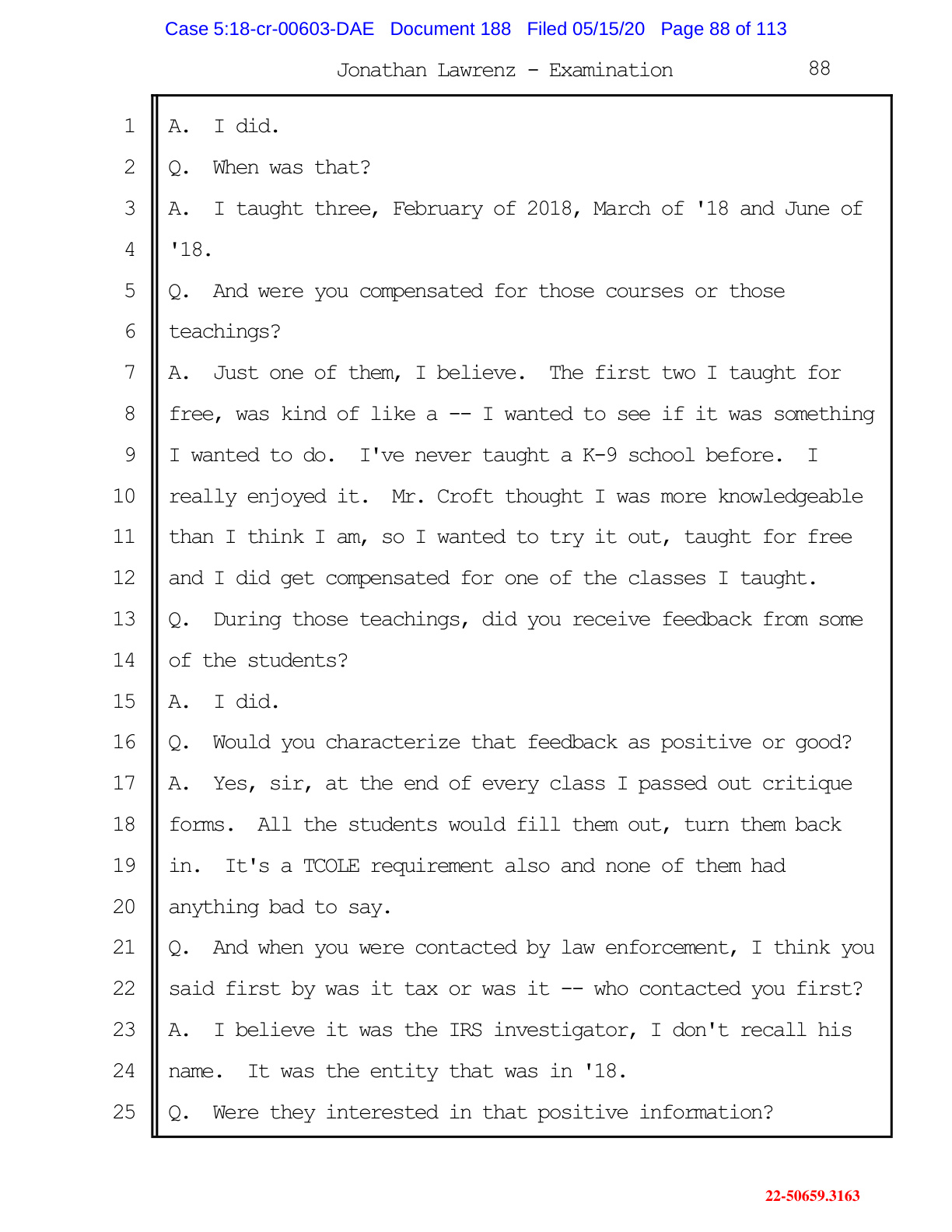
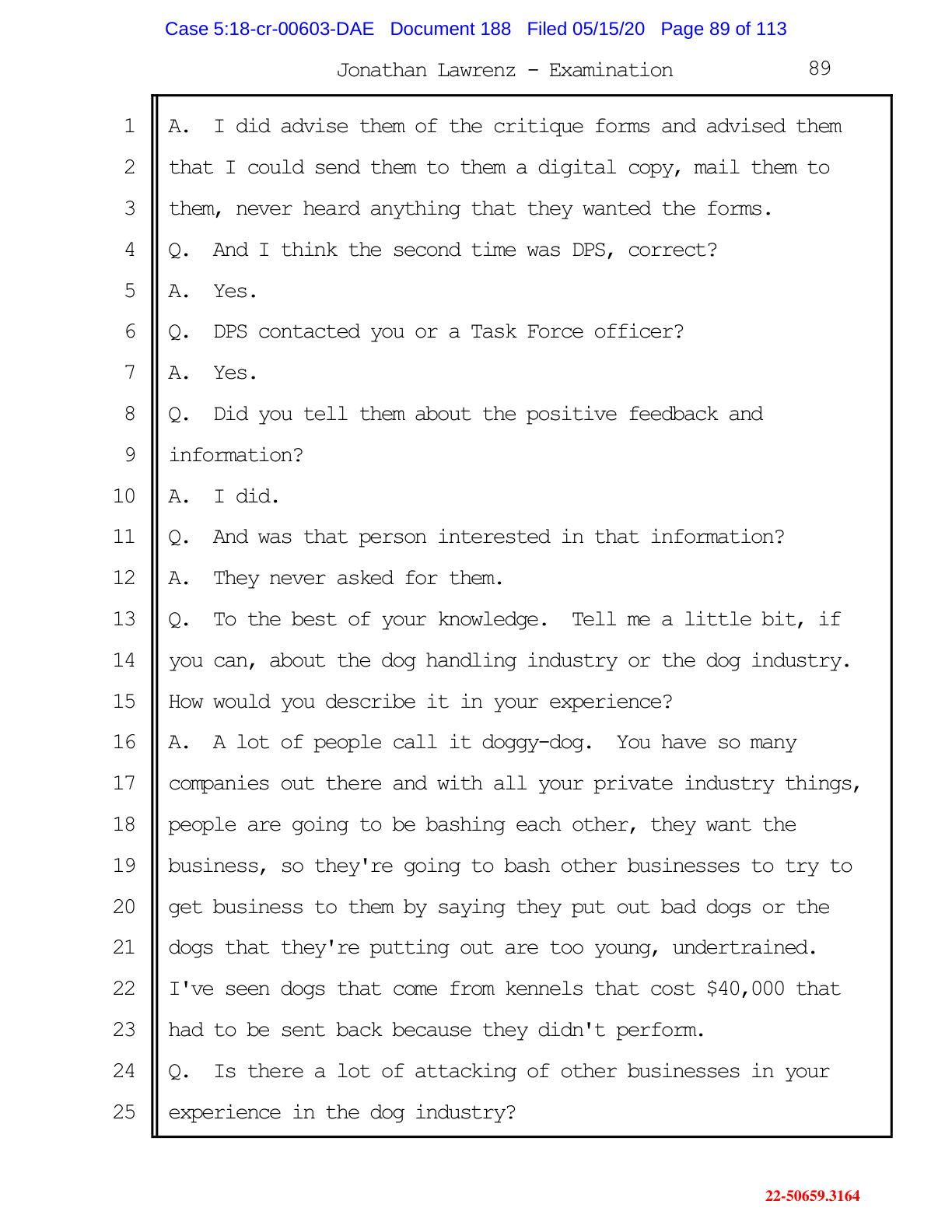
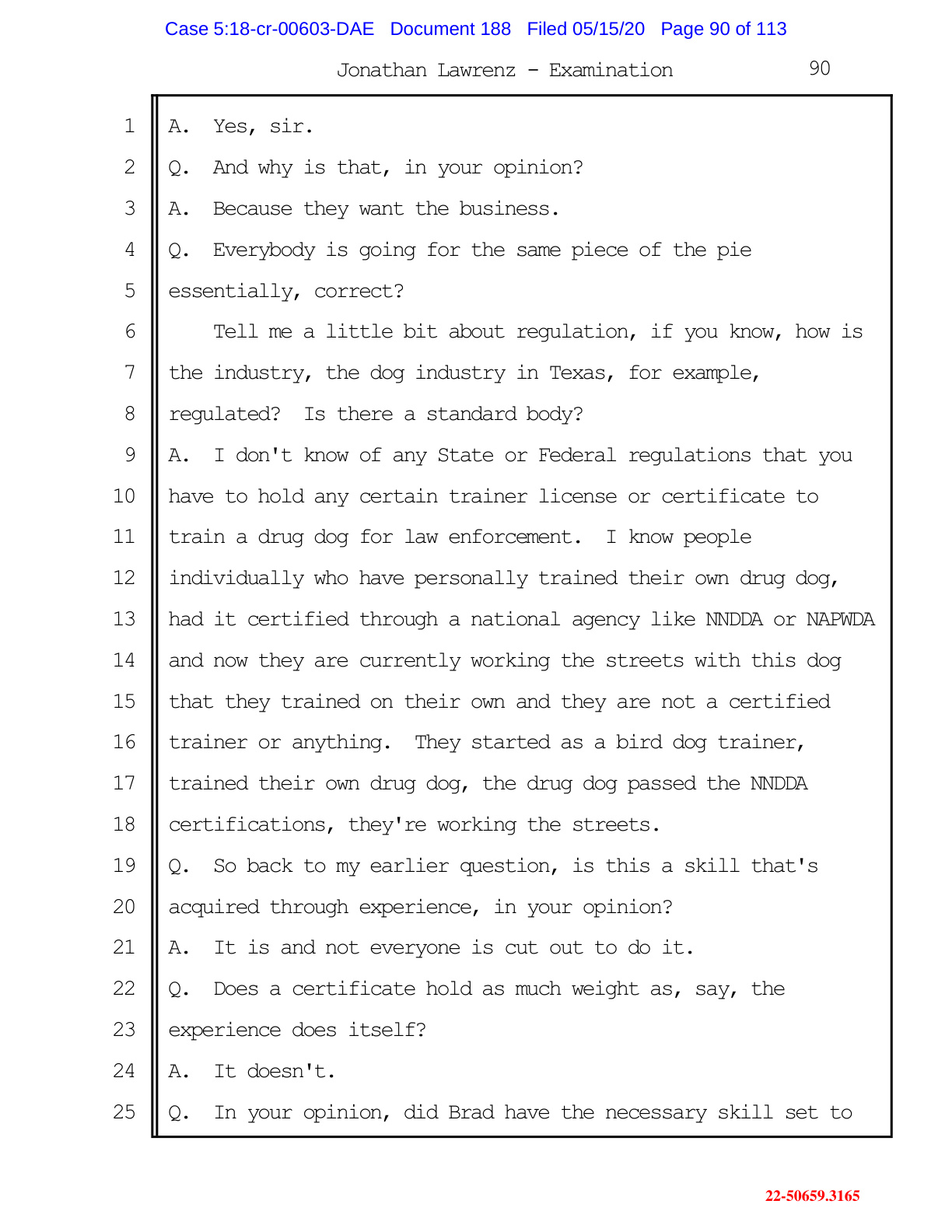
    Jonathan Lawrenz

    Defense witness · Madisonville Police Department officer and K9 handler. Click his name to view the original trial transcript page comparing the handler programs.

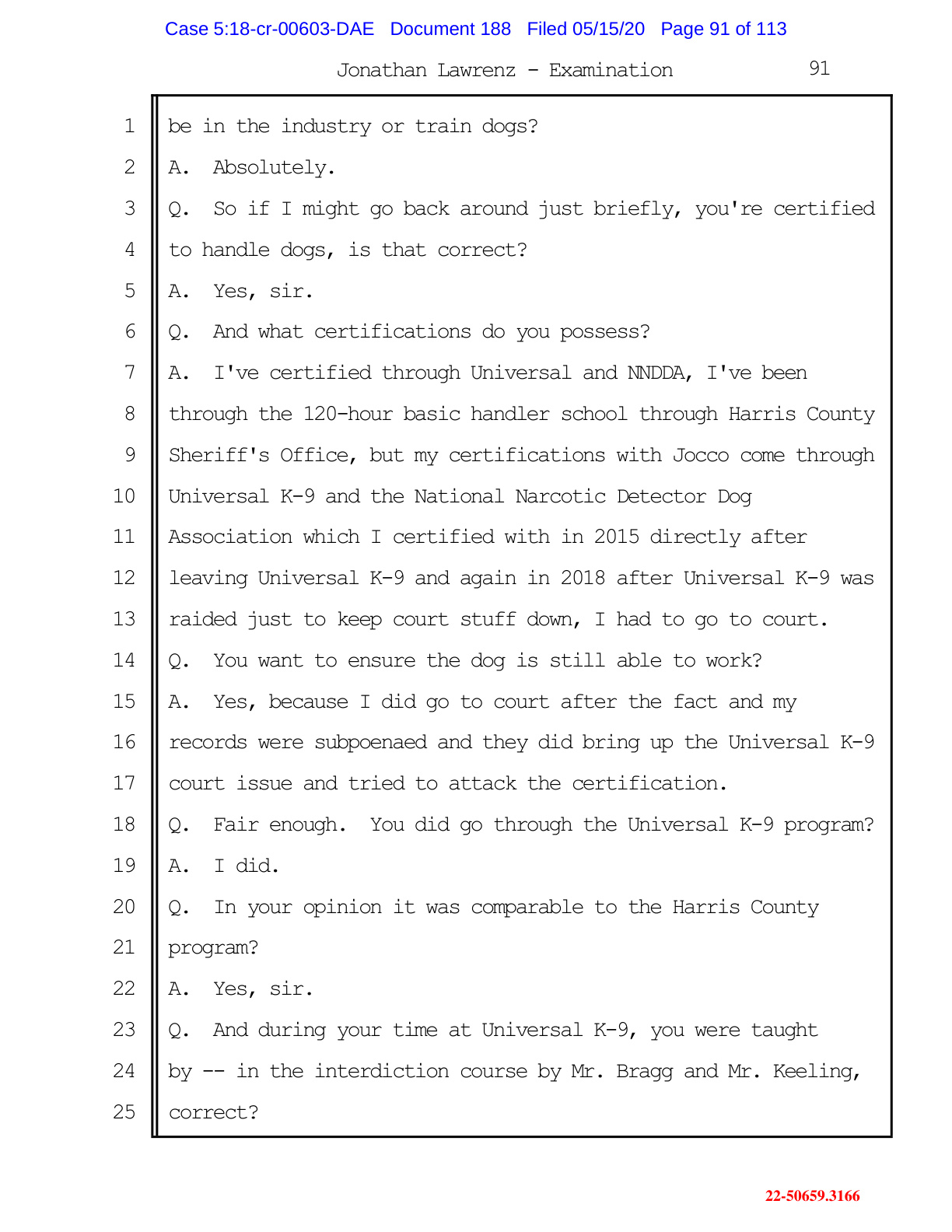
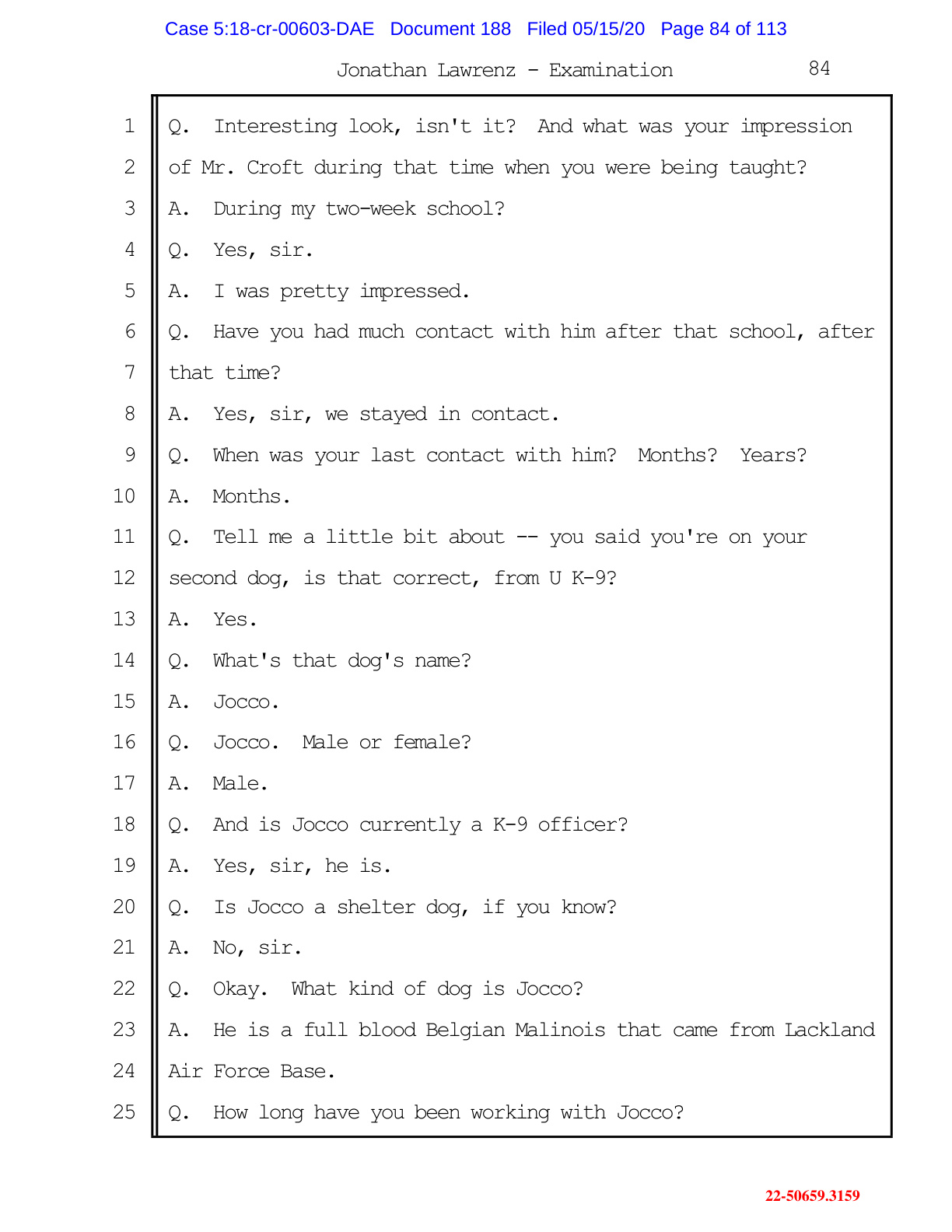
    Officer Jonathan Lawrenz testified that he received his second police K9 from Universal K9 in September 2015 and completed a two-week dual-purpose handler course. His dog, Jocco, remained a working police K9. Lawrenz testified that Jocco had been successful in police service.

    Lawrenz had attended another law-enforcement K9 program before Universal K9: a 120-hour basic handler school through the Harris County Sheriff’s Office. Asked whether Universal K9 was comparable to that program, he answered “Yes, sir.” Asked whether Croft had the skill set to work in the police-dog industry or train dogs, he answered “Absolutely.” He described certifications through Universal K9 and the National Narcotic Detector Dog Association, including later certification after the Universal K9 investigation. Read page 91.

    Lawrenz testified that he later returned to teach courses at Universal K9 and that students completed critiques following those classes; he said none had anything bad to say in those evaluations.

    The distinction matters

    The federal prosecution addressed representations connected to government approval, GI Bill funding, financial transactions, and tax reporting. A separate factual question is whether Universal K9 actually trained police officers and supplied dogs capable of doing police work. On that question, the trial record contains testimony from officers who were there.

    Government witnesses themselves described dogs that made narcotics and currency seizures, located suspects and missing children, facilitated arrests, passed later narcotics certification, and served police departments for years. Defense witnesses also described training, working K9s, later certifications, and police service.

    Those accounts do not erase the federal conviction. They provide context about what the conviction did and did not establish concerning the actual police K9 work performed by Universal K9.

    Why this record is being published

    People considering a working relationship with Universal K9 or Bradley Croft should be able to read the underlying public record rather than infer everything from a headline, a search result, or the title of a criminal case. This page distinguishes the charges actually brought from assumptions about police-dog performance and provides sworn testimony from officers who received training and dogs.

    The officer names above link to the cited pages of the federal trial transcript. The full set of JPEG pages associated with this article is linked below. Readers can see the questions and answers and evaluate the testimony for themselves.

    Read the testimony. Review the record. Draw your own conclusion.

    Transcript page archive

    These are images of selected pages from the official trial transcripts, not complete transcripts. Pages are grouped by witness; consult the complete docket for surrounding testimony and exhibits.

    Dustin Bragg — Document 185, Volume 3 (11 pages)

    page 14, page 15, page 16, page 17, page 41, page 42, page 45, page 46, page 47, page 55, page 56

    Chad Hillier — Document 186, Volume 4 (7 pages)

    page 7, page 8, page 9, page 10, page 12, page 13, page 14

    Wesley Keeling — Document 185, Volume 3 (8 pages)

    page 109, page 110, page 111, page 120, page 121, page 156, page 157, page 158

    Steven Benitez — Document 188, Volume 6 (9 pages)

    page 48, page 49, page 50, page 51, page 52, page 53, page 54, page 55, page 56

    Jonathan Lawrenz — Document 188, Volume 6 (8 pages)

    page 84, page 85, page 86, page 87, page 88, page 89, page 90, page 91

    Source note

    The records discussed on this page come from United States v. Bradley Lane Croft, No. SA-18-CR-603-DAE, United States District Court for the Western District of Texas, San Antonio Division. Sources include the Superseding Indictment at Docket Entry 39; the October 2019 bench-trial testimony later filed as Docket Entries 185, 186, and 188; and the Midlothian Police Department and Ellis County District Attorney credibility records discussed in later filings. The transcript JPEGs identify the docket entry and page on each image. Readers should consult the complete documents for full context.
  • Thomas J McHugh San Antonio: Claims, Court Rulings, and Untested Evidence

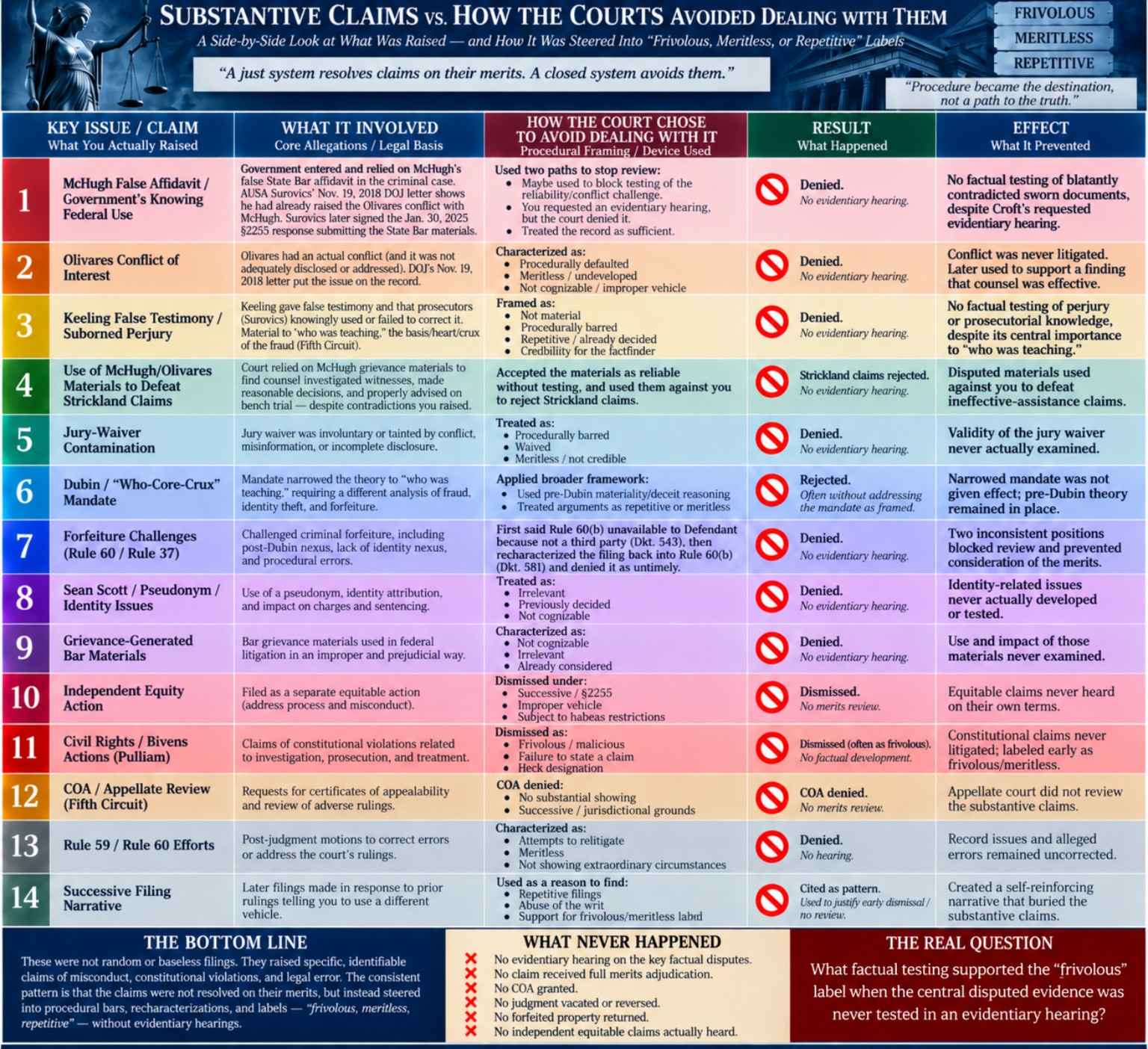
    What do the court records involving Thomas J. McHugh in San Antonio show about the issues Bradley Croft has raised since his Universal K9 criminal case? The chart below is Croft’s summary of fourteen claims and the responses he says they received across criminal, post-conviction, forfeiture, civil, and appellate proceedings. It is an advocacy chart, not a court finding or a substitute for the orders themselves.

    Chart of fourteen issues raised by Bradley Croft, his characterization of procedural rulings, and questions he identifies
    Croft’s issue map. Tap the chart to open the full-size image. The descriptions of disputed conduct and the effects of rulings express Croft’s position; consult the underlying filings and orders.

    The McHugh affidavit and the Olivares conflict letter

    One of Croft’s central allegations concerns a sworn statement by his former defense attorney, Thomas J. McHugh. Croft points to a November 19, 2018 letter from prosecutor Gregory Surovics raising a possible conflict involving defense investigator Fred Olivares. He argues that McHugh’s later account to the State Bar—that no potential conflict was brought to his attention—cannot be reconciled with that letter. McHugh’s position and the complete correspondence should be read together before making a finding about his knowledge or intent.
    Croft also objects to the government’s later use of grievance materials in his federal post-conviction litigation. His point is specific: the disputed sworn account was presented to the court while the prosecution had authored the earlier conflict letter. Croft requested factual testing, including an evidentiary hearing. The court denied relief without such a hearing. That procedural result should not be confused with a judicial finding that Croft’s accusation of knowing falsity was proved.
    What was and was not tested

    The chart groups several other questions with the McHugh issue: the scope of Olivares’s prior FBI involvement, the unserved Midlothian Police Department subpoena, Wes Keeling’s testimony, counsel’s investigation, and the October 2019 jury waiver. Croft alleges that contradictory records on these subjects were never tested through witness testimony in a post-conviction evidentiary hearing. The courts rejected his requests for relief through different procedural and substantive rulings; each claim has its own record and legal standard.

    For the subpoena issue, readers can compare Olivares’s sworn account with Paul Torres’s sworn statement. Torres says he did not handle criminal-case subpoena service. That disagreement raises a factual question; it does not by itself establish perjury or prove what the subpoena would have produced.

    The Dubin appeal and the later proceedings

    After the Supreme Court remanded the identity-theft issue in light of Dubin, the Fifth Circuit again affirmed Croft’s convictions. Its December 1, 2023 published opinion described who taught the courses as central to the fraud theory. Croft disputes whether the panel attributed a more specific “who was teaching” finding to the trial court than the trial record actually contains. The chart extends that concern to later arguments about conviction, forfeiture, and the scope of the mandate. Those are Croft’s legal positions, not rulings in his favor.

    The chart also covers separate Rule 59 and Rule 60 filings, an independent equity action, civil-rights complaints, and requests for appellate review. It compresses multiple courts and proceedings into one visual. A dismissal as untimely, a denial under a merits standard, a refusal to grant a hearing, and a “frivolous” designation have different meanings. Readers should not treat every row as if the same judge made the same ruling for the same reason.

    The question Croft asks

    Croft frames the issue this way: What factual testing supported a “frivolous” label when the central disputed evidence was never tested in an evidentiary hearing? His chart argues that procedural rulings and labels prevented examination of important contradictions. The courts’ written orders provide their reasons for denying relief. Whether those reasons were legally sufficient remains a matter for the applicable appellate process; the chart does not resolve it.

    Read the underlying record

    This article describes a litigant’s arguments and points readers to source materials. Allegations concerning McHugh, Olivares, Keeling, prosecutors, and courts remain disputed unless an identified tribunal has made the particular factual finding.

  • Talon Investigations San Antonio, TX: Fred Olivares and the Unserved Subpoena

    Fred Olivares states that he founded Talon Investigations after his FBI career and later performed investigative work for Thomas McHugh in United States v. Bradley Croft. In a sworn affidavit submitted after a grievance involving McHugh, Olivares offered an explanation for why a defense subpoena to the Midlothian Police Department was never served. A separate sworn statement from attorney Paul A. Torres raises questions about a key part of that explanation.

    What the subpoena sought

    Olivares states that the defense obtained the subpoena on November 13, 2018. It was addressed to Robin West, Midlothian Police Department’s records custodian, and requested communications concerning Wes Keeling and others. According to Olivares, it also requested Keeling’s personnel file.

    That request mattered because records concerning Keeling could have been relevant to assessing his credibility. The subpoena was not served, however, so this record does not establish what the department would have produced in response.

    Olivares’s explanation in the McHugh grievance

    In his March 28, 2022 affidavit (PDF), Olivares says he learned that Midlothian Police Department required in-person service and informed the defense team. He then describes receiving a December 12, 2018 email forwarded by Croft from Torres, who was handling a separate civil matter involving Keeling.

    Olivares says he understood that Torres was locating a local process server for the civil case. He recalls that the same person would serve the police department subpoena. He further states that Croft said he would arrange the subpoena’s service, so Olivares turned to other trial preparation.

    That is Olivares’s account. The affidavit does not identify a process server who accepted the criminal-case subpoena or provide proof that it was delivered for service.

    What Torres says

    In his sworn statement (PDF), Torres describes a different boundary between the two matters. Torres says he represented Croft in a 2019 civil lawsuit against Keeling and that a private process company served the civil citation around June 3, 2019.

    Torres also states that he and Croft never discussed service of documents or subpoenas related to the criminal charges. He says he had no contact with Croft’s criminal defense lawyers and received no request concerning the criminal case.

    Torres’s statement challenges any suggestion that Torres or his civil-case process server had agreed to handle the criminal subpoena. It does not, by itself, resolve whether Croft separately told Olivares he would arrange service through someone else. The accounts and any contemporaneous emails should be compared before reaching that conclusion.

    The unresolved question

    Croft disputes Olivares’s explanation and contends that it shifted responsibility for the unserved subpoena during the McHugh grievance. The two affidavits establish a concrete question: What instructions were actually given for serving the Midlothian Police Department subpoena, and to whom?

    A finding that Olivares knowingly made a false statement would require more than the disagreement between these affidavits. The subpoena, the December 2018 email, service instructions, and any communications with a process server are the records most likely to clarify what happened.

    Read the source documents

    For broader context, review the Fred Olivares records overview and the subpoena and defense investigator record.

  • Bill Harris DOJ: Retaliation Claims in the Public Record

    Editorial note: This article reviews and contextualizes retaliation claims raised in public records and case commentary. The claims are disputed and are not presented as established facts or final court findings.

    Bill Harris is discussed in connection with two different periods of federal prosecution involving Bradley Croft. The available case account states that Harris was involved in an earlier federal case and later attended proceedings in the Universal K9 prosecution, although he was not identified as the lead trial prosecutor.

    Why the record discusses Harris

    Croft interprets Harris’ later courtroom presence as evidence of continuing interest in his cases and raises questions about coordination within the Department of Justice. Croft characterizes that history as retaliation.

    That characterization is an allegation. Courtroom attendance, prior prosecutorial involvement, or professional contact does not by itself establish retaliation, improper coordination, or a conflict of interest. Any conclusion requires review of the docket, transcripts, correspondence, and the government’s explanation.

    Questions presented by the record

    The record raises questions about what role Harris had during the later proceedings, whether his earlier involvement was disclosed or relevant, and whether communications show a connection between the two matters. Those questions should be answered through identified documents rather than inference alone.

    This archive distinguishes unresolved questions and attributed allegations from established judicial findings.

    Review the record

  • William Brooks San Antonio: Co-Counsel Conflict Record

    Editorial note: This article reviews disputed events and defense-performance allegations described in public records and case materials. It does not state that professional misconduct has been established by a court or disciplinary authority.

    William Brooks appears in the Universal K9 case record as a member of Bradley Croft’s defense team. This article examines Brooks’ role in the handling of witness issues, challenges to the government’s theory, and the defense response to potential conflicts.

    Defense-team role

    Croft’s post-trial account argues that Brooks did not raise objections or pursue motions that Croft later considered important to the defense. It also connects Brooks to the defense team’s handling of questions involving Fred Olivares, Thomas J. McHugh, and witness Wes Keeling.

    Those criticisms reflect Croft’s post-trial position. A decision not to file a particular motion or objection can involve legal strategy, available evidence, and counsel’s division of responsibilities. The record does not, by itself, establish why Brooks acted or did not act in a particular way.

    The subpoena and witness record

    The available case materials discuss an issued subpoena for Keeling that was not served. They raise questions about which member of the defense team was responsible for service and whether Keeling’s anticipated testimony was adequately investigated before trial. Later accounts concerning that subpoena are disputed.

    Readers should compare those allegations with the subpoena record, affidavits, court filings, and any available response from Brooks or other participants.

    Review the records

  • Gregory Surovics: Prosecutorial Record in the Universal K9 Case

    Editorial note: This article reviews allegations and disputed events described in public records and case materials. Statements about individuals are attributed claims unless independently established by a final court finding.

    Gregory Surovics served as a federal prosecutor in the Universal K9 case. This record review focuses on two subjects connected with his role: a 2018 letter addressing a possible defense-team conflict and later disputes about witness Wes Keeling’s statements.

    The 2018 letter concerning Fred Olivares

    A November 2018 letter from Surovics to defense counsel Thomas J. McHugh discussed Fred Olivares’ prior relationship with an agent involved in the investigation and identified a possible conflict issue. Later filings dispute how the defense handled that information and whether additional court review was required.

    The existence of a conflict-related letter does not itself establish that Surovics concealed information or committed misconduct. Those are arguments advanced in later filings and should be evaluated against the letter, the docket, and any response from the government.

    Keeling interview and testimony dispute

    Later filings also challenge the consistency of statements attributed to Wes Keeling in an interview memorandum and at trial. Croft’s filings contend that emails and other records conflicted with portions of Keeling’s account and argue that the prosecution knew or should have known of those conflicts.

    Those contentions are allegations made in post-trial litigation. This archive does not present the phrase “suborned perjury” as an adjudicated fact unless a court has made that finding.

    Review the underlying record

  • Fred Olivares San Antonio: Subpoena and Defense-Investigator Record

    Editorial note: This article reviews disputed events described in public records and case materials. Statements about individuals are attributed claims unless independently established by a final court finding.

    Fred Olivares San Antonio archive image

    Fred Olivares is discussed in the Universal K9 case record because of his prior federal law-enforcement service and his later work with the defense team. The available records describe him as a former FBI supervisor who subsequently served as a defense investigator.

    The 2018 conflict letter

    The public record includes a November 2018 letter from the U.S. Attorney’s Office to defense counsel Thomas J. McHugh concerning a possible conflict involving Olivares. The materials describe Olivares’ prior professional proximity to an agent involved in the investigation. Whether that history created a legally disqualifying conflict remains a disputed question; the letter and the surrounding record should be read directly.

    The subpoena record

    The available records also address a subpoena sought for witness Wes Keeling. The record includes an issued subpoena that was not served and a later affidavit from Olivares addressing how service was expected to occur. Croft disputes that account and argues that the subpoena history should be evaluated alongside the defense team’s responsibilities and his release restrictions.

    Those materials raise questions about communication, responsibility for service, and whether the witness evidence was adequately tested. They do not, standing alone, establish intentional misconduct by any person.

    Review the records

  • Media Coverage of Brad Croft San Antonio and Universal K9

    Editorial note: This article reviews allegations and disputed events described in identified public records and source documents. Statements about individuals should be read as attributed claims unless independently established by a final court finding.

    The story of Brad Croft San Antonio is gaining visibility across multiple platforms. These mentions build the record of truth and strengthen the reach of documented evidence. Below is a collection of published coverage.

    Substack Coverage

    Substack Brad Croft Checkmate DOJ

    LinkedIn Coverage

    Why It Matters

    While the DOJ and local outlets leave outdated headlines untouched, these Substack posts are alive, updated, and supported by affidavits, filings, and FOIA records. This list will continue to expand as coverage grows across Substack, LinkedIn, Medium, and other platforms.

    A separate public records archive has been established compiling
    court filings, timelines, and source documents related to
    Thomas J. McHugh in San Antonio.

    Archive:

    Thomas J. McHugh – Public Records & Source Documents (San Antonio)

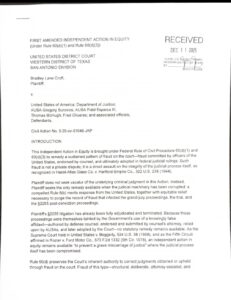
  • Thomas J. McHugh Named in Federal Equity Case

    Editorial note: This article reviews allegations and disputed events described in identified public records and source documents. Statements about individuals should be read as attributed claims unless independently established by a final court finding.

    Thomas J. McHugh San Antonio

    If you search online for a U.S. federal criminal defense lawyer or a former federal prosecutor turned defense attorney, you will likely come across Thomas J. McHugh of San Antonio, Texas.


    But a newly filed federal equity lawsuit names McHugh as a defendant — not as a lawyer defending a client, but as a central figure accused of helping place false information into a federal court record.

    This case does not argue guilt or innocence in a criminal matter. It asks a federal court to address something much more serious: whether the justice system itself was misled.

    WHAT IS THIS CASE ABOUT? (PLAIN ENGLISH)

    The lawsuit alleges that:

    • McHugh knew about a conflict involving a former FBI agent tied to the case
    • Despite that knowledge, a sworn affidavit was later submitted denying any conflict
    • That affidavit was used by federal prosecutors
    • And it was relied on by a federal judge

    When sworn statements known to be false are used in court, federal law calls that “fraud on the court.” This is not a technical mistake — it is considered a serious attack on the integrity of the judicial process.

    WHY THIS IS DIFFERENT FROM NORMAL APPEALS

    Most post-conviction cases argue legal errors.

    This one does not.

    It was filed as an Independent Action in Equity, a rare type of case used only when normal remedies are no longer available and the court itself may have relied on false information.

    In simple terms: the claim is that the court was misled, and equity is the only way to fix it.

    WHY THIS MATTERS TO ANYONE HIRING A FEDERAL DEFENSE LAWYER

    McHugh publicly markets himself as:
    • A federal criminal defense lawyer
    • A former federal prosecutor
    • A lawyer handling white-collar and federal fraud cases nationwide

    Those credentials matter — which is exactly why the allegations matter too.

    If proven, the conduct described in the lawsuit would raise serious questions about ethics, honesty, and trust, all of which are critical when someone’s freedom is on the line.

    WHAT HAPPENS NEXT

    The case requires the United States to respond on the merits — meaning the allegations must be admitted or denied, not avoided.

    That alone makes this filing unusual and important.

    No conclusions have been reached yet. But the allegations are now part of the public federal record.

    BOTTOM LINE

    This isn’t legal drama. It is a serious federal case asking whether false sworn statements were allowed to shape a court’s decisions.

    When that question is raised, everyone should pay attention — especially those searching for a federal criminal defense lawyer they can trust.

  • Thomas J. McHugh – Public Record Timeline (San Antonio)

    Overview

    This timeline organizes publicly available records and filings in chronological order. Entries are added as documents are identified and verified from primary sources.

    February 2026

    Initial archive structure established. Public records and source documents identified for review and publication.

    February 9, 2026 — Archive initiated.
    Public record collection process formally began. Initial court filings, correspondence, and source documents identified for verification and publication.

    February 10, 2026 — Initial document inventory.
    Court filings, correspondence, and related records were reviewed and categorized for verification and staged release.

    Exhibit F — Bench trial proceedings transcript (Oct. 8, 2019) added to Source Documents.