Category: Uncategorized

  • Bill Harris DOJ: Retaliation Claims in the Public Record

    Editorial note: This article reviews and contextualizes retaliation claims raised in public records and case commentary. The claims are disputed and are not presented as established facts or final court findings.

    Bill Harris is discussed in connection with two different periods of federal prosecution involving Bradley Croft. The available case account states that Harris was involved in an earlier federal case and later attended proceedings in the Universal K9 prosecution, although he was not identified as the lead trial prosecutor.

    Why the record discusses Harris

    Croft interprets Harris’ later courtroom presence as evidence of continuing interest in his cases and raises questions about coordination within the Department of Justice. Croft characterizes that history as retaliation.

    That characterization is an allegation. Courtroom attendance, prior prosecutorial involvement, or professional contact does not by itself establish retaliation, improper coordination, or a conflict of interest. Any conclusion requires review of the docket, transcripts, correspondence, and the government’s explanation.

    Questions presented by the record

    The record raises questions about what role Harris had during the later proceedings, whether his earlier involvement was disclosed or relevant, and whether communications show a connection between the two matters. Those questions should be answered through identified documents rather than inference alone.

    This archive distinguishes unresolved questions and attributed allegations from established judicial findings.

    Review the record

  • William Brooks San Antonio: Co-Counsel Conflict Record

    Editorial note: This article reviews disputed events and defense-performance allegations described in public records and case materials. It does not state that professional misconduct has been established by a court or disciplinary authority.

    William Brooks appears in the Universal K9 case record as a member of Bradley Croft’s defense team. This article examines Brooks’ role in the handling of witness issues, challenges to the government’s theory, and the defense response to potential conflicts.

    Defense-team role

    Croft’s post-trial account argues that Brooks did not raise objections or pursue motions that Croft later considered important to the defense. It also connects Brooks to the defense team’s handling of questions involving Fred Olivares, Thomas J. McHugh, and witness Wes Keeling.

    Those criticisms reflect Croft’s post-trial position. A decision not to file a particular motion or objection can involve legal strategy, available evidence, and counsel’s division of responsibilities. The record does not, by itself, establish why Brooks acted or did not act in a particular way.

    The subpoena and witness record

    The available case materials discuss an issued subpoena for Keeling that was not served. They raise questions about which member of the defense team was responsible for service and whether Keeling’s anticipated testimony was adequately investigated before trial. Later accounts concerning that subpoena are disputed.

    Readers should compare those allegations with the subpoena record, affidavits, court filings, and any available response from Brooks or other participants.

    Review the records

  • Gregory Surovics: Prosecutorial Record in the Universal K9 Case

    Editorial note: This article reviews allegations and disputed events described in public records and case materials. Statements about individuals are attributed claims unless independently established by a final court finding.

    Gregory Surovics served as a federal prosecutor in the Universal K9 case. This record review focuses on two subjects connected with his role: a 2018 letter addressing a possible defense-team conflict and later disputes about witness Wes Keeling’s statements.

    The 2018 letter concerning Fred Olivares

    A November 2018 letter from Surovics to defense counsel Thomas J. McHugh discussed Fred Olivares’ prior relationship with an agent involved in the investigation and identified a possible conflict issue. Later filings dispute how the defense handled that information and whether additional court review was required.

    The existence of a conflict-related letter does not itself establish that Surovics concealed information or committed misconduct. Those are arguments advanced in later filings and should be evaluated against the letter, the docket, and any response from the government.

    Keeling interview and testimony dispute

    Later filings also challenge the consistency of statements attributed to Wes Keeling in an interview memorandum and at trial. Croft’s filings contend that emails and other records conflicted with portions of Keeling’s account and argue that the prosecution knew or should have known of those conflicts.

    Those contentions are allegations made in post-trial litigation. This archive does not present the phrase “suborned perjury” as an adjudicated fact unless a court has made that finding.

    Review the underlying record

  • Fred Olivares San Antonio: Subpoena and Defense-Investigator Record

    Editorial note: This article reviews disputed events described in public records and case materials. Statements about individuals are attributed claims unless independently established by a final court finding.

    Fred Olivares San Antonio archive image

    Fred Olivares is discussed in the Universal K9 case record because of his prior federal law-enforcement service and his later work with the defense team. The available records describe him as a former FBI supervisor who subsequently served as a defense investigator.

    The 2018 conflict letter

    The public record includes a November 2018 letter from the U.S. Attorney’s Office to defense counsel Thomas J. McHugh concerning a possible conflict involving Olivares. The materials describe Olivares’ prior professional proximity to an agent involved in the investigation. Whether that history created a legally disqualifying conflict remains a disputed question; the letter and the surrounding record should be read directly.

    The subpoena record

    The available records also address a subpoena sought for witness Wes Keeling. The record includes an issued subpoena that was not served and a later affidavit from Olivares addressing how service was expected to occur. Croft disputes that account and argues that the subpoena history should be evaluated alongside the defense team’s responsibilities and his release restrictions.

    Those materials raise questions about communication, responsibility for service, and whether the witness evidence was adequately tested. They do not, standing alone, establish intentional misconduct by any person.

    Review the records

  • Media Coverage of Brad Croft San Antonio and Universal K9

    Editorial note: This article reviews allegations and disputed events described in identified public records and source documents. Statements about individuals should be read as attributed claims unless independently established by a final court finding.

    The story of Brad Croft San Antonio is gaining visibility across multiple platforms. These mentions build the record of truth and strengthen the reach of documented evidence. Below is a collection of published coverage.

    Substack Coverage

    Substack Brad Croft Checkmate DOJ

    LinkedIn Coverage

    Why It Matters

    While the DOJ and local outlets leave outdated headlines untouched, these Substack posts are alive, updated, and supported by affidavits, filings, and FOIA records. This list will continue to expand as coverage grows across Substack, LinkedIn, Medium, and other platforms.

    A separate public records archive has been established compiling
    court filings, timelines, and source documents related to
    Thomas J. McHugh in San Antonio.

    Archive:

    Thomas J. McHugh – Public Records & Source Documents (San Antonio)

  • Thomas J. McHugh Named in Federal Equity Case

    Editorial note: This article reviews allegations and disputed events described in identified public records and source documents. Statements about individuals should be read as attributed claims unless independently established by a final court finding.

    Thomas J. McHugh San Antonio

    If you search online for a U.S. federal criminal defense lawyer or a former federal prosecutor turned defense attorney, you will likely come across Thomas J. McHugh of San Antonio, Texas.


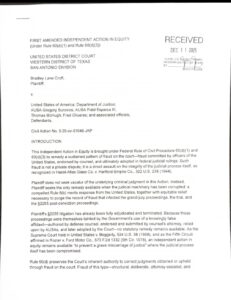
    But a newly filed federal equity lawsuit names McHugh as a defendant — not as a lawyer defending a client, but as a central figure accused of helping place false information into a federal court record.

    This case does not argue guilt or innocence in a criminal matter. It asks a federal court to address something much more serious: whether the justice system itself was misled.

    WHAT IS THIS CASE ABOUT? (PLAIN ENGLISH)

    The lawsuit alleges that:

    • McHugh knew about a conflict involving a former FBI agent tied to the case
    • Despite that knowledge, a sworn affidavit was later submitted denying any conflict
    • That affidavit was used by federal prosecutors
    • And it was relied on by a federal judge

    When sworn statements known to be false are used in court, federal law calls that “fraud on the court.” This is not a technical mistake — it is considered a serious attack on the integrity of the judicial process.

    WHY THIS IS DIFFERENT FROM NORMAL APPEALS

    Most post-conviction cases argue legal errors.

    This one does not.

    It was filed as an Independent Action in Equity, a rare type of case used only when normal remedies are no longer available and the court itself may have relied on false information.

    In simple terms: the claim is that the court was misled, and equity is the only way to fix it.

    WHY THIS MATTERS TO ANYONE HIRING A FEDERAL DEFENSE LAWYER

    McHugh publicly markets himself as:
    • A federal criminal defense lawyer
    • A former federal prosecutor
    • A lawyer handling white-collar and federal fraud cases nationwide

    Those credentials matter — which is exactly why the allegations matter too.

    If proven, the conduct described in the lawsuit would raise serious questions about ethics, honesty, and trust, all of which are critical when someone’s freedom is on the line.

    WHAT HAPPENS NEXT

    The case requires the United States to respond on the merits — meaning the allegations must be admitted or denied, not avoided.

    That alone makes this filing unusual and important.

    No conclusions have been reached yet. But the allegations are now part of the public federal record.

    BOTTOM LINE

    This isn’t legal drama. It is a serious federal case asking whether false sworn statements were allowed to shape a court’s decisions.

    When that question is raised, everyone should pay attention — especially those searching for a federal criminal defense lawyer they can trust.